Things to Do in Chiswick: A Day on the High Road and at Chiswick House

Chiswick is the part of west London that Londoners move to and then quietly stop inviting anyone to, which I understand completely now that I have spent a proper day there. It has a high road where the shops still have names rather than logos, a bronze painter standing on a traffic island with his pug, and at the end of it all an eighteenth century villa that was built purely to show off, sitting in gardens that changed the way the whole of England thought about landscape.
I went twice, once in January and once at the tail end of winter, and both times the weather was the flat pewter grey that west London does so well. Here are the things to do in Chiswick that made both trips worth the District line.
Chiswick High Road, Where the Shops Still Have Names
The High Road runs for the best part of a mile and it is the spine of everything. What makes it unusual for London in 2026 is the ratio: there are chains on it, of course, but they are outnumbered by independents, and the independents are the ones with the good frontages. I walked it slowly from Turnham Green towards Chiswick Lane and kept stopping.
There is a bakery with an awning and pavement tables advertising breakfast, lunch and afternoon tea, with a chalkboard propped against the leg of a chair. There is a mint green shopfront with bistro tables outside that stay out through January regardless of whether anybody is willing to sit at them. There is a plant shop whose window is so full of monstera and bird of paradise leaves that you cannot see into the shop at all, with pots stacked three deep on a black and white tiled step. There is a homeware shop in the same mint green with wicker and terracotta stacked to the ceiling.

The greengrocer is the one that stopped me properly. Baskets tiered up on a slope, squashes and melons on the top row, then a whole shelf of oranges and blood oranges and pomegranates, the sort of display that would look staged anywhere else, and here it is just a Tuesday. It is a good barometer of a high street: if the greengrocer is still trading and still bothers to build a display like that, the street is doing fine.
Foster Books and the Bookshop Habit
At 183 Chiswick High Road there is a dark green shopfront with the number painted on both sides of the fascia and trestle tables of secondhand books set out on the pavement in front of it. Foster Books deals in antiquarian and secondhand stock, and the outside tables are the trap: I went in to look at a tatty paperback and came out twenty minutes later having been shown a shelf of old London topography by someone who clearly knew every spine on it.

A little further along there is a second bookshop with a green front, a books, cards and gifts sort of place with a wire rack of postcards outside it. Two bookshops within a few hundred metres of each other, both busy on a weekday, in a city that keeps being told bookshops are finished.
William Hogarth Still Stands on the Corner
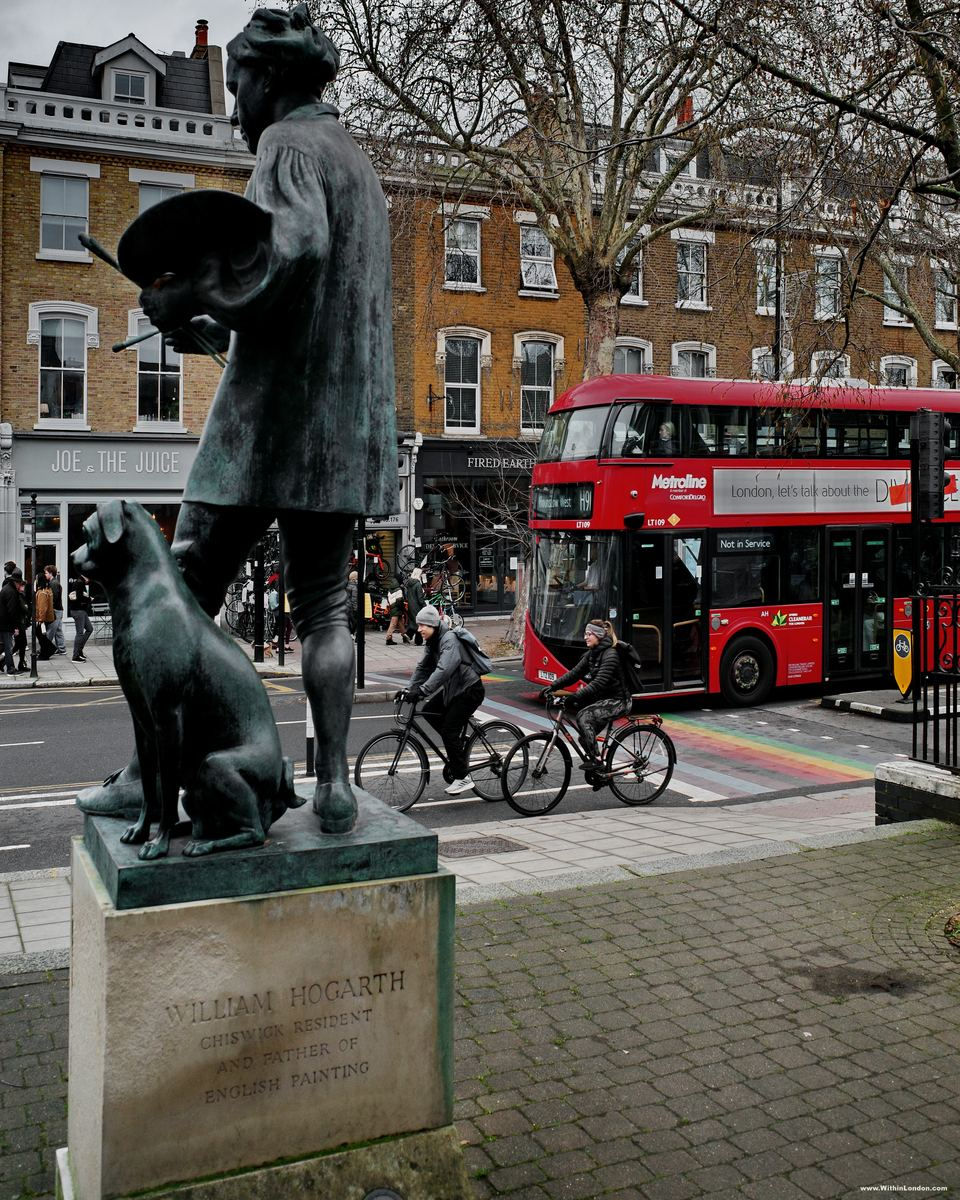
Opposite the junction with Turnham Green Terrace there is a bronze of a man in a coat and hat holding a palette, with a pug sitting at his feet. The plinth reads: William Hogarth, Chiswick resident and father of English painting.
The statue is by the sculptor Jim Mathieson and was unveiled in October 2001, paid for by a local appeal that raised fifty thousand pounds for the figure and another ten thousand for the dog, which tells you something lovely about Chiswick's priorities. Ian Hislop did the unveiling, and David Hockney was the appeal's patron. Hogarth had a series of pugs and painted himself with one of them, so the dog is not a sculptor's whim.
Standing there photographing it, I got a red double-decker crossing behind the statue's shoulder and two cyclists riding over a rainbow crossing at the same moment, which is the most London composition I have managed in a while. Hogarth's actual house is a fifteen-minute walk south on Hogarth Lane, now hemmed in by a roundabout, and it is free to visit when it is open.
Chiswick House: A Villa Built Purely for Showing Off
Twenty-five minutes' walk south of the High Road, or a short bus ride, the streets open out into the grounds of Chiswick House, and the building at the centre of them is not really a house at all. Richard Boyle, the third Earl of Burlington, built it between 1726 and 1729 as a kind of manifesto. He had travelled in Italy, fallen hard for Andrea Palladio, and he wanted somewhere to put his art, his books and his ideas about architecture where the right people would see them. He lived in the older house next door.

What you get, walking up to the entrance front, is a Corinthian portico with six columns under a plain pediment, a rusticated base of rough-cut stone with small windows in it, and two stone staircases curving up either side to the piano nobile. It is symmetrical to the point of being slightly severe, and in flat winter light the whole thing goes the colour of the sky behind it. It was one of the earliest and most influential neo-Palladian villas in England, and the style it launched went on to shape country houses across Europe and the United States, and a fair number of American public buildings too.
The house itself is run by English Heritage and is open seasonally with an admission charge. The gardens are free and open every day, which is the thing worth knowing.
The Gardens, Where the English Landscape Garden Was Invented
Burlington laid out the grounds from the 1720s and then brought in William Kent, who in the 1730s did something genuinely new here: he loosened the geometry, borrowed the composition of French landscape paintings, and made a garden that looked like a picture rather than a diagram. It is widely called England's first landscape garden, and the English Landscape Movement grew out of it. The lake was made around 1727 by widening the Bollo Brook, which is a very grand way of saying they dammed a stream.
In winter, the whole thing is stripped back to its structure, and I think it is better for it. The lake sits black and completely still under bare planes and cedars, with the house's dome showing through the branches on the far bank. There is a classical stone bridge over it, built in 1774 to a design by James Wyatt for Georgiana, Duchess of Devonshire, with a carved urn on a pedestal beside the path leading up to it.

My favourite corner is the Orange Tree Garden. A small domed temple modelled on the Pantheon stands at one end, with a portico and a blue painted door, and in front of it a circular pool with an obelisk rising out of the middle and three concentric rings of raised grass stepping down to the water. On the morning I was there the pool was so still that the temple came back perfectly whole in the reflection, dome, portico, door and all, with the obelisk standing off to one side.
Behind the Italian Garden there is the conservatory, finished in 1813 and, at roughly ninety six metres, the longest glasshouse in the country when it was built. The sixth Duke of Devonshire started filling it with camellias around 1828, and that collection is now one of the oldest under glass in Europe. It flowers from about February into March and the garden puts on a camellia festival around it, which is the single best reason to come to Chiswick at the least promising time of year.
More Things to Do in Chiswick When You Have an Afternoon
Chiswick Flower Market takes over the Old Market Place on the High Road on the first Sunday of every month, with something like thirty-five traders, British growers and nurseries among them. It has been running since 2020, and it is the one day a month the High Road feels like a village rather than a road.
Turnham Green itself is worth five minutes: a proper green with a church on it, and market stalls under gazebos when something is on. There is a run of cafes around its edges that fill up the moment there is any sun at all.
Chiswick also has the river. Strand on the Green, west of Kew Bridge, is a row of cottages and pubs facing straight onto the Thames with the tide coming up over the path, and it is a twenty-minute walk or a short bus ride from the High Road. If you like the idea of a London riverside afternoon, it pairs well with Chiswick House rather than competing with it.
And if the whole formula appeals, west London does it repeatedly: there is a summer's day in Richmond for the Thames version, Isabella Plantation for the azalea version in May, and Ham House for a grander, more theatrical house and garden a few miles upstream.
Visiting Chiswick: Getting There and Practical Notes
Getting there: Turnham Green and Chiswick Park are both on the District line and put you straight onto the High Road. Note that the Piccadilly line only stops at Turnham Green early in the morning and late at night, so plan for the District.
Chiswick overground station is closer to Chiswick House, and Gunnersbury serves the western end. The 94, 27, 237 and 267 buses all run the High Road.
Chiswick House and Gardens: the gardens are free and open daily from early morning until dusk, the house is run by English Heritage and opens seasonally with a ticket, and there is a cafe in the grounds. The conservatory and the camellias are the February and March draw.
Best time to visit: late February and March for the camellias, May for the gardens in full leaf, and the first Sunday of any month for the flower market. Winter is genuinely good here too, because the garden's bones and the villa's geometry show better without leaves in the way.
How long to allow: half a day if you only want the High Road, a full day if you are doing the house and gardens too. And if you enjoy poking around gardens that are not normally open, London Open Gardens is the weekend to put in the diary.
There are more obviously dramatic things to do in Chiswick's part of the city, but very few places where you can go from a greengrocer's pyramid of blood oranges to a Palladian villa in the same twenty-five-minute walk.
_______________________
Did you enjoy this article? If you'd like to contribute to the running costs of WithinLondon, click the button below:
All photos were taken by Ina/WithinLondon, unless stated otherwise.


Comments