Isabella Plantation: Richmond Park's Azalea Woodland Garden

Updated: 7 days ago
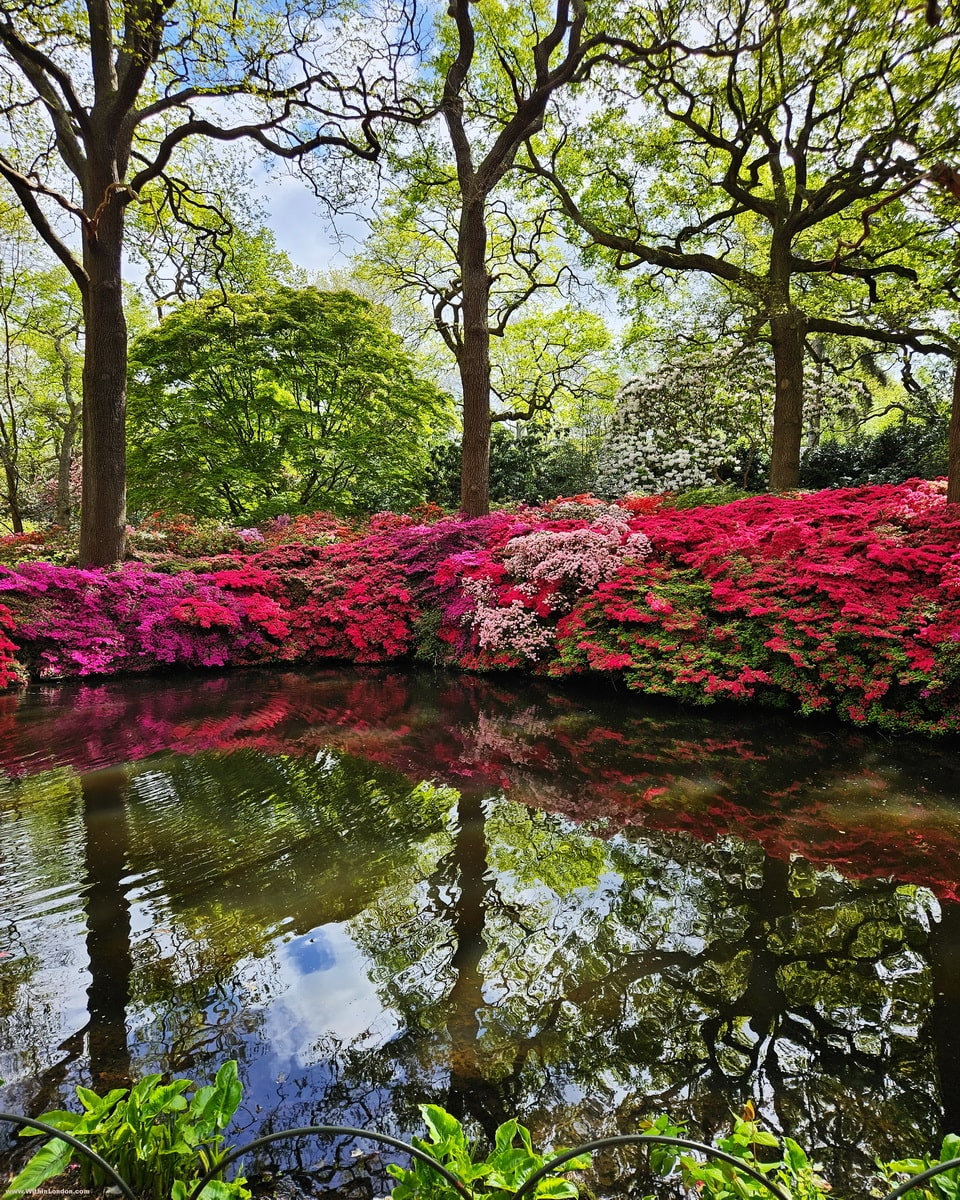
Late April, and the water of the pond was so still it held a second bank of azaleas upside down. Pink, red, a smear of cerise, then the grey trunks of the oaks going up and down at once. Around me the loudest things were rustling leaves and birds.
This is Isabella Plantation, the fenced woodland garden in the south-west corner of Richmond Park. For most of the year it is a quiet place of oaks, streams and ponds. For a couple of weeks each spring it turns into one of the brightest sights in London.
I went at azalea peak. Here is what I saw, plus the history I looked up afterwards: why it is called Isabella, who planted it, and what the Wilson 50 actually are.
Where Is Isabella Plantation in Richmond Park?
Isabella Plantation sits in the south-west of Richmond Park, closer to Kingston than to Richmond town. The Royal Parks describe it as an enclosed, 40 acre woodland garden. It is fenced all the way round, and you go in through one of several gates.
The gates are named Peg's Pond, Broomfield Hill, Bramble, Deer Sanctuary and High Wood. The fence was never there to keep people out. It was put up to keep the park's deer away from the young trees, and it still does that job.
Richmond Park is huge, so it helps to know where you're heading. If you know the town end, with the river and Richmond Hill, I wrote about that side in a summer's day in Richmond. The plantation is a long walk south from there, on the opposite side of the park.
Why Is It Called Isabella Plantation?
It isn't named after a woman, as far as anyone can prove. According to The Royal Parks, the area was called The Sleyt in the 17th century. By 1771 it appears as Isabella Slade.
A slade, or sleyt, meant a boggy open space or shallow valley between woods or banks. Isabel was an old colour word, recorded from the 15th century, meaning a dingy or greyish yellow. The recognised explanation is that it described the colour of the soil there.
Other theories circulate, including a link to Lord Sidmouth, who planted the woodland. That one has a problem with the dates. The name Isabella Slade is on record by 1771, sixty years before Sidmouth put up his fence. So the soil explanation is the one the park's own historians give, and the rest remain theories.
Who Planted Isabella Plantation?
Henry Addington, Viscount Sidmouth, was Prime Minister from 1801 to 1804. Later in life he was Deputy Ranger of Richmond Park and lived at White Lodge, inside the park.
In 1831 Sidmouth fenced off about 17 hectares, or 42 acres, of Isabella Slade. Inside he planted oak, beech and sweet chestnut. This was a timber crop, not a garden. The fence kept the deer from eating the saplings.
Some trees older than the plantation were kept inside the fence. Layers of London notes ancient oak pollards that predate the enclosure of the park itself. So a walk here passes trees from three eras: the old pollards, Sidmouth's timber, and the shrubs planted after the war.
How Did It Become a Woodland Garden?
For over a century it stayed a working wood. The change came after the Second World War. George Thomson was Park Superintendent from 1951 to 1971. With head gardener Wally Miller, he began turning the wood into the garden I walked through.
They cleared out Rhododendron ponticum, an invasive shrub that smothers everything under it. In its place they planted evergreen Kurume azaleas, other rhododendrons, camellias and magnolias. They also dug clearings, ponds and streams.
Isabella Plantation opened to the public in 1953. The main stream, which runs through the garden from Broomfield Gate, was created in 1960. That was the year the plantation was enlarged to take in Peg's Pond. A second, wilder stream was dug in 1989.
The next big change came much later. Between 2011 and 2015 the garden was extensively refurbished with support from the Heritage Lottery Fund and the Big Lottery Fund. The Friends of Richmond Park put the Isabella Plantation Access Project at £1.5 million.
Work included de-silting all three ponds and adding reed beds. Peg's Pond was extended with pontoon decking. More Rhododendron ponticum came out, and paths, toilets and an accessible gate were improved for people with limited mobility.
What Are the Wilson 50 Kurume Azaleas?
Kurume azaleas are small-leaved evergreen azaleas bred in Kurume, on the Japanese island of Kyushu. Motozo Sakamoto and fellow growers there spent generations selecting them. They flower so densely that the leaves almost disappear.
Ernest Henry Wilson was a British plant hunter working for the Arnold Arboretum at Harvard. In 1918 he visited Japan and chose 50 Kurume cultivars to send west. They became known as Wilson's Fifty, or the Wilson 50.
The Royal Parks says these Japanese varieties were introduced to the West in the 1920s. Isabella Plantation holds the National Plant Collection of Wilson 50 Kurume azaleas. It is the reason the plantation is so bright in spring, and it is a living record of one plant hunter's choices.
I can't tell one cultivar from another. What I can say is that the colours in my photos run from soft pink to a red so deep it looks almost purple in the shade.

What Are the Ponds and Streams Called?
There are three ponds: Still Pond, Peg's Pond and Thomson's Pond. The last is named after George Thomson, the superintendent who made the garden. The water is pumped in from Pen Ponds, the large lakes in the middle of Richmond Park.
From the ponds the streams wind through the whole plantation. The paths follow them, so you can drift from one to the next without a map. The Friends of Richmond Park still warn that it is quite easy to get lost.
The reflections are the thing I'd stop for. On a calm day in late April the pond water gave back every azalea on the bank. The streams also have waterfalls and flow diverters, added in the restoration to create pools. Marsh marigolds and skunk cabbage grow along their edges in spring.
The water matters for wildlife as well as for photographs. The Royal Parks count over 70 bird species here, six species of bat, more than 130 butterflies and moths, and over 40 fungi.
When Is the Best Time to See the Azaleas?
The Royal Parks put the peak at late April and early May. The Friends of Richmond Park say the same: usually the last week of April or the first week of May. My own visit was in late April, and the banks were in full colour.
Spring doesn't start with the azaleas, though. Camellias flower through March and April. Magnolias open around the same time, and rhododendrons carry on into May.
If magnolias are your reason to go out, I gathered other spots in the best places to see magnolia blossoms in London. Richmond Park also has bluebells in spring woodland, and my guide to carpets of bluebells in London covers where to find them.
Azalea peak also means crowds, especially on sunny weekends. The Royal Parks warn of a small number of early closures in April and May. Check their Isabella Plantation page before you set off.

Is Isabella Plantation Worth Visiting Outside Azalea Season?
The Royal Parks list a year-round calendar. Azaleas in spring, then autumn colour from the acers, and heathers in winter. The oaks, streams and ponds are there in every season, and the plantation is far quieter once May is over.
For the other end of the year, my guide to the best places to see autumn foliage in London includes Richmond. Nearby, the Cherry Garden at Ham House is worth pairing with Richmond Park in summer, when its lavender is out.
Are Dogs Allowed in Isabella Plantation?
Yes, on a lead. This comes straight from The Royal Parks: dogs on leads are welcome in Isabella Plantation. They are not allowed in the gardens of Pembroke Lodge, elsewhere in the park.
The Royal Parks also ask people to keep dogs on short leads across Richmond Park during the bird nesting season. The deer are wild, and dogs chasing them is a real danger to both.
How Do I Get to Isabella Plantation?
By car, the nearest main car park is Broomfield Hill, about 400 metres from the plantation. Parking in Richmond Park is free. There is a disabled-only car park by Peg's Pond gate. Vehicle gates open at 7am in British Summer Time and close at dusk.
By bus, The Royal Parks point to routes 85 and K3, which stop near Ladderstile Gate. You can also walk in from Kingston Gate or Robin Hood Gate. Both are closer to the plantation than Richmond Gate.
There is a free volunteer-run minibus, the RP1, which stops twice at Isabella Plantation. For 2026 it runs on Mondays, Wednesdays and Fridays, from 16 March to 13 November.
Visiting Isabella Plantation: Practical Notes
📍 Where: Isabella Plantation, south-west Richmond Park, near Kingston Gate. Postcode for the area: KT2 7NA.
⏰ Opening: Open all year in line with Richmond Park, with a small number of early closures in April and May. Pedestrian gates to the park are open 24 hours, except during the deer culls from November to early December and February to early March, when they close 8pm to 7.30am (Friday and Saturday nights excepted). It is an unlit woodland, so go in daylight.
📅 Open days: Every day.
🎫 Admission: Free.
🚇 Getting there: Buses 85 and K3 stop near Ladderstile Gate. Or walk in from Kingston Gate or Robin Hood Gate. The free RP1 minibus stops at the plantation on Mondays, Wednesdays and Fridays in season.
🚗 Parking: Free at Broomfield Hill car park, about 400 metres away. Disabled-only parking at Peg's Pond gate.
☕ Food: No café inside the plantation. The tea rooms at Pembroke Lodge open from 9am and close 15 minutes before dusk. The Still Pond spot is good for a picnic.
⏳ How long: An hour to wander the streams and ponds. Longer if you are combining it with a walk across the park.
📷 Best time: Late April to early May for the azaleas. Calm mornings give the best reflections on the ponds.
🗺️ Nearby: Pen Ponds, Pembroke Lodge and its gardens, and Ham House across Ham Common.
♿ Access: Accessible gate and toilets at Peg's Pond, with baby change. Toilets at Still Pond open April to November; there is a 20p charge, contactless only. A motorised wheelchair can be borrowed on weekdays, 9am to 3pm, booked at least five days ahead.
Have you seen the azaleas at their peak, or do you prefer the plantation in its quiet months?
_______________________
Did you enjoy this article? If you'd like to contribute to the running costs of WithinLondon, click the button below:
All photos were taken by Ina/WithinLondon, unless stated otherwise.


Comments