A Summer's Day in Richmond: Gelato, Geese, and the Thames
- Ina

- 5 hours ago
- 8 min read
There is a particular kind of London summer day that has nothing to do with central London at all, and Richmond specialises in producing exactly that kind of day. It is close enough to feel like a proper outing without needing a whole day of travel, and once you are down by the river, the city recedes almost completely: no traffic noise, no crowds pressing past on a narrow pavement, just water, willow trees, boats knocking gently against a jetty, and, more often than not, a great many Canada geese loudly reminding you whose towpath this really is.
I went on one of those improbably warm July afternoons when the whole of London seems to migrate outdoors at once, and Richmond, true to form, turned out to be one of the best places in the city to actually enjoy it.
A Gelato Van and the Green
Richmond Green is where most versions of this walk should start, if only because it sets the tone immediately. It is a proper village green in the middle of a London borough, ringed by Georgian and Tudor houses, cricket occasionally happening on it in summer, and – on the day I visited – a gelato van parked right outside a pub with a small queue already forming despite it being barely past midday.
The van in question was decorated wall to wall with the kind of oversized ice cream photography that makes you order more than you intended, and I watched a small boy negotiate, with real seriousness, between a scoop of pistachio and a scoop of something startlingly pink while his dad waited with the patience of someone who has done this exact negotiation many times before.
What struck me most was how unhurried the whole scene felt. Nobody was checking a phone, nobody was rushing to the next thing on an itinerary. The pub behind the van had hanging baskets absolutely stuffed with petunias and geraniums in that unmistakable London pub style, window boxes doing the same, and the whole white-painted, black-timbered frontage looked like it had been styled for a postcard rather than just quietly existing on a residential corner of Richmond.
If you only have twenty minutes in Richmond before you need to be somewhere else, spend them here: buy the gelato, sit on the green, and watch the borough go about its unusually pretty Tuesday.

The White Cross and Richmond's Riverside Pubs
From the green it is a short walk down to the water, and the riverside itself is lined with pubs that have clearly understood their assignment. The White Cross is the one that tends to get photographed most, and having now stood in front of it myself, I understand why: a handsome three-storey building in dark brick and white render, a gold ram mounted proudly above the door as a nod to the wool trade that once passed through here, chimney pots lined up along the roofline like a row of soldiers, and hanging baskets in that same riotous London-pub palette of pink, orange, and red cascading down from every available window ledge.
The neon sign spelling out the pub's name in red is doing a lot of work in making the whole building look like something from a slightly heightened, more cinematic version of England, and on a bright July afternoon with a properly blue sky behind it, it did not disappoint.
The genuinely charming detail about the White Cross, which I only discovered by reading a small plaque near the entrance, is that it floods. Not occasionally, not as some historic footnote, but regularly enough that the pub keeps a stock of wellington boots by the door for customers to borrow when the Thames decides to reclaim the beer garden.
There is something very Richmond about a pub treating being partially underwater a few times a year as a minor inconvenience rather than a crisis – a sign, I think, of a place that has made its peace with living directly on a tidal river rather than trying to hold it at arm's length. On the day I was there the water was well behaved and the benches out front were full of people doing exactly what riverside pub benches are for: a pint, a view, and absolutely nowhere else to be.

Richmond Bridge: Boats, Rowers, and a Committee of Geese
Richmond Bridge itself is the other unmissable landmark, and it earns the reputation. Built in the 1770s, it is the oldest surviving bridge across the Thames in London, a graceful run of stone arches that somehow manages to look both sturdy and delicate at once, especially from the towpath looking upstream with willow trees framing it on either side.
Underneath and around it on the day I visited was an entire small economy of wooden rowing boats, all tied up along a floating jetty in front of Richmond Bridge Boathouses – traditional skiffs and dinghies in varnished wood, a couple with cheerful bunting strung between them, one rather grandly named Madaline in gold lettering across its stern.
An artist had set up an easel right at the water's edge and was working on a watercolour of the exact scene in front of her, boats and all, which felt like the most Richmond thing imaginable: a view so classically pretty that people paint it in real time rather than only photographing it.
And then there were the geese. An enormous raft of Canada geese had claimed the stretch of water just downstream of the bridge, dozens of them paddling, preening, occasionally scrapping over nothing in particular, entirely unbothered by the rowing boats gliding past a few feet away or the small motorised dinghy that puttered through the middle of the flock without a single goose bothering to move.
A pair took off low over the water while I was watching, wings almost skimming the surface, which is the kind of moment you can wait an hour for elsewhere in London and here seemed to happen every few minutes without any effort at all. If you want classic Thames-side Richmond in a single frame – old stone bridge, wooden boats, a small crowd of indifferent geese – this stretch of riverbank delivers it more reliably than almost anywhere else on the river.

A Slow Cruise Up the Thames
Richmond is also one of the better places in London to actually get on the water rather than just admire it from the bank, and a proper pleasure cruiser passed by while I was there, decks full of passengers sitting under the roof canopy with a Union Jack fluttering at the stern, heading upstream toward Teddington or perhaps further, towards Hampton Court.
Boats like this one run regularly in summer between Richmond and Westminster in one direction, and up toward Hampton Court in the other, and watching one glide past at an unhurried walking pace, trailing a gentle wake through otherwise still water with dense green woodland pressing in on both banks, made a strong case for treating the boat itself as the destination rather than just transport to one.
What I liked most about watching the cruiser pass was how completely it changed the feel of the river. From the towpath, the Thames at Richmond can feel almost like a large ornamental lake – calm, contained, populated mostly by rowing boats and waterfowl. A cruiser slipping past with a full complement of passengers is a reminder that this is still a working, moving stretch of a very old river, one that has carried boats between Richmond and central London for centuries, long before anyone thought to build a bridge here at all.
If you have the time, boarding one of these cruises yourself is an easy way to see Richmond, Kew, and Teddington Lock from an angle you simply cannot get on foot, gliding past the same water meadows and wooded banks that make this stretch of the Thames feel so unexpectedly rural for somewhere still technically within Greater London.

Petersham Meadows: Where Cows Still Graze by the River
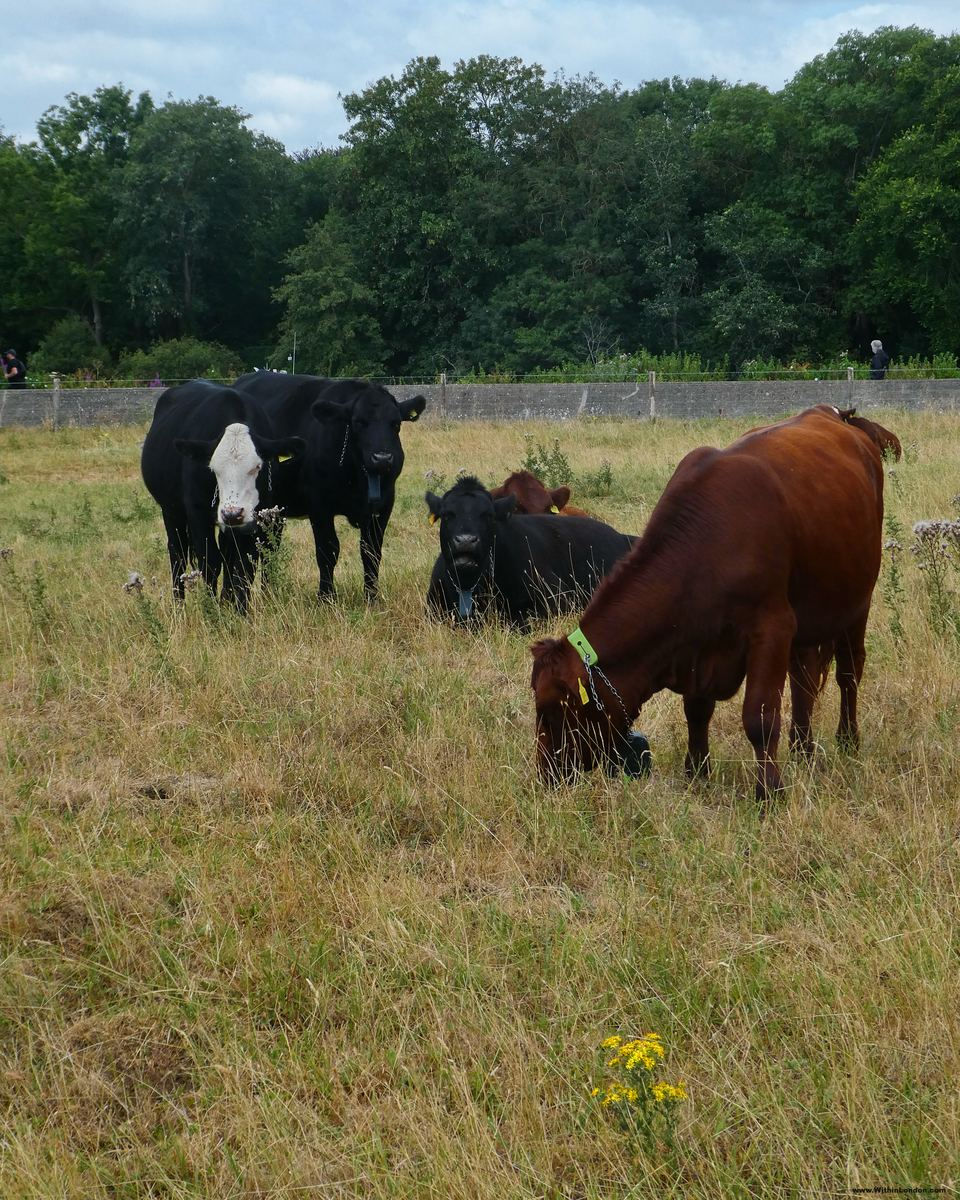
Follow the towpath south from Richmond Bridge for ten or fifteen minutes and the scenery shifts again, this time into something that looks almost nothing like London at all. Petersham Meadows is a wide, open stretch of grazing land running right along the river between Richmond and Petersham village, and it is, remarkably, still an active working pasture – cattle have grazed here for centuries, and on a warm July afternoon a small herd of them, a mix of black and rich chestnut-brown, were doing exactly that, heads down in grass gone golden and dry from the summer heat, entirely unconcerned by the dog walkers and picnickers drifting past a few metres away.
One young calf a soft brown colour with a bright ear tag wandered a little apart from the rest, grazing on its own patch of thistly grass while the older cattle rested in a loose group nearby.
It is a genuinely strange and lovely thing to watch cattle graze with a clear view of the Thames on one side and, if you turn around, the wooded slope of Richmond Hill rising up behind you – the same view, protected by law since the 1902 Richmond, Petersham and Ham Open Spaces Act, that has been painted and photographed from the top of the hill for well over two centuries and is thought to be the only view in England protected by its own Act of Parliament.
Walking through the meadow with the cattle grazing on one side and dog walkers and a couple photographing the middle distance on the other, it was hard to believe this was still zone four of the London transport map rather than somewhere properly out in the countryside. That contradiction – a Tube zone with actual cows in it – is, more than anything else, the reason Richmond keeps pulling people back on a warm summer day.
Practical Notes for a Richmond Day Out
Getting there is easy: Richmond has its own station served by the District line, London Overground, and South Western Railway trains from Waterloo, so it is a straightforward twenty to thirty minute journey from most of central London without needing to plan much beyond checking the next departure.
From the station it is a five to ten minute walk down through the town centre to the green and the river, and everything described here – the green, the White Cross, the bridge, the boathouses, and Petersham Meadows – sits within an easy, flat riverside walk of roughly a mile and a half, easily done in a couple of unhurried hours or stretched across a whole lazy afternoon with stops for gelato and a pub garden along the way.
Summer is unquestionably the best season for this particular walk.
The pub gardens are at their best, the meadows are full and green earlier in the season or sun-bleached gold by midsummer, the geese are at their most numerous and least camera-shy, and the river cruises run at their fullest summer timetable, typically from spring through early autumn.
Weekday mornings and early afternoons are noticeably quieter than weekend afternoons, when the towpath, the boathouses, and every pub garden along the river fill up fast, so if you want the calmer version of this walk – the one where you can actually get a bench at the White Cross without waiting – an early start on a weekday is worth planning around. Either way, bring cash or a card for the gelato van, and do not be surprised if the geese simply refuse to move out of your way.
_______________________
Did you enjoy this article? If you'd like to contribute to the running costs of WithinLondon, click the button below:
All photos were taken by Ina/WithinLondon, unless stated otherwise.


Comments