Yayoi Kusama's Infinity Mirror Rooms at Tate Modern: What They Were Like Inside

Updated: Sep 28
A walkway over black water. Tiny lights in every direction, pulsing and changing colour, and my own reflection repeated until it disappeared. Two minutes, and my time was up.
That was Yayoi Kusama's Infinity Mirror Rooms at Tate Modern. Each visitor got a short, timed spell inside each room, and there was usually a queue at the door. There is a short video of the experience on Instagram.
The exhibition closed on 28 April 2024, after nearly three years and several extensions. The two rooms are recorded here, along with where you can still see Kusama's work in London.

What Were the Infinity Mirror Rooms at Tate Modern?
Yayoi Kusama: Infinity Mirror Rooms was a small ticketed exhibition in the George Economou Gallery. That's on Level 4 of the Blavatnik Building, the brick-clad tower at the back of Tate Modern.
It was built around two of Kusama's mirrored rooms. One was Infinity Mirrored Room – Filled with the Brilliance of Life, dated 2011/2017. The other was Chandelier of Grief, dated 2016/2018.
Around them, the gallery showed photographs and film from Kusama's years in New York. The show was first planned for 2020, to mark Tate Modern's 20th anniversary. The pandemic pushed it back, and it opened on 18 May 2021.
It was meant to run for about a year. Demand kept it open until April 2024.
Can You Still See the Kusama Exhibition at Tate Modern?
No. The Infinity Mirror Rooms exhibition closed on 28 April 2024, and the two rooms left London.
At the end of its run, a ticket cost £10 for adults. Tate Members went free, and under-12s were free with a ticket. Visitors were allowed two minutes inside each room.
Kusama's mirror rooms do travel, though. Museums around the world own and lend them, and Kusama keeps making new ones. If you missed the Tate show, the best advice is to watch the London galleries that work with her, which I cover further down.
What Is an Infinity Mirror Room?
An infinity mirror room is a small, enclosed space lined with mirrors, usually lit by hundreds of small lights. The mirrors reflect each other, so the lights repeat into what looks like endless space.
Kusama made her first one in 1965. Infinity Mirror Room – Phalli's Field was a mirrored room with a floor covered in red-spotted stuffed fabric shapes. Since then she has made more than 20 rooms.
The later rooms are darker. Most are lit by LEDs that switch on and off, so the space seems to breathe.
The effect depends on you being there. Your reflection repeats along with the lights, so every visitor sees a slightly different room. That's also why the time limit exists: a room this small only works with a few people inside.

What Was Inside Chandelier of Grief?
Chandelier of Grief was the first room in the exhibition. From the outside it was a plain white box that blended into the gallery wall.
Inside, a single crystal chandelier hung from the ceiling, turning slowly. The mirrors on every side multiplied it into rows and rows of chandeliers, stretching away in all directions.
The candle bulbs flickered, and visitors' reflections appeared among the chandeliers. Tate described the effect as the illusion of a boundless universe of chandeliers. The title pairs sadness with beauty, and the room holds both.
What Was Inside Filled With the Brilliance of Life?
The second room was the larger one. Kusama made it for her 2012 retrospective at Tate Modern, and it's one of the biggest installations she has made.
A narrow walkway crossed a shallow pool of water. Hundreds of small LED lights hung from the ceiling on thin cords. The mirrors and the water reflected them above and below, so the lights seemed to go on forever.
The lights pulsed and changed colour. My two photos from inside show the same room in different colours, one red and green, one deep blue.

What Else Was in the Tate Modern Exhibition?
Between the two rooms, the gallery traced Kusama's time in New York. She moved to the United States in 1957 and settled in New York City in 1958.
One series was Walking Piece, from 1966. It's a set of colour slides showing Kusama walking through New York in a pink kimono, carrying a black parasol. The show also included photographs from her Mirror Performance of 1968 and portraits by the photographer Eikoh Hosoe.
There was studio film from her New York workspace in the mid-1960s, too. And there was a smaller mirrored work, The Universe as Seen from the Stairway to Heaven, which you looked into through a peephole.
For anyone who found the rooms overwhelming, Tate had a quiet room for visitors who needed a break from the crowds. It was across the bridge in the Natalie Bell Building.
Why Is Yayoi Kusama So Famous?
Kusama was born in Matsumoto, Japan, in 1929. She first came to attention with her happenings and installations in 1960s New York.
She returned to Japan in 1973. Since the 1970s she has lived and worked in Tokyo, with a studio close to the psychiatric hospital where she has lived by choice since 1977.
Her work covers painting, sculpture, installation, fashion and writing. Two motifs run through almost all of it: polka dots and endless repetition. Kusama has linked both to hallucinations she experienced as a child, and she calls the feeling self-obliteration.
The mirror rooms turned that feeling into something anyone can step into. They also photograph beautifully, which is part of why her shows draw such long queues.
Where Can You See Yayoi Kusama's Work in London?
The best answer is outdoors, and free. Infinite Accumulation is a permanent Kusama sculpture outside Liverpool Street station, unveiled in August 2024. It's a chain of polished metal spheres on twisting supports, running for about 100 metres and rising about 10 metres high. It's her largest public sculpture and her first permanent public work in the UK.
It was commissioned through the Crossrail Art Programme for the Elizabeth line, with funding from British Land and the City of London. The spheres reflect the people walking past, so it works a little like a mirror room turned inside out. Leadenhall Market and the Sky Garden are both a short walk away.
Kusama's London gallery is Victoria Miro, at 16 Wharf Road in Islington. It has shown her work many times. EVERY DAY I PRAY FOR LOVE (25 September to 2 November 2024) included a new infinity mirror room, and the gallery lists new shows on its website.
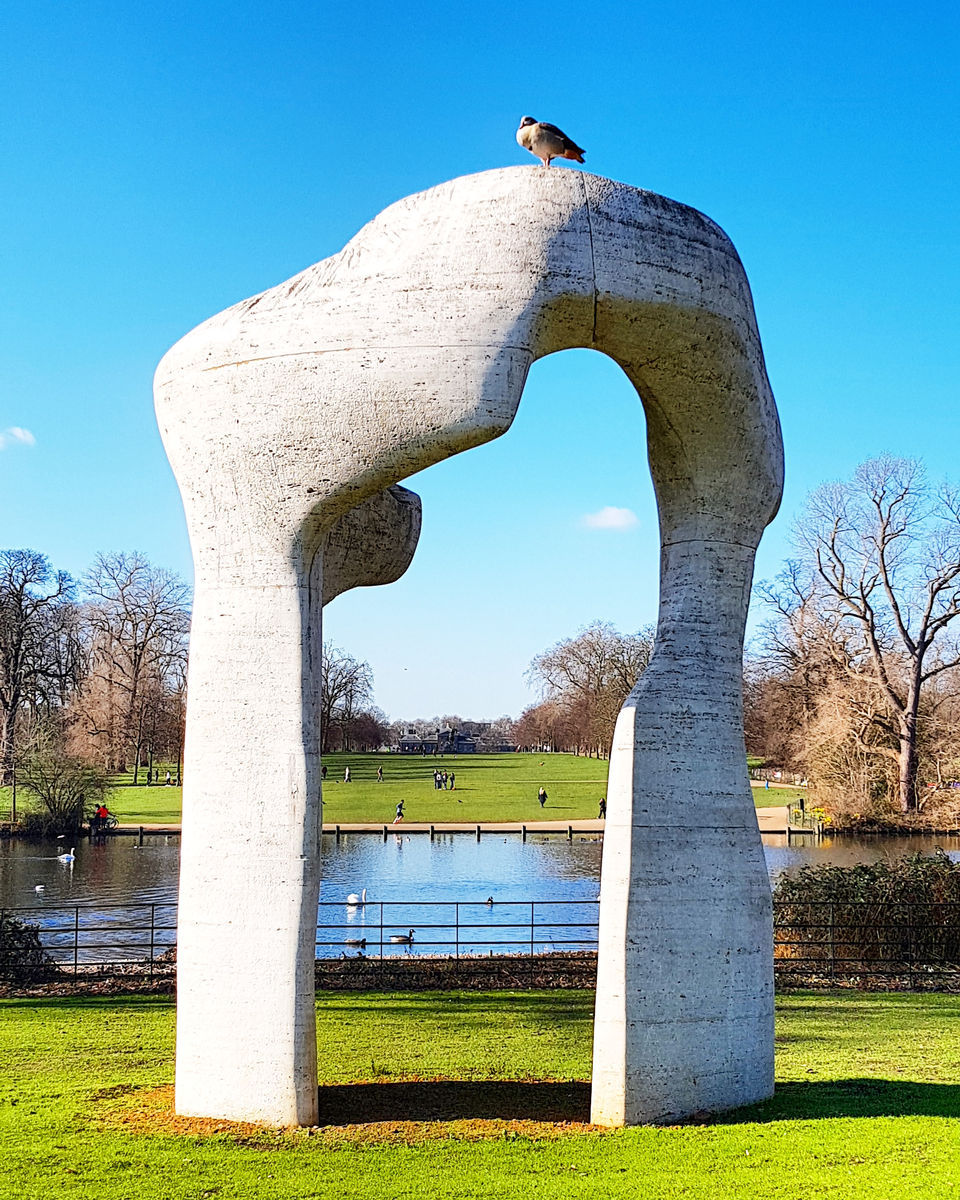
One of her bronze Pumpkin sculptures also spent a summer in Kensington Gardens, from 9 July to 3 November 2024. It was temporary. The permanent sculpture there is Henry Moore's travertine Arch, beside the Long Water.
If you like big outdoor art, I've also written about the Frieze Sculpture trail in Regent's Park, which brings temporary works to the park each autumn.
Seeing Kusama's Work in London: Practical Notes
📍 Where: Infinite Accumulation is on the plaza outside the Elizabeth line entrance at Liverpool Street station, EC2M. Victoria Miro is at 16 Wharf Road, London N1 7RW.
⏰ Opening: The sculpture is outdoors and can be seen at any time. Check the Victoria Miro website for gallery hours and current shows.
🎫 Admission: Free for both. The Tate Modern exhibition, which closed on 28 April 2024, cost £10 for adults at the end of its run.
🚇 Getting there: Liverpool Street station (Central, Circle, Hammersmith & City, Metropolitan and Elizabeth lines, plus the Overground). For Victoria Miro, Old Street or Angel.
⏳ How long: A few minutes to walk the length of the sculpture, longer if you want photos.
📷 Best time: Early on a weekend, when the plaza is quiet and the spheres reflect the buildings rather than a crowd.
🗺️ Nearby: Leadenhall Market, the Sky Garden and Spitalfields Market.
Did you make it inside the Infinity Mirror Rooms before they closed, and which room stayed with you longer?
_______________________
Did you enjoy this article? If you'd like to contribute to the running costs of WithinLondon, click the button below:
All photos were taken by Ina/WithinLondon, unless stated otherwise.

Comments