Inside Leighton House: The Arab Hall, the Studio and What to See
Updated: Sep 28
Go on a dull winter day and Leighton House feels like a trip somewhere far away. The light is low, which makes the whole place mysterious, and the greens and blues are so vivid that the afternoon starts to feel like a fever dream. I spend the entire visit fantasising about living here – which corner would be my favourite, where I would curl up with a book.
The answer: anywhere, as long as I have a book. On a sunny day I love to sit in the darkness of the house and stare out at the garden bathed in sunshine. Those heavy curtains, too. God!

And the fountain in the Arab Hall: you hear it echoing through the whole house, and that is pure magic. Then you step outside into one of the most expensive neighbourhoods in London, and everything looks dull.
The house was built for Frederic Leighton, the Victorian painter who became President of the Royal Academy, and George Aitchison went on extending it for him for thirty years. At its centre is the Arab Hall: a gilded dome, walls of blue Damascus tiles, marble columns, and that fountain set into the mosaic floor. It reopened in October 2022 after a three-year restoration. Here is what there is to see inside (more photos here).
What Is Leighton House?
Leighton House is the home and studio that Frederic Leighton built for himself on Holland Park Road, on what was then the western edge of Kensington. He bought the plot in 1864. Building started in 1865, and he moved in the following year, into a house only three windows wide with one big north-facing studio upstairs. Then he kept building.

The architect throughout was his friend George Aitchison. The east wing came in 1869 to 1870 and the Arab Hall between 1877 and 1881. A glazed winter studio followed in 1889 to 1890, then the Silk Room in 1894 to 1895, finished only months before Leighton died. Thirty years of extensions, and the result is one man's idea of a house: a sequence of rooms for painting, collecting and entertaining, with a single small bedroom tucked in behind them.

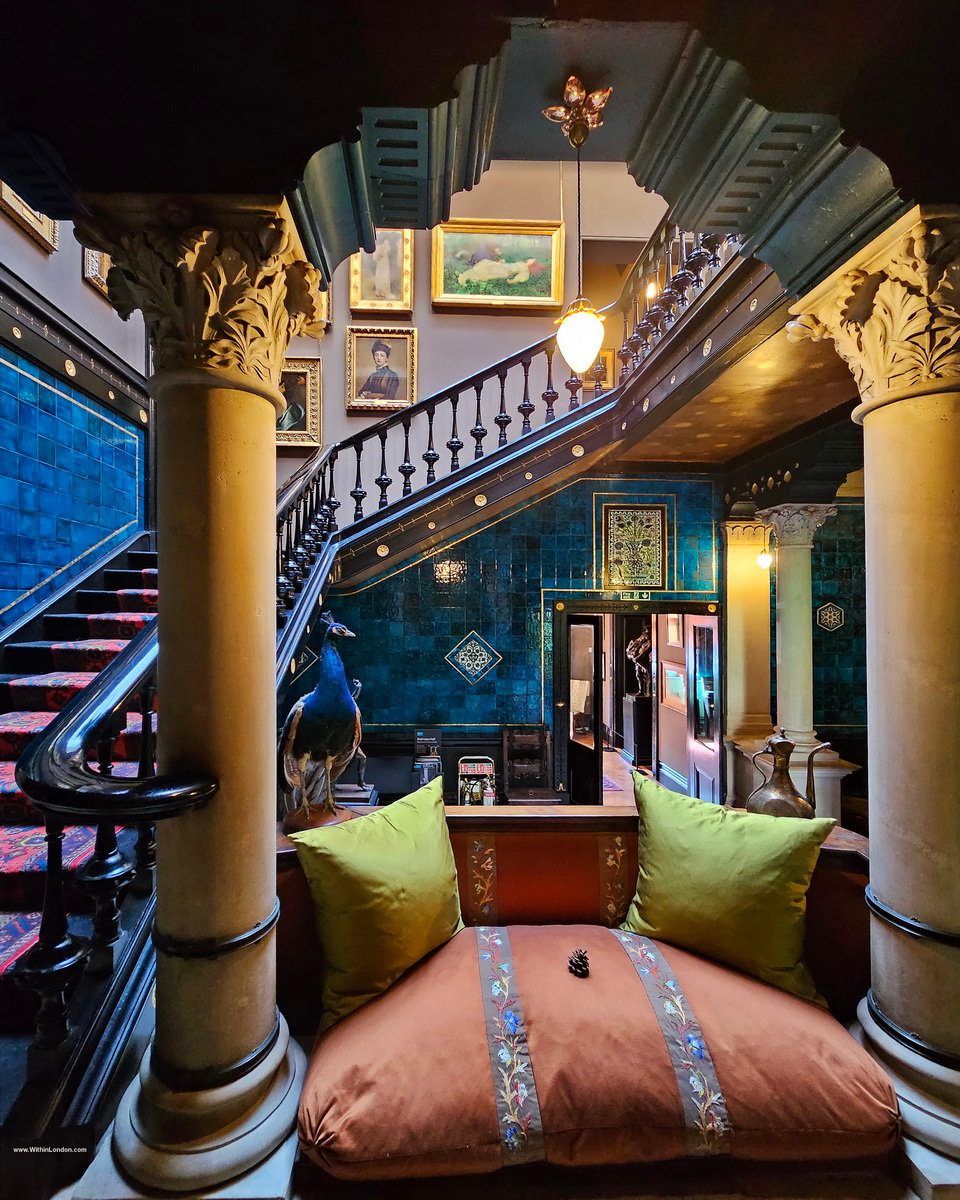
Leighton himself was the most successful painter of his generation. He was elected President of the Royal Academy in 1878 and held the post until his death. The house was built to match that position. Visitors came up the stairs past the peacock and into the Arab Hall before they ever saw a painting, and that was the point.
What Is the Arab Hall at Leighton House?
The Arab Hall is the reason most people come. Aitchison modelled it on a room at La Zisa, the Norman palace in Palermo, and Leighton filled it with the tiles he had been collecting on his travels. Most of them are from Damascus and were made at the end of the 16th century and the start of the 17th. Where the old tiles ran out, William De Morgan made new ones to fill the gaps, and it takes a while to work out which are which.

Above the tiles runs a gilded mosaic frieze designed by Walter Crane. The capitals on the marble columns were carved by Joseph Edgar Boehm and by Randolph Caldecott, better known for his children's picture books. The carved wooden lattice windows came from Damascus too. And in the middle of the floor, set into the mosaic, is the pool with its small fountain. That is the sound you hear from the front door.

Look up at the dome. Then look down, because the floor is a mosaic as well, and most people never notice it.

Why Is the Staircase Hall So Blue?
You reach the Arab Hall through two smaller rooms, and both of them are blue. The staircase hall has peacock-blue glazed tiles along the walls, a mosaic floor designed by Aitchison, and a mounted peacock standing at the foot of the stairs. Next to it is the Narcissus Hall, lined floor to ceiling in William De Morgan's blue tiles under a gilded ceiling, named after the bronze figure that stands in it.

This is why a grey day works so well here. The blues do not need sunshine. They glow on their own, and the lower the light outside, the deeper they look.

Where Did Leighton Paint?
Upstairs. The studio is the largest room in the house, 45 feet by 25, with tall north-facing windows so the light never changed through the day. Almost every painting of Leighton's mature career was made in this room. It was also his showroom. Each spring the studio was opened to visitors to see the year's pictures before they went to the Royal Academy. Musical evenings were held here too, with the leading performers of the day.

Do not look for Flaming June, the painting everyone knows him for. He painted it in 1895, the year before he died, and it has been in Puerto Rico since the 1960s, at the Museo de Arte de Ponce. What the studio has instead is the room itself: red walls, cabinets of sculpture and photographs, and the apse at the far end.
Beyond it is the Winter Studio, added in 1889 to 1890 and restored in the 2019 to 2022 works. It is a glazed, heated extension built so that he could keep painting through the dark months. Leighton did not stop for winter.

What Is in the Silk Room?
The Silk Room was the last thing Leighton built, in 1894 to 1895, sitting over the Narcissus Hall. Its walls are hung with green silk, and it was his picture gallery for the work of friends: John Everett Millais among them. It was finished only months before he died.

Leighton's bedroom is the smallest room on the tour and the most surprising. It is the only bedroom in the house apart from the servants' quarters, and it holds a single narrow bed. He died in it on 25 January 1896, aged 65. The day before, he had been made Baron Leighton of Stretton, which makes his the shortest peerage in British history.

What Happened to the House After Leighton Died?
The contents were sold at Christie's in 1896. The Fine Art Society bought more than a thousand of his drawings. The house itself opened as a museum in 1900, run by a committee led by Leighton's neighbour, and passed to the Royal Borough of Kensington and Chelsea in 1926. The Perrin galleries, designed by Halsey Ricardo, were added in 1929.

Two restorations followed. Closer to Home ran from 2008 to 2010 and restored the historic rooms. Then, in November 2019, the museum closed for the bigger project.

What Changed in the 2022 Restoration?
The house reopened on 15 October 2022 after works by the architects BDP. The 1920s additions were replaced with a new Perrin Wing, and inside it is a helical staircase wrapped in Oneness, an eleven-metre mural painted across three floors by the Iranian artist Shahrzad Ghaffari. There is a lift now, so every floor is step-free for the first time.
The Winter Studio was restored, a drawings gallery was built (free to enter), and the entrance hall was put back with its Tintoretto portrait. On the ground floor, opening onto the garden, is the De Morgan Café. The project was a finalist for Art Fund Museum of the Year in 2023 and won a RIBA London Award in 2024.

Should You Visit Sambourne House on the Same Day?
Yes, if you have the afternoon. Sambourne House is the other museum on the same ticket, at 18 Stafford Terrace, about ten minutes' walk away. It was the home of Linley Sambourne, the Punch cartoonist, and it has been kept as the family left it, dark and crowded and full of his photographs. The joint ticket costs £23 against £26 for the two houses separately. Sambourne House is closed on Mondays and Tuesdays, so a joint day means Wednesday to Sunday.
The two houses are ten minutes apart and could not be more different. Leighton built a palace for one man and one bed. The Sambournes squeezed a whole family, their servants and a lifetime of clutter into a terraced house. Do Leighton first, while your eyes are fresh.
What Was On at Leighton House in 2026?
2026 marked a hundred years since the house passed to the council, and the museum spent the year on the Arab Hall. The Arab Hall: Past and Present ran from 21 March to 4 October 2026. Three contemporary installations took turns in the hall (Ramzi Mallat until 15 May, Kamilah Ahmed until 31 July, Soraya Syed until 4 October), alongside a short film by Soudade Kaadan about the tiles. All of it was included in the admission price.
Visiting Leighton House: Practical Notes
📍 Where: 12 Holland Park Road, London W14 8LZ, on a quiet residential street behind Kensington High Street.
⏰ Opening: Monday and Wednesday to Sunday, 10am to 5.30pm. Last entry 4.30pm. Closed on Tuesdays.
🎫 Admission: £14 adults, £10 concessions, £6 for ages 6 to 18, free under 6 (prices checked September 2026). Joint ticket with Sambourne House £23, £16 and £8. Pay what you want on the first Monday of each month, 10am to 1pm.
🚇 Getting there: High Street Kensington (Circle and District lines) or Kensington (Olympia) on the Overground, both within fifteen minutes on foot. Holland Park on the Central line is a little further. Buses 9, 23, 27, 28, 49, 328 and C1.
☕ Food: The De Morgan Café on the ground floor, with tables looking onto the garden.
⏳ How long: An hour and a half for the house. Longer if you sit in the café, and a full afternoon with Sambourne House.
📷 Best time: A grey afternoon, when the tiles do the work. Hand-held photography without flash is allowed; no tripods.
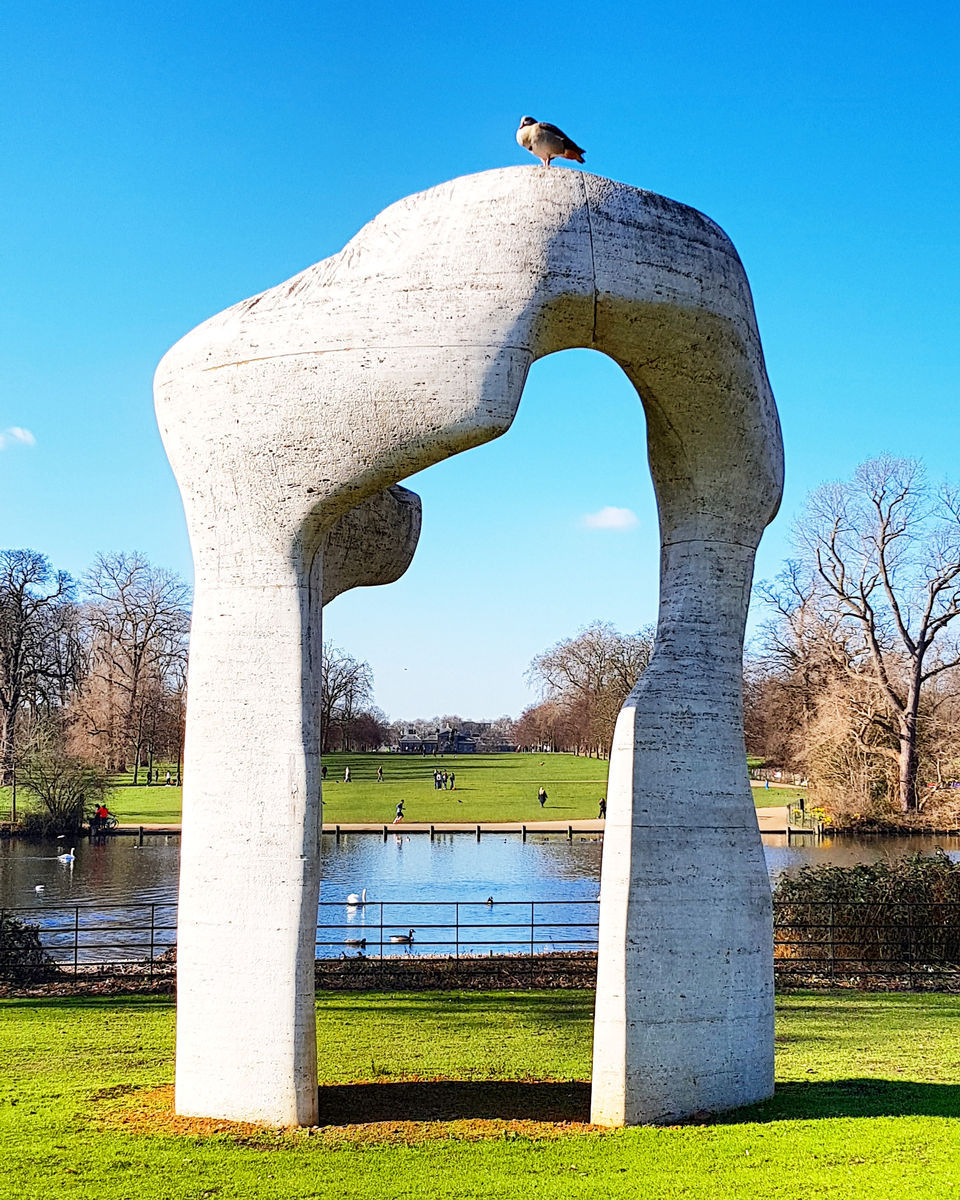
🗺️ Nearby: Holland Park is five minutes away, and the streets around it are at their best in autumn. Kensington Gardens, with the Elfin Oak and Henry Moore's Arch, is a twenty-minute walk east.
♿ Access: Step-free to every floor, with lifts, since the 2022 restoration. Sambourne House has no step-free access.
🧳 Left luggage: None. Bags larger than 55 by 40 by 20 cm are not allowed in.
Which corner would you take?
_______________________
Did you enjoy this article? If you'd like to contribute to the running costs of WithinLondon, click the button below:
All photos were taken by Ina/WithinLondon, unless stated otherwise.


Comments