Woodstock in Oxfordshire: The Town at Blenheim Palace's Gate

Everyone who comes to Woodstock in Oxfordshire is really on their way to Blenheim Palace. The bus from Oxford stops outside the palace gate, the coaches turn in, and the town gets walked through rather than looked at. Which is a shame, because the town is the better half of the day.
We stayed a night in early June, in the kind of weather where the stone has been warming up since morning and gives the heat back at five o'clock. Woodstock is built of the same honey-coloured limestone as the Cotswold villages to its west, and in that light it glows. Roses on the walls, poppies at the edge of town, and two old cars parked as if somebody had arranged them.
This is a town of about 3,500 people with two main streets, a market place, a free museum and more pubs than seems reasonable. It also has more history per square yard than almost anywhere in the county, most of it hidden behind a wall.

What Is Woodstock in Oxfordshire Known For?
Blenheim Palace, first and foremost. The palace sits inside a 2,000-acre walled park whose main gate opens straight onto Park Street, in the middle of town. It was built between 1705 and 1722 for John Churchill, first Duke of Marlborough, as the nation's thank-you for the Battle of Blenheim in 1704. Winston Churchill was born there in 1874, and the whole estate has been a UNESCO World Heritage Site since 1987.
But the park was royal long before it was ducal. Henry I enclosed it as a hunting ground and is said to have kept a menagerie there. Henry II granted the town its market charter in 1179 and, according to the story, kept his mistress Rosamund Clifford in a bower in the park. Edward the Black Prince was born in the royal palace here in 1330.
That palace is gone. It was wrecked in the Civil War and the ruins were cleared when Blenheim went up. The town it left behind is what you walk through now: a Georgian-fronted, medieval-boned market town that made its money from leather gloves, of all things, for the best part of four hundred years.
Oxford Street and Market Place: Where the Pubs Are
Woodstock has two streets worth knowing. Oxford Street is the one the bus comes up, lined with stone houses that have been shops for a very long time. Market Place, just off it, is the old commercial heart, with the Town Hall at one end. Between them they hold most of the town's pubs and cafes, and on a warm afternoon most of its people, sitting outside.
The Punchbowl Inn on Oxford Street is where we stayed, and it is the one I would send you to first, if only for the look of it. Cotswold stone, teal-painted windows, a stack of tall brick chimneys, nine rooms upstairs. And a sign on the wall reading Please Do Not Feed The Ducks, which raises more questions than it answers.
A few doors up at number 17 is the Missing Bean, the Woodstock cafe of the Oxford coffee roaster, which bakes its own bread and brings it out here. We had a focaccia sandwich there for breakfast that I am still thinking about. It opens at eight on weekdays, nine at weekends, and closes at four, so it is a breakfast and lunch place.

Parked outside was a pale blue Nissan Figaro, which is a car Nissan built for a single year in 1991 and which seems to turn up wherever there are pretty streets to be parked in. A few doors along, in front of a tall golden townhouse, sat a green Morris Minor. That one at least belongs here. The Morris Minor was built at Cowley, on the edge of Oxford, eight miles down the road.

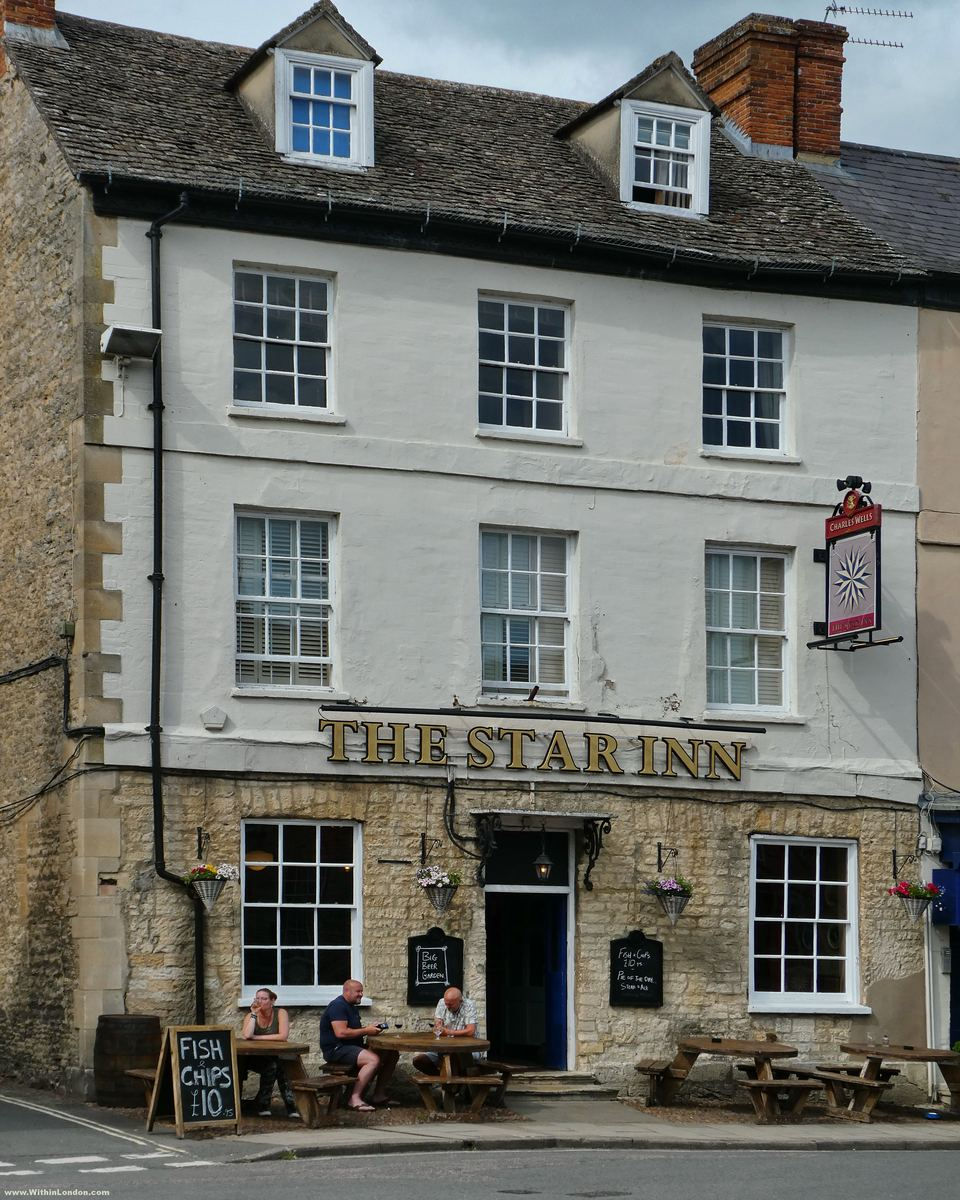
The Star Inn is on Market Place, three storeys of stone and white paint with a hanging sign and a blackboard leaning against the wall. By late afternoon every outside table was taken. Across the square is Antiques of Woodstock under a blue awning, which is the kind of shop that reminds you this town has been selling things to visitors since the eighteenth century.
The Town Hall closing the square was built in 1766 to a design by Sir William Chambers, the architect of Somerset House in London, and paid for by the Duke of Marlborough. It is small and rather severe, and it tells you exactly who was in charge here.
Old Woodstock and the Black Prince
Walk north down the hill from the town centre and you cross the River Glyme into Old Woodstock, which is older than the town it is named after and much quieter. The A44 carries straight on through, but turn off it onto Manor Road and the traffic goes with it.
The reason to walk it is the Black Prince, a sixteenth-century pub on Manor Road with its name painted across the gable end and a garden that runs down to the river. It is named for Edward, eldest son of Edward III, who was born in the royal palace up the hill in 1330 and went on to win at Crecy and Poitiers. Of all the pub names in England, this is one of the few that is local.

At the edge of town there is a patch of long grass full of field poppies, with the rooftops and chimneys of Woodstock going soft in the distance behind them. Early June is the month for it. By July the poppies have gone over and the grass has been cut.

The roses are the other June thing. Woodstock's houses are stone, which means climbing roses show against them the way they never do on brick. There is a red door on a side street with red roses trained across the wall beside it, and it is the kind of door that stops you on the pavement.

Was Elizabeth I Really Imprisoned in Woodstock?
Yes, for almost a year. In 1554 Mary I's government suspected her half-sister of being behind Wyatt's rebellion, and after two months in the Tower of London the twenty-year-old Elizabeth was moved to Woodstock. The royal palace was so run down that she was kept in the gatehouse instead, under the eye of Sir Henry Bedingfield, from May 1554 until April 1555.
She is said to have scratched a couplet into a window with a diamond ring while she was there: Much suspected by me, nothing proved can be, quoth Elizabeth prisoner. It is the sort of story that is too good to check, and I have not tried. What is certain is that she was released, outlived her sister, and came back to Woodstock as queen.
Nothing of the gatehouse survives. The site is inside Blenheim's park, near the Grand Bridge, and is marked only by a stone and a sycamore tree. If you take the palace tour you will hear the story; if you walk the park on the public footpath you will pass close to where it happened without a sign to tell you.
The Glove Trade That Paid for the Stone
Every Cotswold town has a trade that built it. For most it was wool. For Woodstock it was gloves, and the trade lasted longer here than almost anywhere in England. There were glove-makers in the town by the 1580s, working leather from the deer and sheep of the royal park. Woodstock gloves went to Elizabeth I, James I and the Duke and Duchess of York.
At its height it was enormous for a town this size. In 1809 the trade employed sixty or seventy male cutters and around 1,500 women and girls, who did the sewing at home. Numbers like that mean almost every household in Woodstock had someone stitching gloves by the window. The trade shrank after cheap French imports were allowed in from 1825, but factories were still making 750 pairs a week here in the 1930s.
The place to see this is the Oxfordshire Museum on Park Street, which is free. It lives in Fletcher's House, a handsome town house with a garden behind it, and its galleries cover the whole county. Archaeology, the landscape, local trades. In the garden, a set of megalosaurus footprints that came from a quarry at Ardley. Give it forty minutes. It is closed on Mondays.
Can You See Blenheim Park Without a Ticket?
Partly, and legally, yes. A public footpath crosses Blenheim's park, entering by a small green gate on the main road at the Old Woodstock end of town and running through to the village of Combe on the far side. Walkers on it can see the lake, the Grand Bridge and the palace from a distance, and the Column of Victory on its ridge. Dogs on leads, no bicycles, and you stay on the path.
It is a proper walk rather than a shortcut, a couple of miles across parkland that Capability Brown laid out in the 1760s when he dammed the Glyme to make the lake. If you have done the Long Walk at Windsor, it has the same feeling of a landscape built to be looked at from one exact spot.
If you want the formal gardens, the courtyard or the inside of the palace, you need a ticket, and they are not cheap. A park-and-gardens day ticket is £31 for an adult online, and the pass that includes the palace is £41. The consolation is that every day ticket converts into a twelve-month annual pass at no extra cost, because the palace treats the admission as a charitable donation. If you think you might come back, that changes the arithmetic, and I say more about what is inside below.
The main gate is a ten-minute walk from the bus stop through the park to the palace itself. Blenheim is open from ten in the morning until half past five.
Inside Blenheim Palace: Is It Worth the Ticket?
If you have never been, yes, once. Blenheim is not a house so much as a statement, and Vanbrugh made it at a scale that still catches you off guard. The Great Court alone is bigger than most village greens. Inside, the Great Hall rises 67 feet to a ceiling that James Thornhill painted in 1716, with the Duke presenting his battle plan to Britannia.
The Long Library is the room I would cross the county for. It runs 55 metres along the west front, lined with books and portraits, and ends in a Willis organ that fills the far wall. The Churchill rooms are the other reason people come: the small bedroom where he was born on 30 November 1874, and the exhibition around it. He is buried a mile away at Bladon, in a churchyard you can see from the park.
Outside, the Water Terraces below the west front were laid out in the 1920s by the French designer Achille Duchene, and they are the best-kept part of the gardens. The Italian Garden is private to the family and only seen from the terrace. A miniature train runs from the palace to the Pleasure Gardens, where the Marlborough Maze is, which is the part small children remember.
A day ticket converts into an annual pass, so the sensible way to see Blenheim is not to see it all at once. Do the palace and the terraces on one visit. Come back for the park in October, when the beeches along the lake turn and the crowds have gone.
Visiting Woodstock in Oxfordshire
Woodstock works as a half-day on its own and a very full day with Blenheim. If you are doing both, do the town in the late afternoon, when the coaches have left and the light is on the stone.
📍 Address: Woodstock, Oxfordshire OX20. Blenheim Palace is at OX20 1PP; the visitor car park uses OX20 1UL.
🚇 Getting there: Train from London Paddington to Oxford takes about an hour, then the Stagecoach S3 bus from the city centre to Woodstock, roughly half an hour. The S3 and S7 together run about four times an hour, seven days a week. Alternatively the Cotswold Line to Hanborough, about seventy minutes from Paddington, then the 233 bus or a taxi for the last three miles.
🎫 Cost: The town and the Oxfordshire Museum are free. Blenheim park and gardens are £31 for an adult online (£34 on the day); palace, park and gardens are £41 (£44). Every day ticket converts to an annual pass.
⏰ Opening: Blenheim Palace is open 10.00 to 17.30. The Oxfordshire Museum opens 11.00 to 17.00 Tuesday to Saturday, 14.00 to 17.00 on Sunday, and is closed on Monday.
☕ Food: We stayed at the Punchbowl Inn on Oxford Street, which has nine rooms and tables out front. The Missing Bean a few doors up does the best focaccia sandwich for miles, from breakfast until it closes at four. The Star Inn on Market Place and the Black Prince in Old Woodstock, with its riverside garden, are the other two to know.
⏳ How long to allow: Two to three hours for the town, museum and a walk into Old Woodstock. A full day with Blenheim, and most of it on your feet.
📷 Best time to visit: Early June for the roses and the poppies. Any month for the stone, which is at its best in the last two hours before sunset.
🗺️ Nearby: Oxford is eight miles south. Bampton, the Downton Abbey village, is half an hour west by car, and Burford and Witney are on the same Cotswold Line out of Paddington. If you are coming in October, the Cotswold villages in autumn start twenty minutes up the road.
Woodstock in Oxfordshire is the town people walk through to get to something grander. Stay an extra two hours. The something grander is not going anywhere, and the town is nicer to sit in.
_______________________
Did you enjoy this article? If you'd like to contribute to the running costs of WithinLondon, click the button below:
All photos were taken by Ina/WithinLondon, unless stated otherwise.


Comments