Ramses and the Pharaohs' Gold at Battersea Power Station – Review

Updated: 2 days ago
I didn't know what to expect from Ramses and the Pharaohs' Gold at Battersea Power Station. I had the vague sense of a school trip – educational, earnest, slightly dull. I was completely wrong.
The exhibition opens in near-darkness. Then a colossal stone head emerges from the shadows, flanked by illuminated cartouches. It takes a moment to process the scale of it. This is a man who ruled Egypt for almost 70 years. He built half of what tourists now fly to Egypt to see. He was worshipped as a god while still alive. And somehow they have managed to bring 180 objects from the Egyptian Museum in Cairo to a building beside the Thames.
Who Was Ramses the Great?
Ramses II came to power around 1279 BC, as a teenager. His reign lasted nearly 67 years, making him one of the longest-serving pharaohs in history. He outlived most of his own children.
During his reign he fought the Hittites at Kadesh and signed what may be history's first major peace treaty. He fathered more than 100 children. He built Abu Simbel, with four statues of himself flanking the entrance – each around 20 metres tall.
He was also extremely good at self-promotion. He had his name carved over the monuments of earlier rulers. He understood that legacy is built as much through image as through action. The exhibition makes this point from its very first gallery, and it does not let go of it.

What Is in the Ramses and the Pharaohs' Gold Exhibition?
There are 180 objects in total, all from the Egyptian Museum in Cairo. Many have never been shown outside Egypt.
The exhibition walks you through Ramses' military campaigns, his building projects, his religious role, and the Egyptian understanding of the afterlife. Objects range from small amulets and jewellery to enormous statues. Some sit in cases. Others stand open in the middle of a room, which means you can walk around them and get very close.

The highlight for most visitors is the wooden coffin that once held Ramses II himself. It is taller than you expect. Decorated with painted hieroglyphs and royal symbols, it carries a strange authority. Next to it, a screen shows a digital facial reconstruction based on CT scans of his mummy. Looking between the two, the distance of 3,000 years briefly collapses.
What Are the Most Striking Objects?

The gold mask appears on all the marketing, and it earns its place. It is the gilded wooden mask from the coffin of Amenemope – a later pharaoh, not Ramses himself – but it is extraordinarily well preserved. The black kohl outlining the eyes, the cobra rearing from the brow, the expression of calm authority: it reads as both immediately human and entirely otherworldly.
The painted wall relief stopped me for a long time. Two figures in profile, wearing elaborate headdresses, their white linen robes picked out in vivid terracotta, teal and red against a pale ground. The colours have survived more than three thousand years. The piece of wall they are painted on has an irregular broken edge. It feels less like a museum object and more like a fragment of something enormous.

Is the VR Add-On Worth £14?
The standard ticket covers the exhibition only. For an extra £14, you can add a VR tour in which Nefertari – Ramses' most beloved wife – guides you around digital reconstructions of the temples he built. I did not try it on this visit. But the people coming out of it looked pleased.
There is also an audio guide narrated by the historian Dan Snow, available for £5. Given that the exhibition moves quickly through a lot of history, I would recommend it. The labels are good but short, and the audio gives context that changes how you read individual objects.

How Does the Exhibition Handle the Egyptian Afterlife?
One of the strongest sections deals with death and what follows it. The objects here are funerary: shabtis, canopic equipment, amulets placed with the dead to protect them in the afterlife.
What strikes me most is the consistency of the belief system across thousands of years. The same symbols, the same gods, the same rituals, repeated generation after generation. The Book of the Dead was not a single text but a collection of spells assembled for each individual burial. You could commission it from a scribe, choose your preferred chapters, and have your own name inserted in the blanks.

The section on mummification is handled carefully. It does not use actual human remains in a way that feels exploitative. The information is there for those who want it. You can move through it at your own pace. Children seemed fascinated rather than disturbed, which is perhaps the right outcome.
The Setting at Battersea Power Station

NEON at Battersea Power Station occupies one of the former turbine halls. The ceiling is high. The lighting is theatrical – pools of light on specific objects, deep shadow between them. This is not the even, neutral lighting of a Victorian museum. It is closer to a film set, or a temple interior.
The effect works. Ramses II understood spectacle. His temples were designed to awe visitors into submission. Presenting his objects in a space built around drama rather than neutrality feels appropriate. The one bright, conventionally museological gallery in the middle of the exhibition is where I spent the least time.
The Colossal Statue: What to Expect
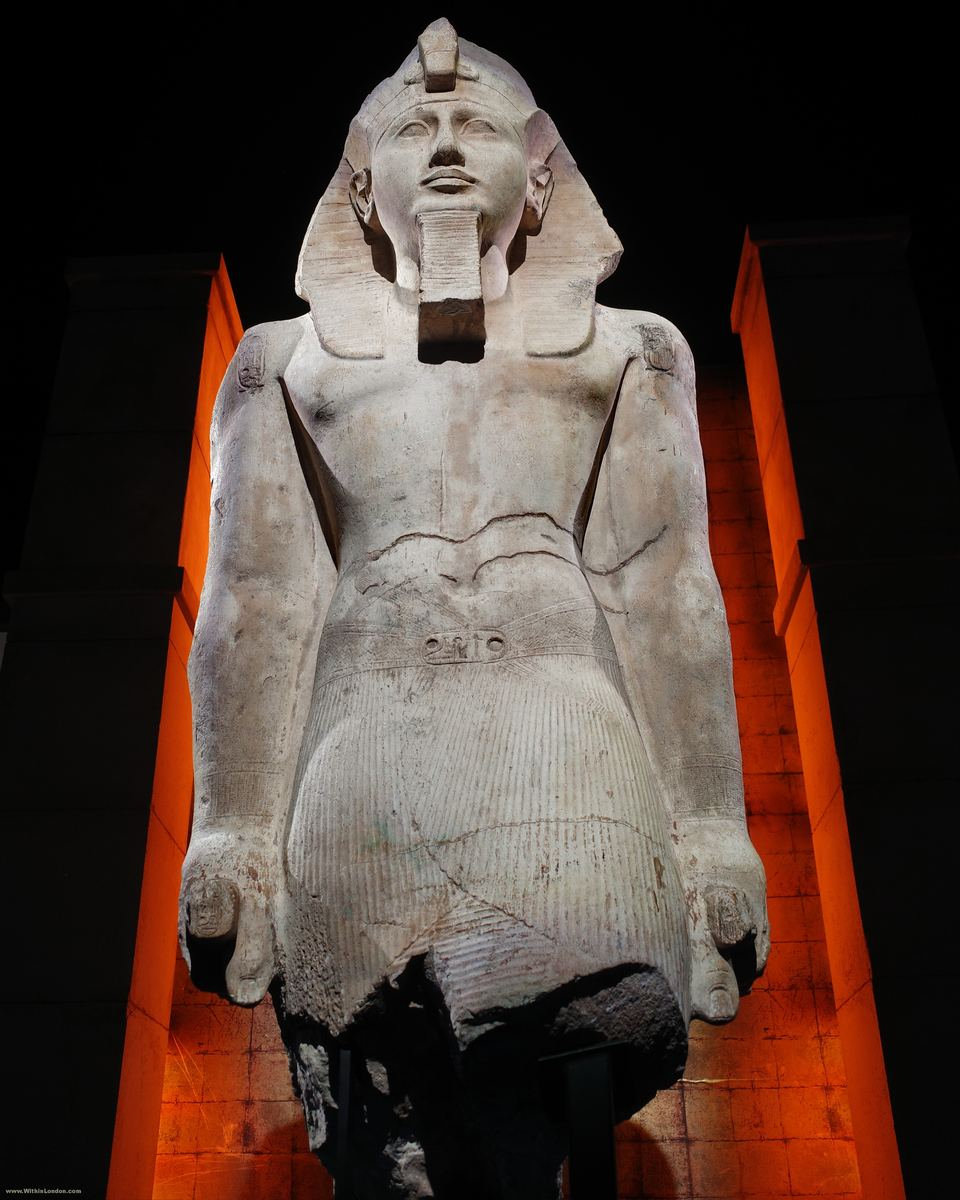
The exhibition ends with a colossal seated statue of Ramses II, lit from below against an orange-red backdrop. It is around four metres tall and weighs several tonnes. Standing in front of it, looking up at a face carved 3,200 years ago by someone who never imagined their work would end up in Battersea, is when the exhibition earns its ticket price.
Ramses the Great was obsessed with being remembered. He had his name carved on monuments the length of the Nile. Three thousand years later, crowds in London are queuing to see his coffin. He would be extremely satisfied with this outcome.
Visiting Ramses and the Pharaohs' Gold: Practical Notes
📍 Where: NEON at Battersea Power Station, Circus Road East, Nine Elms, London SW11 8DD.
⏰ Opening: Daily 9am – 8pm, last entry 6:30pm. Check the website before visiting as times can vary.
📅 Dates: 28 February 2026 to 1 January 2027.
🎫 Admission: Adult tickets from £32. Audio guide £5. VR add-on £14. Book in advance at ramsestheexhibition.co.uk.
🚇 Getting there: Battersea Power Station is on the Northern line. The exhibition is around a five-minute walk from the station exit through the development.
⏳ How long to allow: Around 60 to 75 minutes for the exhibition. Add 45 minutes for the VR tour.
📷 Best time to visit: Weekday mornings are quietest. The theatrical lighting works best when the space is not crowded.
🗺️ Nearby: Battersea Power Station itself is worth exploring after the exhibition. The Christmas lights here are among the best in London. A short tube ride north brings you to the Wallace Collection and other London museums.
Are you going to add the VR tour, or will you stick with the exhibition on its own?
_______________________
Did you enjoy this article? If you'd like to contribute to the running costs of WithinLondon, click the button below:
All photos were taken by Ina/WithinLondon, unless stated otherwise.


Comments