Annely Juda Fine Art: Nicola Turner's Wool and Horsehair Installation

If you leave Bond Street station by the Hanover Square exit, the wool is the first thing to look for. At 16 Hanover Square, a thick braid of dark wool climbs out of the porch of Annely Juda Fine Art, over the first-floor balcony and up the brick front towards the windows above.
It is the Nicola Turner exhibition I Tear Secrets from Your Yielding Flesh on from 1 October to 7 November 2026. Inside, the same dark wool and horsehair fill the ground-floor rooms. Almost every part of it points back to the house, so this post covers what it is made of, what it refers to, and how to see it.

Annely Juda Fine Art at 16 Hanover Square
Annely Juda Fine Art is a commercial gallery founded in 1968 by Annely Juda and her son David Juda. It shows twentieth-century avant-garde art, Russian Constructivism in particular, and living artists including David Hockney, Roger Ackling and Prunella Clough.
The gallery moved to Hanover Square, in Mayfair, in November 2025 after nearly sixty years at earlier London addresses. It opened the new space with a David Hockney exhibition. The square itself is around 300 years old, and the gallery's news page links its reopening to the new Elizabeth line station at Bond Street.
The building is a Grade II listed townhouse of around 1720, in brown brick with a stuccoed ground floor, a Doric porch and a cast-iron balcony above it. The listing also records a cut-string staircase inside. The gallery has two floors of exhibition space and a former ballroom under a glass dome.

Nicola Turner's Installation at Annely Juda Fine Art
I Tear Secrets from Your Yielding Flesh is Turner's first solo exhibition with the gallery. It is site-responsive, which means she made it for these rooms and this house. The material is mainly dark wool and horsehair.
The gallery says the work runs 12 metres up the front of the building. Inside, thick braids of wool lie across the floorboards, climb the walls and hang from the ceiling. The gallery compares the whole thing to a wedding march, or perhaps a funeral procession, passing through the house.
What I loved first was the front of the building. It made me curious before I had even gone in. Inside, the wool leads you from room to room like a mystery you are following, and it made me think of life itself. All those threads, thick in one place and thin in another as if they were pulsing, end in a simple step. To me that is life in one image.

In the close view above the porch, the braids are knotted over each other into a heavy mass. One thinner tail leaves it and rises towards the windows. The same shape repeats inside, thick at the base and thin where it reaches. The part on the front of the house can be seen from the square even when the gallery is closed.
Through a doorway in the next room, a freestanding sculpture stands on thin legs that end in points. The gallery's text says dressmakers' scissors and scientific instruments become feet and hands in the show, which gives these pieces a precarious look, as if they could take a step. The doorways line the pieces up one behind another, so you see the next one before you reach it.

The room under the glass dome is the tallest in the show. A thin braid reaches from a mass of wool at the left edge up towards the glass, while the rest of the work stays low on the floor. The gallery's news page describes the former ballroom as having a glass-domed ceiling.

From a second angle, the thick end of the braid anchors against the wall and a long tail curls out across the floor.

The House Before the Gallery: Chemistry and Purple Dye
In 1845 the Royal College of Chemistry opened in this house, with August Wilhelm von Hofmann as its first professor. Money ran short, and by 1848 the college had moved to cheaper rooms at 299 Oxford Street. It later became part of what is now Imperial College London.
One of Hofmann's students was William Henry Perkin. In the Easter holiday of 1856, aged 18, he was trying to make quinine, the malaria drug, from coal-tar chemicals. He got a murky mixture that dyed cloth an intense purple, and he filed a patent for it that August. He had been working away from the college, and the gallery calls the discovery accidental and, for a while, secret.
Purple had been an expensive colour, worn by the very rich. Perkin's dye put it on ordinary clothes. The gallery's text reads this as a story about how fabric can carry a hidden meaning.

Turner brings that history into the rooms. In this close view, black glass bulbs sit in laboratory clamps, and wool-wrapped stems grow up around them like stalks. You can see loose hairs sticking out of the wool.
Why Is the Installation Black?
The gallery's text gives the house a second dye story. From about 1906 to 1911, it says, the couture house Reville & Rossiter was based at 15 and 16 Hanover Square. The V&A dates the firm to 1906, founded by two buyers from the Jay's department store, and says it won a Royal Warrant in 1910.
King Edward VII died in May 1910. The gallery says the firm dyed all its fabric stock black to meet the demand for mourning dress. In 1911 it designed Queen Mary's coronation robe, and in 1913, according to the gallery, it made the wedding dress of Vita Sackville-West.
The gallery does not say why the wool is black. The two dye stories, and the funeral procession it mentions, make mourning dress the obvious reading. Purple and black are both colours that fabric took on in this house, and both changed what clothes could say about the person wearing them.
What Does the Title Mean?
The title comes from a poem by Vita Sackville-West, written in 1918 to her lover Violet Trefusis. Sackville-West had married Harold Nicolson in 1913. Both had relationships with people of the same sex, which are now well documented. The poem was found in 2013, almost a century after she wrote it.
Turner uses the line for the idea of shame. The gallery explains that pudendum, the Latin word for female genitalia, also means to be ashamed or modest. Turner connects this to the way women are taught to hide their ability and keep quiet, including her own history of being told to pretend.
Secret-keeping runs through all of it. A dye worked out in a garden hut. A poem hidden for decades. A marriage with other lives running beside it. And a house whose past is mostly invisible from the pavement.
Wool and Horsehair: Materials With a Past
Turner works with materials that have already had a life. She takes horsehair from old mattresses, which the gallery describes as places where people are conceived, born and die. She builds her sculptures on salvaged antique furniture and found objects, and encases the materials in hand-sewn mesh.

Her subjects are pairs that pull against each other: life and death, human and animal, attraction and repulsion. The gallery says the sculptures have an animal quality, with tendrils that reach for whatever is near them. In the photo above, the wool has a pointed metal foot at its base, like a blade set in the floor. This is the simple step I mean: the whole mass of wool ends on one thin foot.
The heel of that foot is lifted, and it made me think of a gentle landing. It is so delicate and fragile.
The shape of the foot is so realistic. All that abstract, fluctuating wool ends in something as practical and real as a foot. Perhaps it nods at how our complicated lives and personalities end one day and we return to the ground. We are reduced to the same mundane realisation, regardless of how much we did and how we were.
The gallery says the work draws on loss, bereavement and medical intrusion, and that this gives it an unsettling force. It also reads the work as an affirmation of life: reuse, renewal, and a way of seeing how tied up we are with everything around us.
Turner worked in set and costume design before an MA in Fine Art at Bath Spa University, which she finished in 2019, which suits a show built around a dressmaker's house. In 2024, her installation The Meddling Fiend interacted with the statue of Sir Joshua Reynolds in the courtyard of the Royal Academy for the whole Summer Exhibition.
That year she also received the RWA Academy Award. In 2023 she founded FORM-ica, an independent collective of artists based in Bath. I Tear Secrets from Your Yielding Flesh is her first solo show at Annely Juda Fine Art.
Fabric as a carrier of memory has a long history in sculpture. I wrote about Louise Bourgeois's textile works at the Hayward Gallery, if you're interested in a comparison.
Visiting Annely Juda Fine Art: Practical Notes
📍 Where: 16 Hanover Square, London W1S 1HT
⏰ Opening: Tuesday to Friday, 10am to 5.30pm; Saturday, 11am to 5pm
📅 Open days: I Tear Secrets from Your Yielding Flesh runs from 1 October to 7 November 2026. The gallery is closed on Sundays, Mondays and Saturdays in August
🎫 Admission: No admission price is listed on the gallery's website. Commercial galleries are normally free to enter, but check before you go
🚇 Getting there: Bond Street and Oxford Circus are both close to the square
♿ Access: The front door is up a few steps, so ask the gallery about step-free access: ajfa@annelyjudafineart.co.uk or +44 (0)20 7629 7578
⏳ How long: Allow half an hour for the ground-floor rooms, plus a few minutes on the pavement to look at the front of the building
🗺️ Nearby: St George's Church stands on the square, and Handel Hendrix House is on Brook Street, a few minutes away
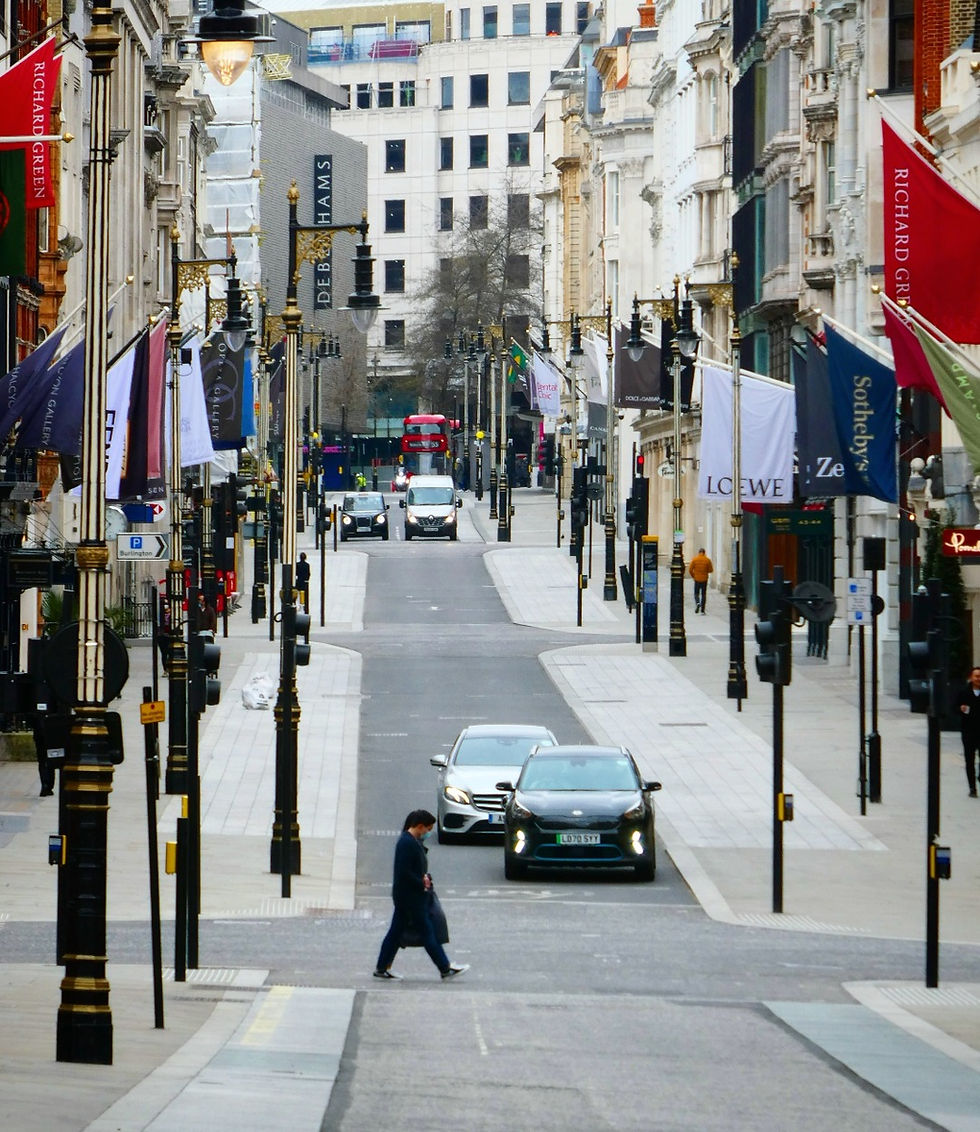
Bond Street is the nearest big shopping street, and I have written a walking guide to Old and New Bond Street. The Handel Hendrix House guide covers the flat on Brook Street, and Christmas in Mayfair shows the streets and arcades around the square dressed for December.
And there was the smell, and I wish I could put it on this page. Wool, and something warm that seemed to come out of the earth, like lying in bed under a woolly blanket on a cold Sunday afternoon in November. It reminded me of Neon Amber by Molton Brown.
_______________________
Did you enjoy this article? If you'd like to contribute to the running costs of WithinLondon, click the button below:
All photos were taken by Ina/WithinLondon, unless stated otherwise.


Comments