Neasden Temple: The Stone Mandir Carved in India and Built in London

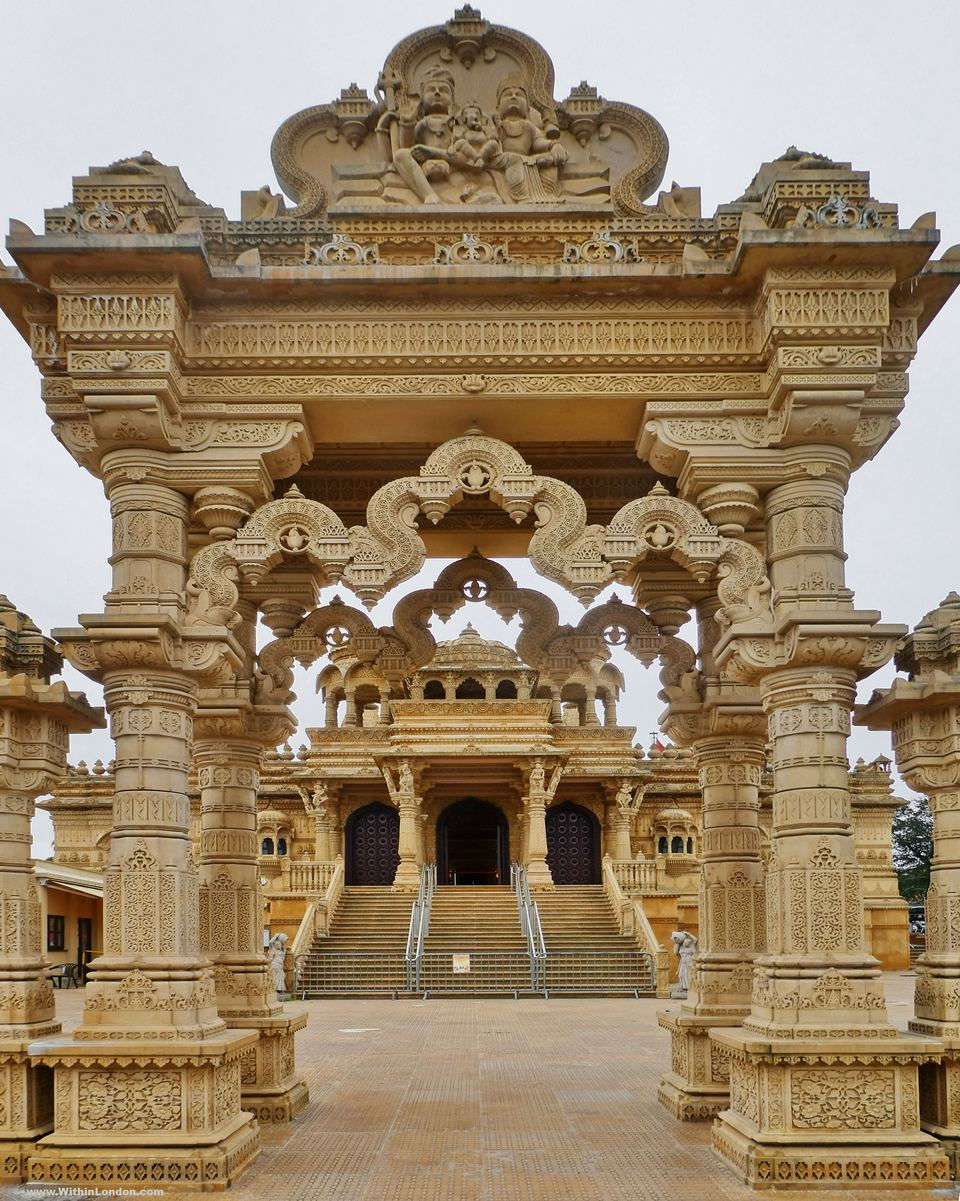
The first thing I saw was a gold gate. Black ironwork, gilded scrolls, set into a red brick wall on a suburban road in north-west London. Behind it, a white stone archway, and through that arch another one, and beyond both, the domes.

It was Sunday 18 September 2022, a bright afternoon with fast clouds, and Open House London was on. The temple takes part in the festival most years, and I went as part of it. I had come to see the Neasden Temple, properly called BAPS Shri Swaminarayan Mandir, and I had seen photographs of it for years. None of them prepared me for the scale of the carving.
This is a building made almost entirely of hand-carved stone, with no structural steel in it, and it was carved in India and put together in Neasden like a very large jigsaw. Here is what I learned about it, what you can see, and how to visit.
What Is the Neasden Temple?
BAPS Shri Swaminarayan Mandir is a Hindu temple, or mandir, on Pramukh Swami Road in Neasden, in the London Borough of Brent. It belongs to BAPS, the Bochasanwasi Akshar Purushottam Swaminarayan Sanstha, a branch of the Swaminarayan tradition of Hinduism.
It opened on 20 August 1995 and was inaugurated by Pramukh Swami Maharaj, then the spiritual head of BAPS, whose name the road now carries. It was the first traditional Hindu stone temple built in Europe. When it opened, it was also the largest Hindu temple outside India.
Most people simply call it the Neasden Temple. There are other temples nearby, and they are easy to confuse. The golden stone one on Ealing Road is a different building, which I wrote about in my post on Shree Sanatan Hindu Mandir in Wembley. The white one is this one.

It is busiest at festivals. At Diwali and the Hindu New Year that follows it, the temple holds the Annakut, an offering of hundreds of vegetarian dishes laid out before the shrines. In 2000, the offering reached 1,247 dishes, which Guinness World Records recognised.
The temple marked its thirtieth anniversary in 2025. King Charles and Queen Camilla visited on 29 October that year. He had also been the Prince of Wales.
How Was the Neasden Temple Built?
Slowly, and mostly by hand. Planning permission came in August 1992 and building started that November. The foundations were poured on 24 November 1992, when about 4,500 tonnes of concrete went in over 24 hours.
The stone was the long part. The outside is Bulgarian limestone, around 2,828 tonnes of it. The inside is Italian and Indian marble, around 2,000 tonnes more. All of it was shipped to India to be carved.
There, 1,526 sculptors worked it into about 26,300 separate pieces. The pieces were then shipped to London. The whole building was then assembled on site in about two and a half years, and it cost around £12 million.
Hundreds of craftsmen worked on it, alongside about a hundred full-time volunteers and more than a thousand part-time ones.
There is no iron or steel holding it up. Traditional temple building follows the Shilpa Shastras, old Indian texts on sacred architecture, and they rule out ferrous metal in the structure. The weight is carried by the stone itself, through 193 pillars.

What Should I Look For Outside the Neasden Temple?
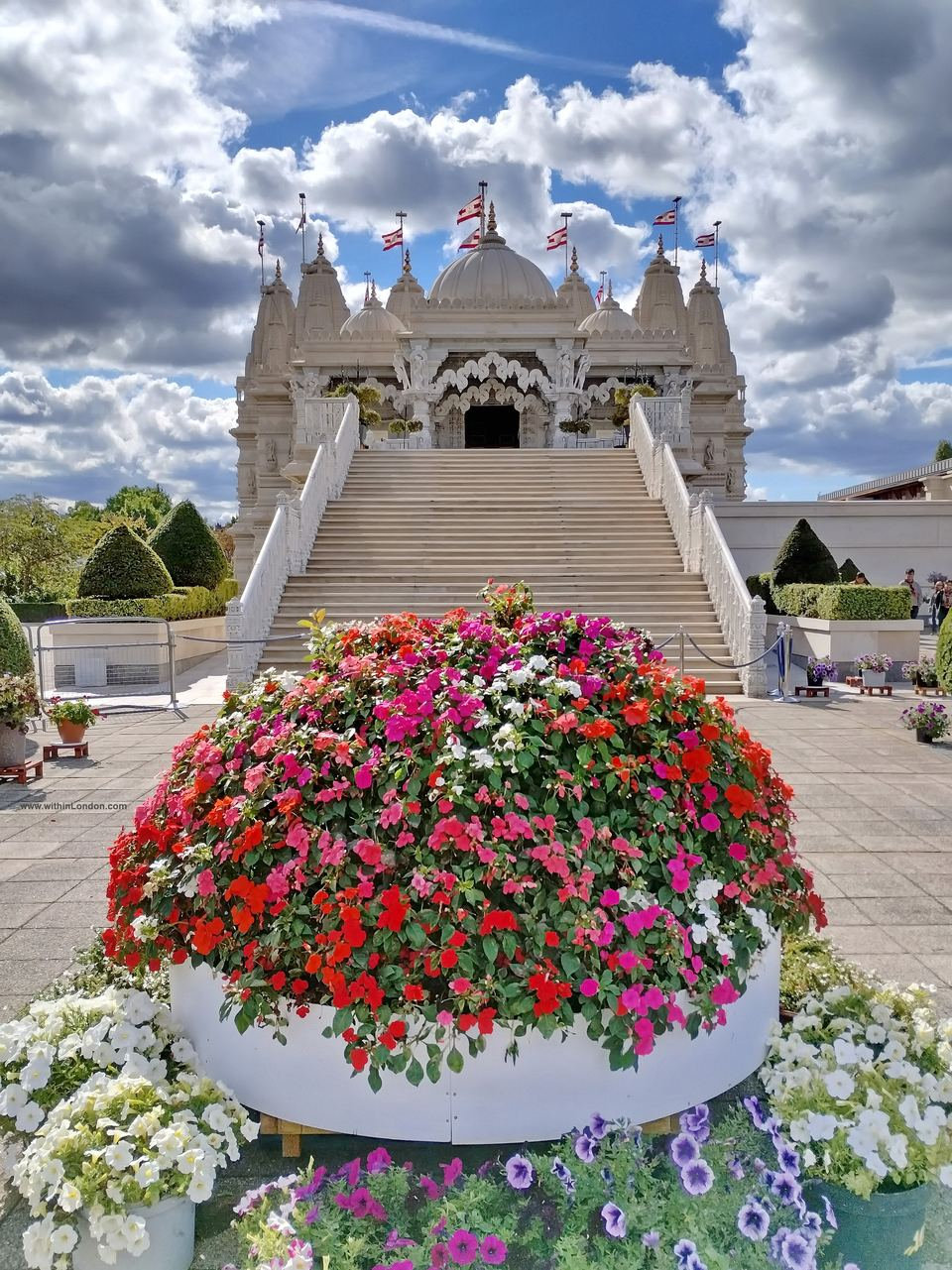
Look up first. The roofline has seven shikharas, the tall tapering spires that sit over the shrines, and six domes. Each shikhara carries a small flag on a pole. From the garden, they stack up one behind another, like a range of small white peaks.
Then look closer. Every surface you can reach is carved: bands of figures, lotus flowers, columns with brackets, deep window frames. The design follows the North Indian style of temple building. BAPS lists more than 500 different carved designs and 55 different ceilings across the complex.
The approach is part of the design. You walk under the white stone arches, along a paved path lined with pots of flowers, and up a wide flight of steps to the temple doors. It frames the building so that you see it whole before you are close enough to see the carving.

The garden to one side is clipped hedging and cones of topiary, very neat and very green against the white stone. It has won prizes in Brent in Bloom several times. On the day I went, there were flowers everywhere: a huge round planter of red, pink and white busy lizzies at the foot of the steps, and more pots along the path.
What Else Is at the Neasden Temple Complex?
The temple is only one part of the site. Beside it is the Haveli, the cultural centre, and it is the opposite of the white stone. Its front is dark carved wood, with balconies, brackets and screens, in the style of the old merchant houses of Gujarat.
The Haveli's woodwork is English oak and Burmese teak. About 17,000 square feet of wood was carved by 169 craftsmen, working at five sites across India. The oak came from 226 trees, and BAPS planted more than 2,300 oak saplings in Devon to replace them.
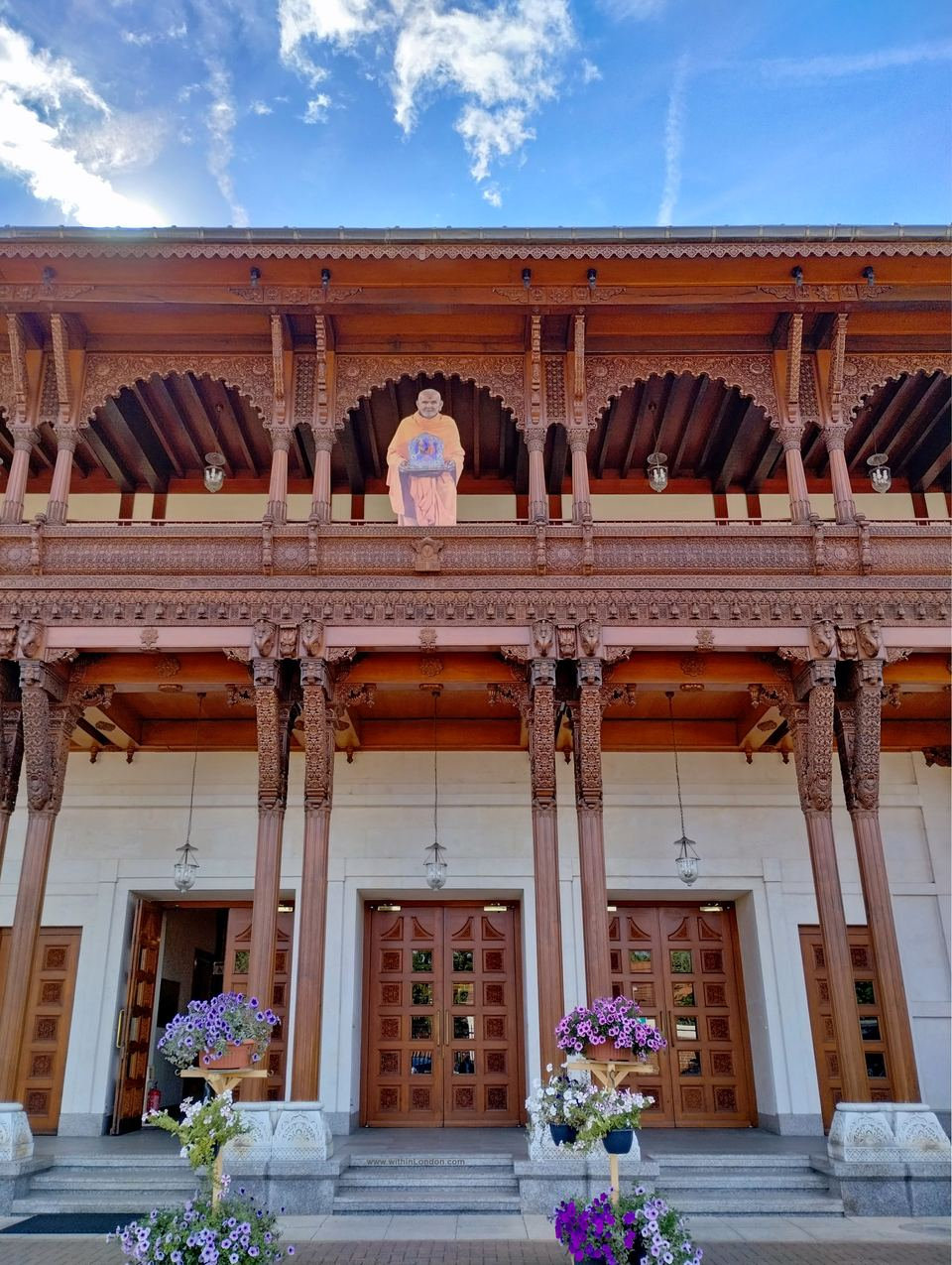
In the courtyard in September 2022, there were two more things that drew a crowd. One was a large gold statue of a seated holy man, garlanded with pink flowers, set in front of the temple. The other was a white elephant with a gold saddle cloth, surrounded by pots of petunias and geraniums.

I have not been able to confirm whether either is a permanent fixture. The statue may have been there for a celebration that year. So treat them as something you might see rather than something you will.

Can Anyone Visit the Neasden Temple?
Yes. Anyone can visit, whatever their faith, and entry is free. It is a working place of worship, though, so there are rules, and they are worth knowing before you go.
On an Open House day, the place is full of strangers, and the people there that Sunday fell into two groups. Some were thrilled to have visitors. Others were plainly annoyed by the crowds. I tried to stay positive and not let the second group get to me.
I went inside. I left my shoes in a room by the entrance and walked into a ceremony that was already underway. People were singing, and the air felt almost celestial. Everyone looked happy and absorbed.
Many of the people there were in special clothes, and I wasn't wearing anything of the kind. It didn't matter. They made room for me and seemed proud to have visitors at their ritual. It humbled me. It was properly uplifting, and I'm not necessarily a religious person.
Cover up. Tops must cover the shoulders, chest, navel, and upper arms, and legs must be covered below the knee. Shoes come off, and there are racks for them. Food, drink, and chewing gum are not allowed on the premises.
Photography is allowed only outside, from ground level, and only with a phone for personal use. No photos or filming inside the temple or the Haveli. Cameras and large bags go into the baggage cabin at the entrance. That is why every photo in this post is of the outside.
Inside the temple, the marble halls are quiet areas, and you are asked not to touch the carvings. At the arti ceremonies, men and women sit separately. Under-16s must stay with an adult.
What Is the Understanding Hinduism Exhibition?
Below the temple is a permanent exhibition called Understanding Hinduism. It covers more than 3,000 square feet, with dioramas, paintings and models explaining the ideas behind the faith. It also shows a short film about how the temple was built.
If you go into one thing beyond the temple itself, I would pick this. It answers most of the questions the building raises: who the figures in the carving are, what the shrines hold, and why the stone was carved so far away. Visit London lists a small charge for it, so bring a few pounds.
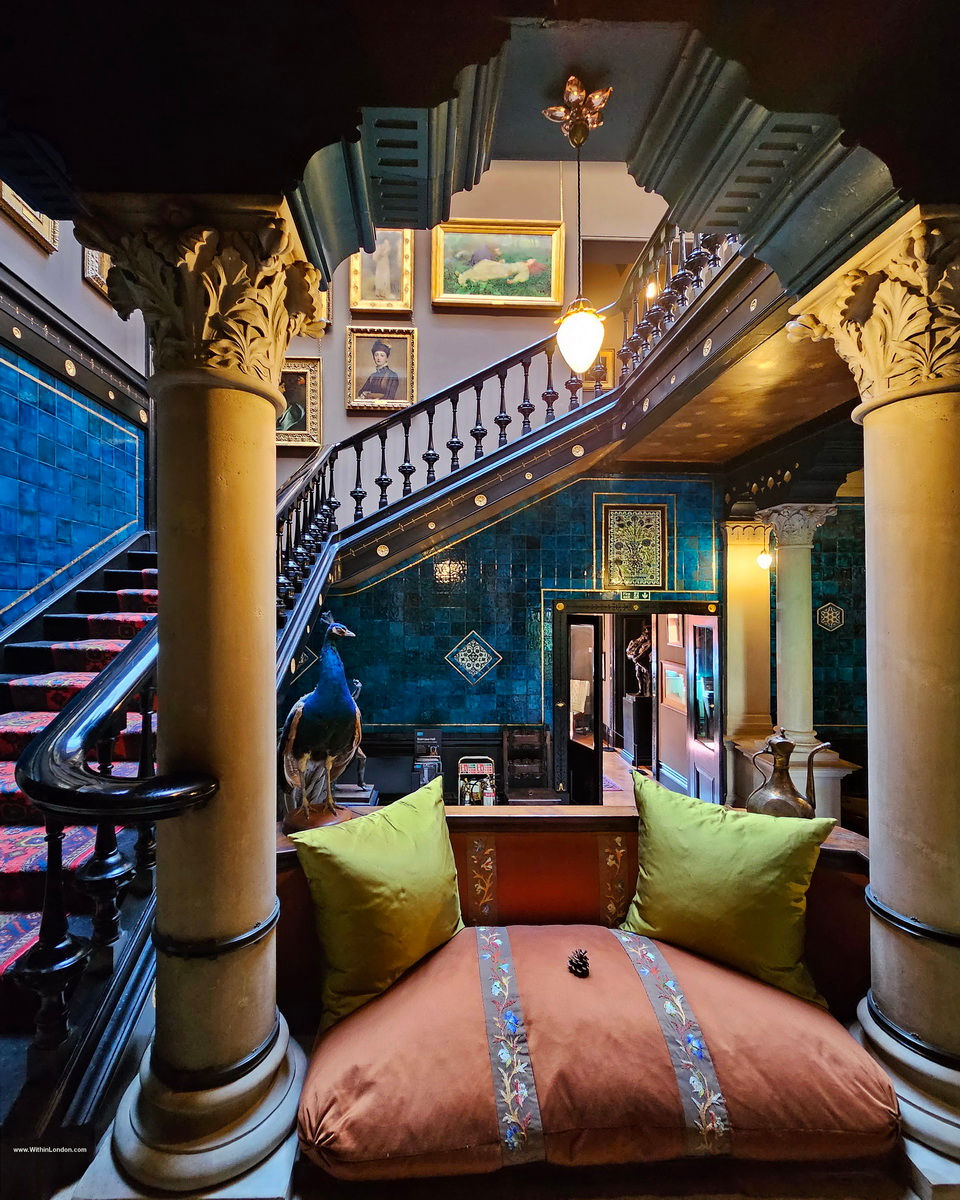
The carving tradition behind the temple is one London has borrowed before. The Arab Hall at Leighton House reused tiles from Damascus. And the gate in the Japanese garden at Kew was made in Japan and shipped over. Neasden did the same thing with a whole building.
Visiting the Neasden Temple: Practical Notes
📍 Where: BAPS Shri Swaminarayan Mandir, Pramukh Swami Road, Neasden, London NW10 8HW.
⏰ Opening: The temple's own site gives 9am to 6pm, Monday to Sunday (September 2026). The shrines are open for viewing at set times, with a break in the middle of the day, so check the darshan times on londonmandir.baps.org before you go.
🎫 Admission: Free. Free guided tours can be booked through the temple. The Understanding Hinduism exhibition has a small separate charge.
🚇 Getting there: Neasden (Jubilee line) is about 20 minutes' walk. Stonebridge Park (Bakerloo line and Overground) is about 15 to 18 minutes. Buses 206 and 224 stop on Brentfield Road.
🚗 Parking: Free car park on site. Coach parking is limited, and smoking is not allowed in the car parks.
☕ Food: No food or drink on the premises. Shayona, a vegetarian restaurant, is just across the road.
⏳ How long: The temple suggests at least two hours if you want to see the temple, the Haveli and the exhibition.
📷 Best time: A bright afternoon, when the sun is on the white stone. Photos outside only, on a phone.
♿ Access: Wheelchair access and lifts are available.
🗺️ Nearby: Pair it with the other great stone temple in the area, Shree Sanatan Hindu Mandir on Ealing Road in Wembley, a short bus ride away.
On my way out I turned round at the gold gate for one last look. Through the two white arches, the spires were still catching the sun, and the flags were still going.
_______________________
Did you enjoy this article? If you'd like to contribute to the running costs of WithinLondon, click the button below:
All photos were taken by Ina/WithinLondon, unless stated otherwise.

Comments