Shree Sanatan Hindu Mandir: The Carved Stone Temple in Wembley

Updated: 6 hours ago
There is a building on Ealing Road in Wembley with no steel in it. Not a reduced amount. None. Two hundred and ten carved stone pillars carry the whole thing, because the Vedic building codes it was made to forbid iron in the structure. So a twenty-first-century building in a north-west London suburb was put up the way a temple in Gujarat would have been put up eight hundred years ago.
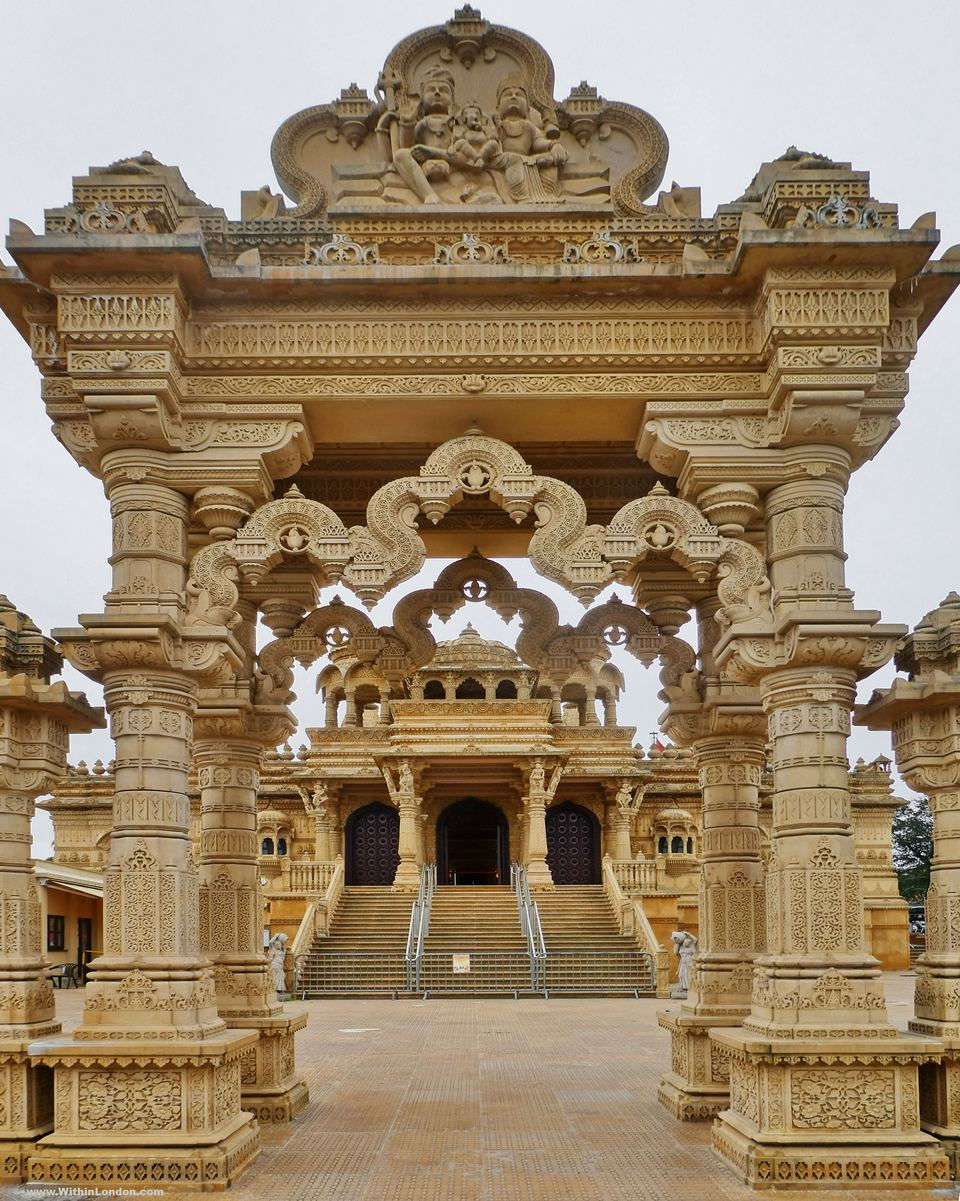
Shree Sanatan Hindu Mandir is honey-coloured, carved over practically every surface, and topped with spires flying saffron flags. A very large number of Londoners drive past the end of its road without ever going in. Anyone can. It is free. Here is what you are looking at, and how to visit it properly if you are not Hindu.
Not the White One
First, a clarification, because London has two famous stone mandirs and people mix them up constantly.
The white one is BAPS Shri Swaminarayan Mandir in Neasden, opened in 1995, built of Bulgarian limestone outside and Italian Carrara and Indian marble inside. It is the one on every list of London's most beautiful buildings, and rightly so.
This is the other one.
Shree Sanatan Hindu Mandir on Ealing Road in Wembley, sometimes called the Shri Vallabh Nidhi mandir after the charity that built it, is golden rather than white. It is built of Jaisalmer limestone from Rajasthan with marble from Bansi Paharpur and Makrana.
On a bright day it reads almost apricot. On a grey day it looks like it is generating its own light, which is a strange effect to encounter between a retail park and a row of shops.
It opened in the summer of 2010 after a programme lasting about fourteen years and costing somewhere around sixteen million pounds. The site is two and a half acres, the building is 182 feet by 115, and the highest point is about sixty-six feet.
Where the Stone Came From
This is the part that changes how you look at it. The components were hand-carved in the town of Sola in Gujarat, by craftsmen working in a tradition that has not fundamentally changed in centuries. Then they were shipped to Britain and assembled here like the largest and most serious flat-pack in the country.
No structural steel, as I said. The load is carried by the stone. That is not a stylistic choice, it is a rule from the Shilpa Shastra, the body of Indian texts governing sacred architecture. And it is why the pillars are so many and so thick and why the walls have the mass they have.
A modern British building of this size would be a steel frame with a stone skin. This is the real thing, structurally as well as decoratively, which makes it one of the more remarkable pieces of construction in London and almost nobody discusses it as architecture at all.

What You Are Actually Looking At
A short glossary, because the vocabulary makes the building far more legible.
Shikhara: the tall curved spire over a shrine, stepped and ribbed as it rises and crowned with a finial. This building has a cluster of them, the largest over the central sanctums, and each one flies a saffron flag on a pole. Seen from the car park they stack up behind each other like a small stone mountain range, which is exactly the idea: a shikhara represents a mountain peak.
Torana: the free-standing carved archway. There is one framing the flight of steps up to the temple, and walking through it rather than round it is the point. It is a threshold, and it is the best photograph on the site.
Jali: the pierced stone screen. The windows here are filled with them, cut in geometric patterns fine enough that from a few feet away the stone looks like lace. In the arched window above the main level there is a jali panel with small carved figures either side and a deep scalloped arch over it.
Chhatri: the little domed pavilion, on pillars, that sits on the roofline. There are several, and they are what stop the silhouette from being solid.
Then there is the sheer density of carving. Bands of figures, lotus borders, elephants, dancers, foliage, running the full height of the walls and continuing round the sides where hardly anyone walks. The doors are deep red timber set into carved surrounds so elaborate that the door itself becomes the plain bit. Give yourself twenty minutes just to walk the perimeter.

Inside Shree Sanatan Hindu Mandir
There are forty-one marble murtis, made in India, across eleven inner temples and twenty-nine smaller sanctums. The three main shrines sit side by side and are deliberately co-equal: Radha and Krishna in the centre, Shiva and Parvati to the left, Lakshmi and Narayan to the right. Around them are Ganesh, Hanuman, Durga, Tirupati Balaji, Shirdi Sai Baba and others.
That arrangement is the key to the place. Most mandirs belong to one sect. This one was built explicitly to serve all Hindu traditions without preference, which is why three different pairs of deities get equal billing rather than one taking the centre. The carved decoration takes the same approach to an unusual extreme: among the figures you will find Guru Nanak and Mother Teresa.
The ceiling inside, a carved marble dome, is the thing people compare to the Jain temples at Mount Abu. It is also, and I want to be careful here, the part you should not photograph. See the next section.

How to Visit If You Are Not Hindu
You are welcome. That is stated plainly by the temple itself: the doors are open to all, whatever your background or faith. Nobody will quiz you and nobody will mind that you do not know what to do.
Shoes come off before you go in. There are free racks by the entrance. Wear socks you do not mind being seen in and slip-ons make life easier.
Dress modestly, shoulders and knees covered. Traditional dress is welcome but not expected and jeans are fine. Avoid shorts and very short skirts.
There is bag screening on the way in, so give yourself a minute.
On photography, be conservative. I photographed only the exterior, which is normal and uncontroversial at mandirs of this kind. Inside, assume no photography, particularly anywhere near the sanctums, and ask at the desk if you want to. That is the standard rule at London's stone temples and it is far better to ask and be told yes than to be the person with a phone out in front of a shrine.
Beyond that: move clockwise, do not point the soles of your feet at a shrine if you sit down, stay back from anything roped off. And if an aarti is happening, stand at the edge and watch. Aarti is the ceremony with lamps and bells, and it is the best time to be there if you want to understand the building as a working temple rather than a piece of architecture. There are several a day, morning through to late evening, and they are longer and busier during festivals.
Prasad, blessed food, is handed out after ceremonies. Take it with your right hand.
Ealing Road, Festivals and Making a Day of It
Do not just drive to the temple and drive away. Ealing Road is the commercial heart of Wembley's Gujarati community and one of the best food streets in London. Sweet shops with trays of barfi and jalebi in the window, vegetarian restaurants, sari shops, gold jewellers, greengrocers with produce you will not find in a supermarket. Chaat, dosa and thali are all within a few minutes' walk of the temple gates.
For festivals, Navratri in September or October is the big one. Nine nights of garba dancing, and it is claimed as the largest Navratri celebration in the country. Diwali and Annakut fall in October or November, Janmashtami in August or September, Mahashivratri in February or March, Ram Navami in April and Holi in the spring. Any of these will be crowded, loud and wonderful, and none of them will be good for quiet contemplation or for photographs.
Wembley Stadium is fifteen minutes away, so check the fixture list before you plan a quiet afternoon.

Visiting Shree Sanatan Hindu Mandir: Practical Notes
📍 Address: Ealing Road, Alperton, Wembley HA0 4TA.
🚉 Getting there: Alperton on the Piccadilly line is the closest station, about four hundred and fifty metres away. Wembley Central on the Bakerloo, Overground and national rail is the other option, with buses running along Ealing Road. There is parking on site, though reports differ on whether it is free or charged, so bring change.
🎫 Cost: free. Donations welcome.
🕒 Opening: the temple's own site gives daily hours from seven in the morning to seven in the evening. But other listings give a split day with a long afternoon closure, which is the normal pattern at traditional mandirs. Ring ahead on 020 8903 7737 rather than turning up on a guess, especially if you are travelling across London for it.
📷 Best time to go: a weekday mid-afternoon for a quiet visit, or at an evening aarti if you want to see it in use. Late afternoon light on the western elevation is the best the stone ever looks.
⏳ How long to allow: an hour for the temple, two or three if you eat on Ealing Road afterwards, which you should.
If unusual London buildings are your thing, the Open House festival is the annual way in, and the Eventim Apollo in Hammersmith is a completely different kind of jaw-drop. Japan House on Kensington High Street is another free and beautifully made piece of another culture in London. For pure street looking, there is London's prettiest streets.
Shree Sanatan Hindu Mandir is a building made in Gujarat and reassembled in Wembley, holding itself up with nothing but carved stone, and open to anybody who takes their shoes off. Go and look at it.
_______________________
Did you enjoy this article? If you'd like to contribute to the running costs of WithinLondon, click the button below:
All photos were taken by Ina/WithinLondon, unless stated otherwise.


Comments