Inside the Argentine Ambassador's Residence, 49 Belgrave Square: Where Florence Nightingale's Crimea Mission Was Planned

Updated: 9 hours ago
49 Belgrave Square is the north-east corner of Belgravia's grandest square. A detached stucco mansion built around 1851 by Thomas Cubitt for Sidney Herbert, Grade II* listed, and since 1936 the official London residence of the Argentine Ambassador. Argentina bought it complete – furniture, paintings, tapestries, mirrors and lamps all included – which is why the rooms inside still look like this. It opens to the public, free, one weekend every September.
It sat on my list for three years. Every September the Argentine Ambassador's Residence would turn up in the Open House programme, I would add it to my itinerary, and every September something would happen. A weekend away, a morning that got away from me. Yesterday I finally walked through the door, and I have not stopped thinking about it since.
I expected it to be beautiful. And it sure is. But what I did not expect was how lived-in it would feel. There were no ropes across the doorways, no glass cases, none of that museum chill where the furniture is arranged to be looked at rather than sat on. Although you can't really sit on most of the furniture.
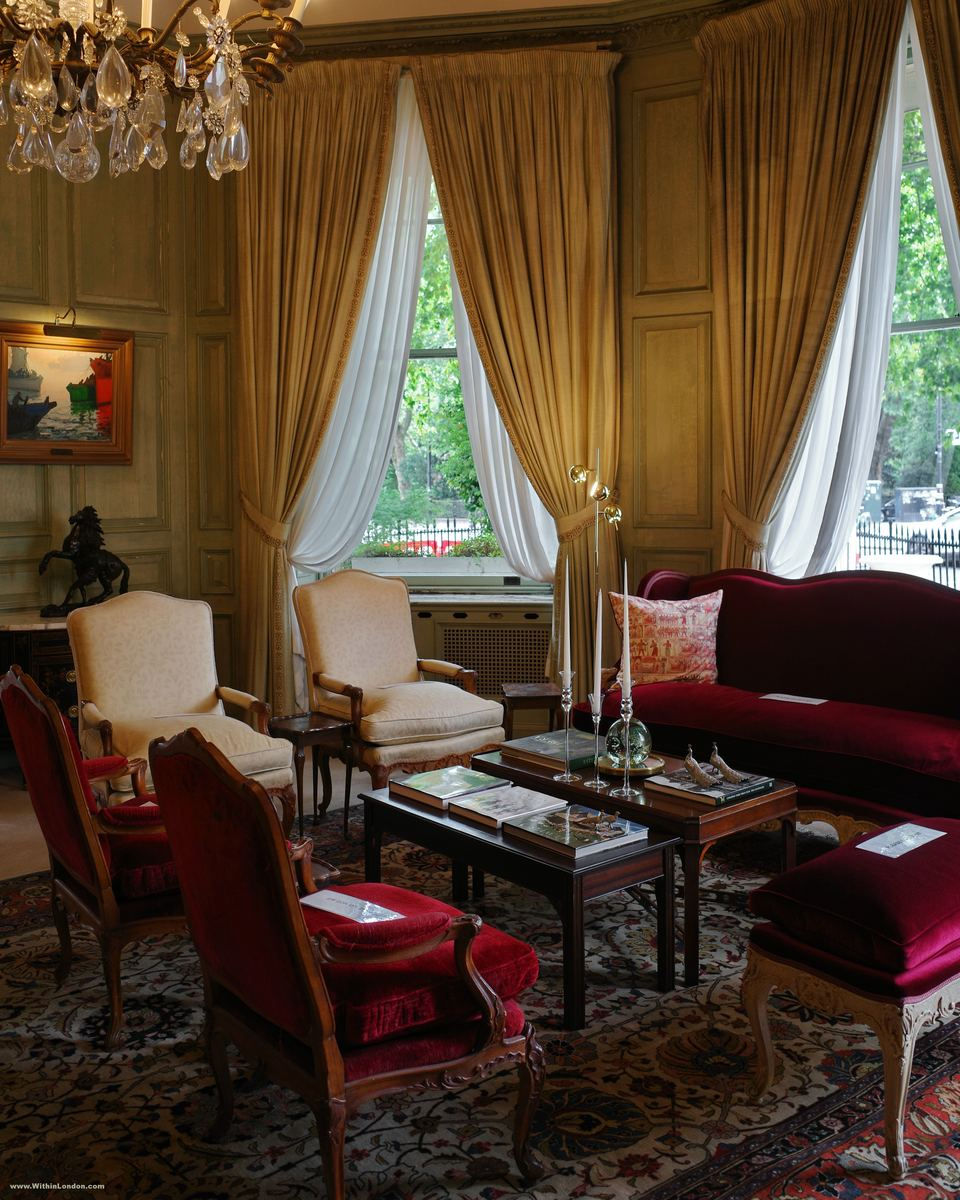
There were remainings of an actual burning fire in the grate in the Green Room. There were art books on every coffee table. In the study, framed pictures were leaning against the bookshelves waiting to be hung, exactly the way they would be in anybody's house mid-rearrange. I came out fantasising about living there, which is not a reasonable response to somebody's embassy, and I am not going to pretend otherwise.

What Has Actually Happened at 49 Belgrave Square
For a house almost nobody has heard of, it has had an unreasonable amount of history walk through it:
Florence Nightingale's Crimea expedition was organised here. Sidney Herbert, who built the house, was Secretary at War in 1854. Nightingale left for Scutari on 21 October that year with thirty-eight nurses, and the modern profession of nursing traces back to it.
A bomb fell on it in 1941 and did not explode.
A very young John F. Kennedy lodged here.
The emblem of the Argentine Volunteer Squadron was designed here. The house was a gathering place during the Second World War for Argentines who fought with British forces, most of them pilots.
A 6th Duke of Richmond lived here for forty-one years. And the Beit family, whose money came out of South African gold and diamonds, kept a serious art collection in it before selling to Argentina in 1936.
It was the first embassy in London to open for Open House, in 2006, and it has done it almost every year since. In 1990 it hosted the reception marking the restoration of diplomatic relations between Buenos Aires and London, and three Argentine presidents have made official visits.
The house is worth knowing about on any day of the year, not just the one weekend it opens. So here is the whole story of it: who built it, who lived in it, why Argentina owns it, and every way I know of to get yourself inside.
Who Built 49 Belgrave Square? Thomas Cubitt and the Corner Mansions
Belgravia was laid out from the 1820s on land belonging to the Grosvenor family, who still own a great deal of it. The square itself was designed by George Basevi for the 2nd Earl Grosvenor, and built by Thomas Cubitt, the master builder whose name is attached to half of stucco London.
It is a piece of planning of almost aggressive symmetry. Four terraces, three of eleven houses and one of twelve, around 650 feet across, with a two-hectare private garden in the middle that ordinary mortals cannot walk into. Most of the square was occupied by 1840.
What makes it unusual is the corners. Basevi left the four corners of the square open for detached mansions, each built separately and each a little different in character from the terraces around it. Number 49 is the north-east one, and it went up around 1851 for Sidney Herbert. Because it stands alone between Halkin Street and Grosvenor Crescent, it was known for decades as the Independent North Mansion.
Herbert himself called it Belgrave Villa. His successor, the 6th Duke of Richmond, could not be bothered with all that and simply called it The Villa.
It has been Grade II* listed since 24 February 1958. The official list entry is characteristically unromantic: "Mansion. Circa 1840 to 50. Stucco. 4 storeys." It notes the five-window frontage with its full-height canted bay, the channelled ground floor, the pedimented outer windows on the first floor, the heavy cornice with a balustrade above it, and the Doric porch.
That is Cubitt in his later manner, quoined and astylar, which is the architectural way of saying there are no columns stuck on the front and the corners are picked out in blocks instead. The porch and the octagonal entrance hall came later, added in 1859 by Mayhew and Knight. And the interiors were reworked again by Mewes and Davis, the practice behind the Ritz, at some point before 1914.
Four visible storeys is also a polite fiction. There are six floors in there: two for entertaining, two for bedrooms, and two more for the staff who made the first four possible. Today, something over twenty embassies and high commissions have addresses on Belgrave Square, which is why the place feels so oddly quiet for central London. Almost nobody who works on this square goes home on it.
Sidney Herbert, Florence Nightingale and the Road to the Crimea
Sidney Herbert, later the 1st Baron Herbert of Lea, was a Conservative MP and, at the critical moment, Secretary at War. His son, the future 14th Earl of Pembroke, was born in this house in 1853. The following year Britain went to war in the Crimea, the reports came back from Scutari about the state of the military hospitals, and Herbert did the thing he is now chiefly remembered for.
He and Florence Nightingale knew each other socially and had been circling the question of army nursing for years. The residence's own history is clear that the Crimean nursing expedition was organised from this house, and Nightingale left for the Crimea on 21 October 1854 with a party of thirty-eight nurses.
Everything that followed - the mortality statistics, the sanitary reforms, the entire modern profession of nursing - traces back to that decision. Herbert died in 1861, worn out at fifty, and Nightingale considered it the great loss of her life.
I did not know any of this while I was standing in the hall. I found it out afterwards, which is usually how these things go, and it completely changed how I think about the building. It is not just a very good address. It is a house where something happened.
Why Does Argentina Own 49 Belgrave Square?
After Herbert's death, the lease went, in May 1862, to Charles Gordon-Lennox, the 6th Duke of Richmond, who stayed until he died in 1903. The Richmonds held on into the twentieth century, and then the house passed to the Beit family, whose money came out of South African gold and diamonds. Sir Otto Beit and, after him, his son Sir Alfred Beit kept it along with a very serious art collection, and in 1936 Alfred sold up.
The buyer was Argentina, which took the house as the official London residence of its Ambassador and has owned it ever since. The crucial detail, and the reason the interiors are still worth crossing London for, is that it was bought complete: the furniture, the paintings, the tapestries, the mirrors and the lamps all stayed. Ninety years on, the reception rooms have not been stripped, modernised or turned into open plan offices. They were simply kept, added to, and used.
A Room-by-Room Walk-Through of 49 Belgrave Square
The public route covers the ground and first floor, which is where all the entertaining happens anyway. You come in through the octagonal hall, where the fireplace is heavily ornamented and set with bas-relief sculpture, and the scale immediately tells you what kind of house this is.
From there the ground floor rooms run into one another in an enfilade, which is the best thing a Georgian or early Victorian plan can do. Stand in the right spot, and you can see through three sets of doorways at once, each one pedimented, each one framing another chandelier.
The Pink Room and the Green Room both have ornate fireplaces, and the Green Room is panelled, with a carved marble chimneypiece and a modern landscape hanging over it. The Pink Room was my favourite. Warm ochre walls, an enormous tapestry filling one side of it, a crystal chandelier, a deep red sofa and a stack of books on the low table in front of it.

Those rooms lead into the dining room, which has cream panelled walls, a dark pink marble fireplace and a long oval table under another chandelier. Set with chairs enough for a proper state dinner and looking straight out onto the plane trees of the square. The windows are the giveaway that this is a corner mansion rather than a terraced house: light comes in from more than one direction, and the canted bay pushes out into it.

The staircase is at the far end of the main hallway, near the dining room door. Black-painted wrought iron ornament, a brass rail, and a curve that carries you up to the first floor landing, where a second, similar spiral continues to the upper floors beneath a long oblong skylight. Stand underneath it and look up. It is the single best piece of architecture in the building, and most people walk past it on the way to the ballroom.
And the ballroom is what everyone comes for. Ionic columns and a cornice picked out in gold, full-length mirrors set into the walls so the room doubles and doubles again. A parquet floor, a grand piano, and a vast tapestry of a courtly garden scene covering one wall. It is genuinely grand and, unlike a lot of grand rooms, it is still used. Concerts and receptions happen in it, which you can tell, because it does not have the airless quality of a room that is only ever photographed.

The Best Thing About It Is That Somebody Actually Lives Here
I want to come back to this, because it is the thing I keep telling people about. Historic houses in London are usually one of two things. Either they are museums, in which case everything is perfect, labelled, roped and slightly dead. Or they are corporate, in which case somebody has put a reception desk and a carpet tile floor into a room that deserved better.
This is neither. It is somebody's home and somebody's workplace at the same time, and the evidence is everywhere once you start looking for it. The fire was lit at some point. There were current art books on the coffee table, and I'm pretty sure I spotted some Bose speakers.
In the study, which is lined floor to ceiling with red and black bound volumes under gold damask walls, a group of framed drawings and prints was propped on the floor against the bookcase. Waiting for a hook. There were photographs on side tables. There was a bronze horse on a lacquered commode that had clearly been put there because someone liked it rather than because a curator had approved it.

None of that sounds like much written down. In person, it is the whole difference between admiring a house and wanting to live in it. Cold, intimidating rooms are easy to build. Grand rooms that still feel inhabited are not.
Argentina in the Details, Inside and Out
The house is Victorian English to its bones, so the Argentine layer is something you notice gradually rather than all at once. During Open House, the embassy hangs an exhibition of work by Argentine artists through the reception rooms. And contemporary painting in a panelled Victorian room is a much better look than it has any right to be.
One of the lovely Open House volunteers said the artists are on site, and you can chat to them - how amazing is this? There is a dark, glittering abstract canvas hanging above a gilt console laid with a silver tea service that I stood in front of for a good five minutes.
Then there is the history the building has absorbed over the last ninety years. The emblem of the Argentine Volunteer Squadron, made up of Argentines who fought with British forces, was created here during the Second World War, and the house was a gathering place for them. A bomb fell on it in 1941 and did not explode. A very young John F. Kennedy lodged here. In 1990 the house hosted the reception marking the restoration of diplomatic relations between Buenos Aires and London. Three Argentine presidents have made official visits.
Step back outside and look across to the square garden as well. On Belgrave Square stands a bronze of General Jose de San Martin, the liberator of Argentina, Chile and Peru. Sculpted by the Argentine artist Juan Carlos Ferraro and unveiled on 2 November 1994 by Prince Philip, alongside the then Ambassador Mario Campora. He has company: Simon Bolivar and Christopher Columbus are on the square too. For a square best known for the Duke of Wellington's neighbourhood, it has an unexpectedly strong Latin American accent.
Can You Visit the Argentine Ambassador's Residence?
Yes, and for free. The main route in is the Open House Festival every September. In 2006 it became the first embassy in London to open its doors to the public for Open House, and it has done it almost every year since. It is free, it is drop-in, and there is no ticket to book.
In 2026 it opened on Saturday 12 and Sunday 13 September, 10:00 to 17:00 on both days. Dates and hours change from year to year, so check the programme when it goes live in late summer. And while you are in there, my guide to the best of Open House London is a decent place to start planning the rest of the weekend.
Go early. This is one of the popular ones, and the queue builds through the morning. The visit is self-guided; the rooms open are on the ground and first floor. The staff is a mix of embassy staff and Open House volunteers, which means the answers to your questions are both well-informed and could be extremely diplomatic. Allow forty-five minutes to an hour if you want to do it properly.
Open House is not the only way in, though it is the easiest. The residence increasingly hosts concerts, conferences, exhibitions and cultural presentations aimed at building links between Argentina and the UK, and tickets for those occasionally reach the public. The Royal Academy has run Friends excursions here. Gallery collaborations have used the house for exhibitions. If you follow the embassy's own channels, you will see them come up.
And if you enjoy this sort of thing, London has a whole quiet circuit of buildings that open once a year and are worth planning around. From the British Academy's Nash Terrace on Carlton House Terrace to the Law Society at 113 Chancery Lane.
Make a day of it while you are there. Hyde Park Corner has Apsley House and the Wellington Arch within a couple of minutes of the square. Walk south, and you are in the prettiest part of Belgravia in about ten minutes, with Eccleston Yards, Elizabeth Street and Motcomb Street all within range for lunch. The square garden itself is private, so admire it through the railings like the rest of us.
Best time to visit is obvious if Open House is your route. The second or third weekend of September, first thing in the morning, ideally on a bright day so the light comes through the bay windows and off the ballroom mirrors. That is the version of this house I saw, and three years of waiting turned out to be worth it.
If you want more of the same weekend, the De Beauvoir Square house I visited last year is proof that Open House is at its best when somebody actually lives in the building.
📍 Where: Argentine Ambassador's Residence, 49 Belgrave Square, London SW1X 8QZ, on the north-east corner of the square.
🚇 Getting there: The nearest London Underground station is Hyde Park Corner on the Piccadilly line, about four minutes on foot. Knightsbridge and Sloane Square are both walkable, and Victoria is the nearest mainline station.
🎫 Admission: Free and drop-in during the Open House Festival each September. No ticket, no booking. Allow forty-five minutes to an hour, and go first thing.
♿ Access: Step-free access and a lift to the ground and first floors, handrails on one side of the stairs, seating, drinking water and toilets. Family friendly, with a quieter area if you need one.
_______________________
Did you enjoy this article? If you'd like to contribute to the running costs of WithinLondon, click the button below:
All photos were taken by Ina/WithinLondon, unless stated otherwise.


Comments