Borough Market: A Guide to One of London's Oldest Food Markets

Updated: Sep 28
The green iron sign says it plainly: BOROUGH MARKET, in big letters over the entrance. Behind it, the Shard rises like a glass needle. Below it, a slow river of people squeezes in under the railway.

That view sums the place up for me. Very old and very modern London, stacked on top of each other, with a lot of food in between. Trains rumble over the roof every few minutes. Somebody is always frying something.
This is my guide to Borough Market as a whole. It covers how the market is laid out, what it's known for, the history behind it and how to dodge the worst of the crowds. The opening hours were checked on the official website in September 2026.
Why Is Borough Market Worth Visiting?
Because it is a working food market, not a food court with a theme. Around 120 businesses trade here, according to the market's 2024 annual report. They include farmers and cheesemakers, butchers, fishmongers, bakers, street food traders, restaurants and a handful of wholesalers.
It is also busy on a scale few markets match. The same report says that by the end of 2023/24 the market was regularly welcoming around 500,000 visitors a week. On a Saturday you feel every one of them.

The setting does a lot of the work. Victorian iron roofs, yellow-brick warehouses and railway viaducts crowd around the stalls. Much of it sits under cover, so a rainy day is no reason to stay away.
Prices are not bargain-basement. You are paying for specialist producers, many of whom grow, rear or make what they sell. If you want cheaper street eating, I'd look elsewhere. If you want to taste things you can't find in a supermarket, this is the place.
How Is Borough Market Laid Out?
The market is a tangle of halls, lanes and passages rather than one big room. The official site groups the trading into three main areas, and knowing them makes the whole place easier to read.
Three Crown Square is the largest. It sits under the railway off Stoney Street and holds many of the bigger producers and merchants. Fruit and vegetables, meat, fish and cheese are the backbone here.
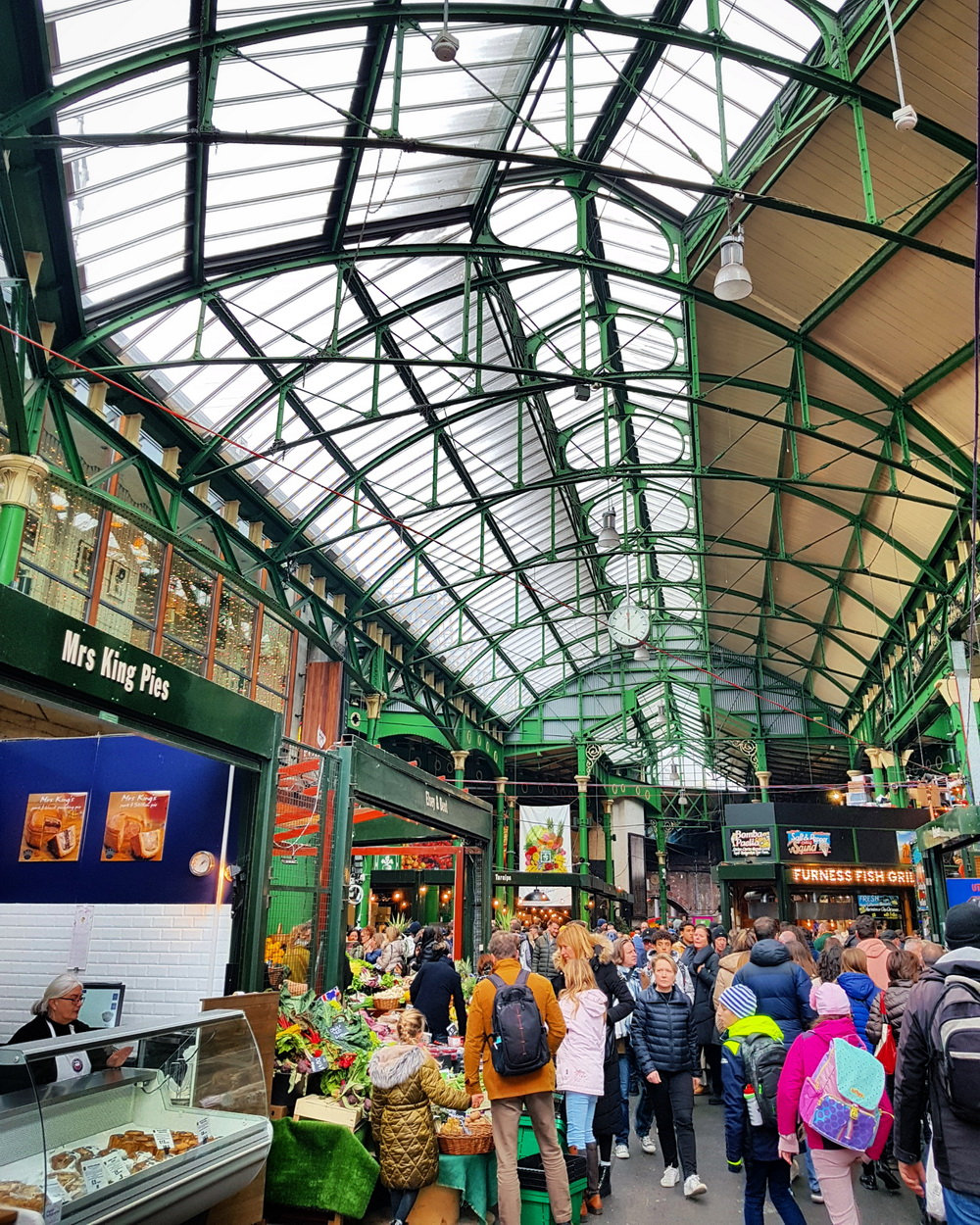
The Green Market is home to more specialist produce traders. Look out for the grey iron and glass portico with a huge fan-shaped window. It is the old Floral Hall frontage from Covent Garden, re-erected here in 2004.
If you want to see where it came from, the Royal Opera House in Covent Garden still has the rest of the Floral Hall.
The Borough Market Kitchen, in Jubilee Place, is where most of the street food is. It opened in autumn 2019, bringing together more than 20 food traders around long shared tables.
Then there is the Market Hall, a glass building on the corner of Borough High Street and Bedale Street. It opened in July 2013 with planters on its columns and benches for sitting. It is one of three places with public toilets.
Around the edges, Stoney Street, Park Street, Bedale Street and Rochester Walk are lined with shops, restaurants and bars. These are part of the market too, even when they don't look it.
What Is Borough Market Known For?
Cheese, first. Neal's Yard Dairy has its shop at 8 Park Street. It sells British and Irish cheeses, many of them matured in its own arches in Bermondsey. It was one of the first retailers to move into the empty warehouses around the market in the 1990s.
Produce, second. The fruit and vegetable stalls are the market's oldest trade, and they still fill a large part of Three Crown Square. Crates of mushrooms, herbs, leaves and roots sit next to fruit from much further away.

Then bread and baking. Loaves are piled up on counters all over the market, from dark sourdough to soft rolls, next to trays of pastries and cakes.

And hot food. The smell of it drifts through the halls well before lunchtime. On my visit, one mushroom stall had a cook working a wok the size of a small satellite dish. Elsewhere, steam was rising from pans under a striped awning.

Which Stalls Should You Look For at Borough Market?
Stalls come and go, so here are the ones I photographed, with a note on which ones I could confirm are still trading in September 2026.
The French Comte glowed like a lantern. It sells food from the Franche-Comté region of eastern France, including cheese and smoked Morteau sausage. The market lists it in Three Crown Square, on Stoney Street.

Ted's Veg had a chalk sign promising home-grown, chemical-free vegetables. The stall is run by a family farm in south Lincolnshire that has worked the land for four generations. The market lists it in Three Crown Square too.

Some stalls I couldn't match to a name, so I'll describe them as I saw them. There was a red and white VW camper van turned into a food stall, with a bicycle parked in front of it.

There was a juice stall with sugarcane stacked upright under strings of bunting, ready to be pressed.

And a flower stall with bunches of orange blooms and an old wooden cart wheel propped up as decoration.
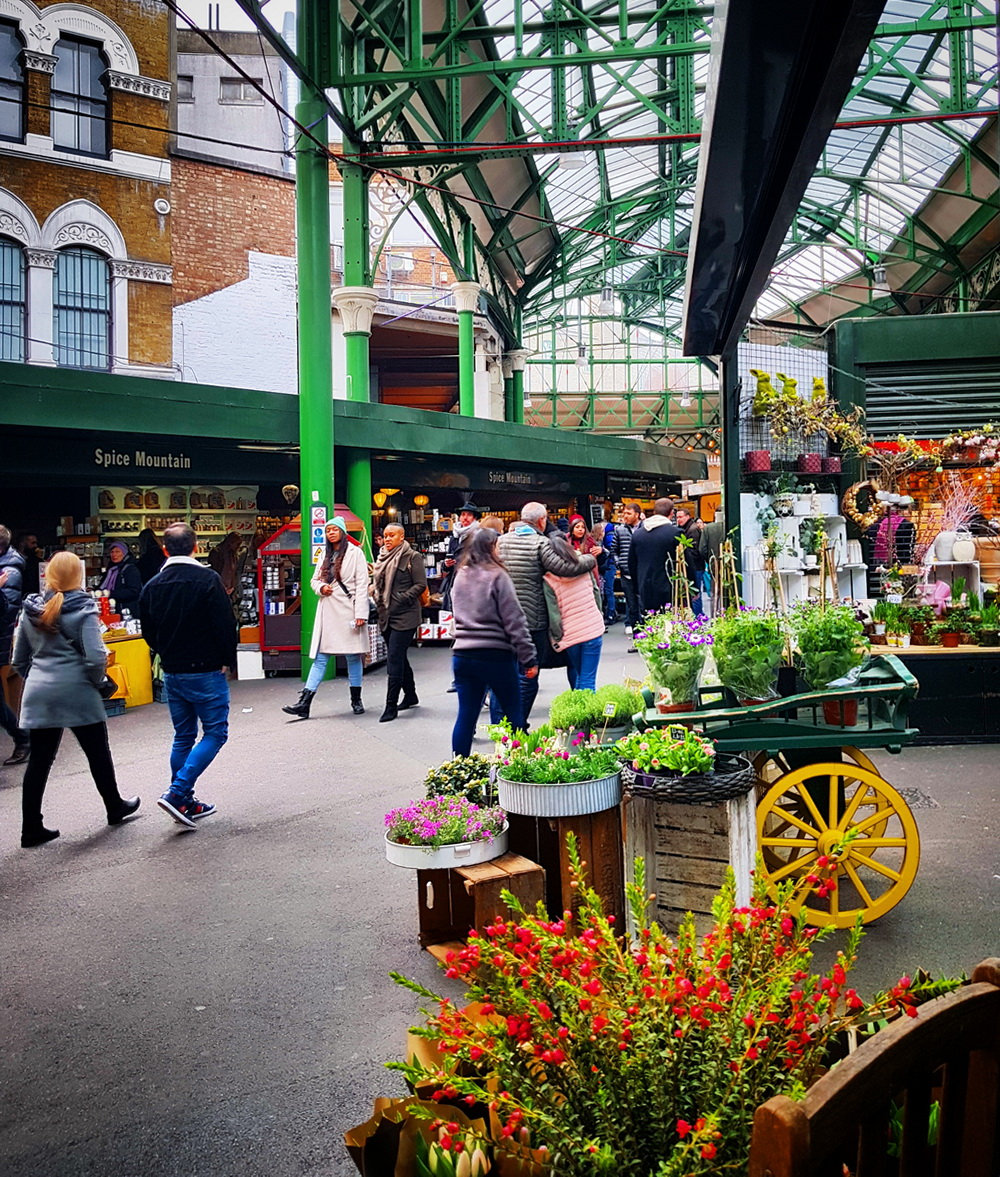
Outside the halls, a yellow market awning shaded a stall stacked with jars. Another stall had rhubarb, oranges and lettuces side by side.

Does Borough Market Still Have a Wholesale Market?
Yes, though it is a small part of the whole. The market's 2024 annual report lists four wholesalers among its traders. They trade while most visitors are asleep.
One of them, Grovers, is a family fruit and vegetable business in its third generation. At the time of writing, its trader page lists it as open 24 hours from Monday to Saturday. It supplies stalls in the market and businesses around London, and sells to the public overnight as a wholesale stand.
This night-time trade is the market's original backbone. After a railway viaduct was driven through the site in 1862, Borough grew into a major fruit and vegetable wholesale hub. It stayed central to London's produce trade into the 1950s, until the spread of supermarkets pushed it into decline.

Why Does the Market Porter Open at 6am?
The Market Porter, at 9 Stoney Street, is one of London's last early houses. These are pubs that open in the early morning to serve people who have worked through the night.
In Borough's case, that meant the market traders and porters. According to a March 2025 report in Southwark News, some traders even received their wages over a pint. The regulars today include night-shift workers, nurses and train staff.
At the time of writing, CAMRA lists its weekday hours as 6am to 9am, then 10am to 11pm. At weekends it opens at noon. You can see the pub from inside the market, right across the street from the stalls.

How Old Is Borough Market?
Old enough that the official site talks in millennia. It says its story began 1,000 years ago, at the foot of London Bridge. The London Museum notes records from 1014 of grain, fish, vegetables and cattle being sold in Southwark.
The first formal mention of a fruit and vegetable market comes in 1276, when it moved to the High Street. In 1550, the City of London took control and extended trading from two days a week to four.
By the 1750s the market was blocking Borough High Street. Parliament moved to shut it in 1754. So the parishioners of St Saviour's raised £6,000 and bought a patch of land known as the Triangle.
The Borough Market Act of 1756 moved the market onto that land. It declared the site an estate for the benefit of the parish, and it is still run by a charitable trust. Its board of trustees are volunteers who receive no benefits from the charity.
The iron market buildings came later, designed by Henry Rose from 1851. The Art Deco entrance on Southwark Street was added in 1932. After decades of wholesale decline, a Food Lovers' Fair in November 1998 started the market's second life as a retail market. Sunday trading followed in 2021.
If you like the ironwork, Leadenhall Market across the river is another Victorian market roof worth a detour.
Which Films Were Shot at Borough Market?
Quite a few. The market and the streets around it appear in Lock, Stock and Two Smoking Barrels (1998), Bridget Jones's Diary (2001) and Harry Potter and the Prisoner of Azkaban (2004). The Imaginarium of Doctor Parnassus (2009) was also filmed here.
For Harry Potter fans, the spot to find is 7 Stoney Street, which stood in for the Leaky Cauldron. Bridget Jones's flat is the building above the Globe Tavern on Bedale Street. Only the outside was used, so don't expect to recognise the rooms.
What's Next to Borough Market?
Southwark Cathedral stands right beside the market, just to the north. The church was St Saviour's, the parish that bought the market land in 1756. It became a cathedral in 1905, and its history goes back to an Augustinian priory founded in 1106.
London Bridge is a couple of minutes' walk away, and the Thames path heads east towards Tower Bridge. Walk west along Bankside and you reach the Globe and Tate Modern.
How Do You Avoid the Crowds at Borough Market?
Go early, and go midweek. Tuesday to Friday mornings, soon after the 10am opening, are the calmest. The official site warns that Saturday afternoons get very busy.
If Saturday is your only option, arrive for the 9am start and do your food shopping first. By late morning, the passages under the railway can be shoulder to shoulder.
Late afternoon is the other quiet window. Crowds start to thin before closing, though some stalls will have sold out.
A few practical tips. Card and contactless payments are widely taken, but it does no harm to carry a little cash in case a card machine fails. Public toilets are in Three Crown Square, the Borough Market Kitchen and the Market Hall. Dogs are allowed on a lead, though peak hours are no fun for them.
If you enjoy markets with a strong Sunday rhythm, Columbia Road Flower Market and Brick Lane make a good contrast.
Visiting Borough Market: Practical Notes
📍 Where: 8 Southwark Street, London SE1 1TL, beside London Bridge station and just south of Southwark Cathedral.
⏰ Opening: At the time of writing (September 2026), Tuesday to Friday 10am to 5pm, Saturday 9am to 5pm and Sunday 10am to 4pm. Hours vary at bank holidays and over Christmas, so check the official Borough Market website before you go.
📅 Open days: Tuesday to Sunday. The market is closed on Mondays, except in December, when it opens seven days a week.
🎫 Admission: Free to walk around.
🚇 Getting there: London Bridge station (Jubilee and Northern lines, plus National Rail) is next door. Buses 17, 21, 35, 47, 133, 343 and 381 stop nearby.
🚗 Parking: There is no market car park, and the area is inside the Congestion Charge zone. There are bike racks within the market.
☕ Food: Street food in the Borough Market Kitchen, seating in the Market Hall, plus bakeries, cheese shops, cafés, restaurants and pubs around the edges.
⏳ How long: An hour for a slow loop. Two or more if you plan to eat and shop.
📷 Best time: Weekday mornings soon after opening. Saturday afternoons are the busiest.
🗺️ Nearby: Southwark Cathedral, the Market Porter, the Stoney Street film locations, London Bridge and the Thames path.
♿ Access: The public areas are on one ground-floor level, with cobbles in places and some narrow passages. There are four accessible toilets with emergency pull cords, and no radar key is needed.
Have you been to Borough Market, and which stall do you head for first?
_______________________
Did you enjoy this article? If you'd like to contribute to the running costs of WithinLondon, click the button below:
All photos were taken by Ina/WithinLondon, unless stated otherwise.


Comments