Winchcombe: Wandering the Cotswolds' Most Honest High Street

Updated: Sep 28
Winchcombe does not try particularly hard to impress you, and that is exactly why it works. It sits in a fold of the Cotswold hills between Cheltenham and Broadway, a proper working market town rather than a place that exists purely for coach parties, and it wears its history so lightly that you can walk the length of the high street without quite clocking that you are in one of the oldest towns in Gloucestershire, once the capital of an entire Anglo-Saxon kingdom. I went for an Easter weekend, and what struck me most was how much genuine, everyday charm is packed into a town this size: honey-coloured stone terraces, a bakery that has been in the same spot since 1967, and front doors so determined to be individually named and decorated that half the pleasure of the visit is simply slowing down to read them.
A Working High Street, Not a Film Set
The first thing you notice walking down Winchcombe's high street is that it still functions as a high street, in the way so many small English towns have quietly stopped doing. There is a butcher, a proper old-fashioned ironmonger, several independent shops selling everything from quality gifts to local jewellery, and pubs with names like The Lion Inn hanging their painted signs out over the pavement rather than anything that reads as staged for visitors. The street itself curves gently downhill, terraces of honey and grey Cotswold stone pressing close on both sides, and at the bottom the land opens out into green hills rolling away toward the Cotswold escarpment, cows and sheep visible on the slopes even from the middle of town. It is a view that keeps interrupting the streetscape at odd angles, glimpsed between rooflines and down side alleys, a reminder that you are never more than a couple of minutes' walk from open countryside here.
What makes it feel lived-in rather than preserved is the mix of the everyday and the historic sitting side by side without any apparent tension. A For Sale sign from a local estate agent hangs a few doors down from a pub with a three-hundred-year-old painted lion on its swinging sign; a resident walks out of a terraced cottage in tracksuit bottoms directly beneath a carved stone lintel that has presumably watched several centuries of residents do exactly the same thing. Winchcombe has clearly made a decision, consciously or not, to stay a town people actually live and shop in rather than converting itself entirely into a heritage attraction, and the result is a place that rewards an unhurried wander far more than a checklist of sights.
The Old Police Station and Its Blossom
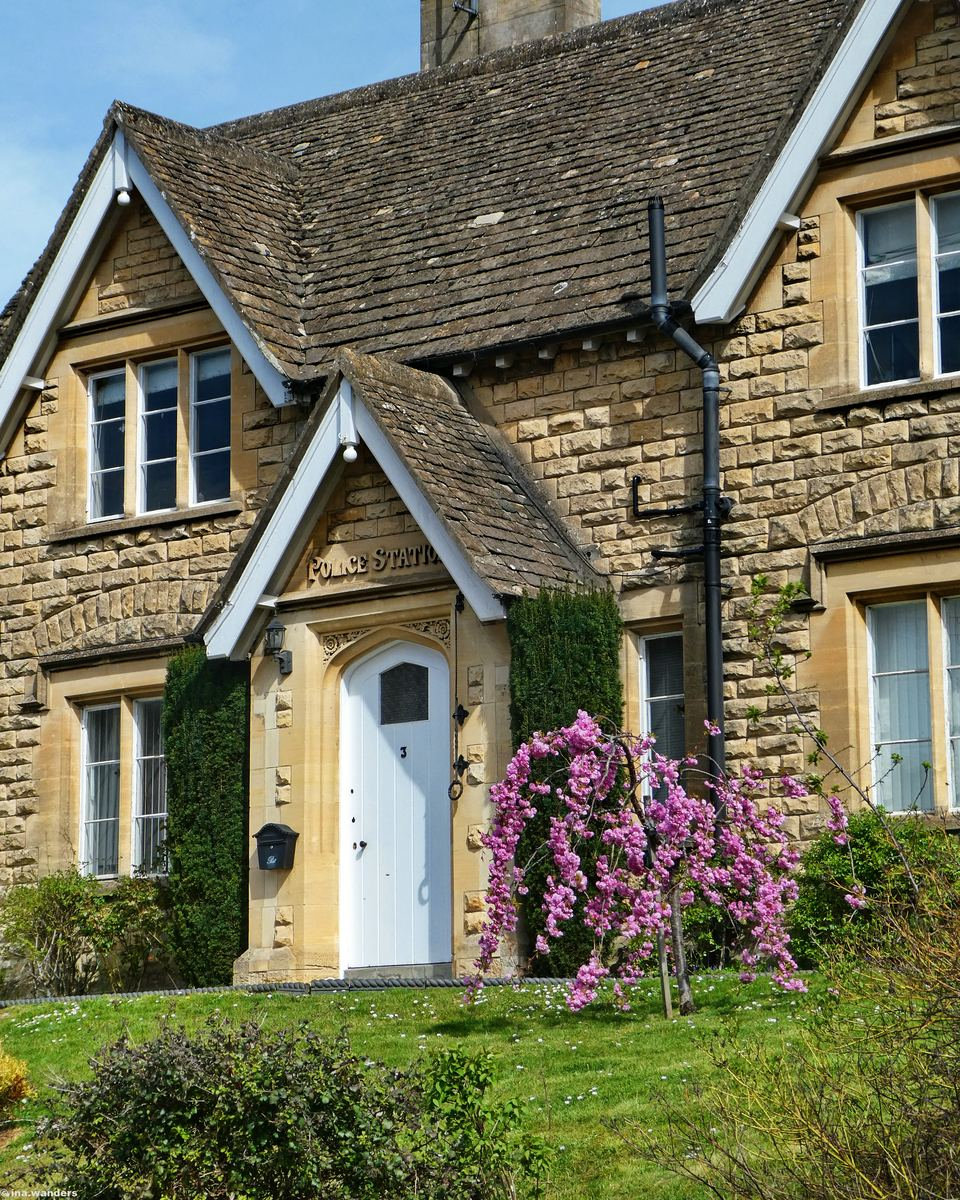
One of the loveliest buildings I passed was not a pub or a church but a former police station, its Victorian Gothic stonework, steep gables, and carved lettering over the door still spelling out its old purpose long after it stopped keeping the peace. On the April afternoon I visited, a young ornamental cherry in full pink blossom had planted itself directly in front of the entrance, spilling flowers across the lawn and against the pale stone in a way that felt almost too perfectly composed to be accidental. It is a small, specific kind of Cotswold magic: a building with a fairly stern original purpose, softened completely by a few weeks of blossom every spring, visited by nobody in particular except whoever happens to be walking past at the right moment.
Winchcombe is full of these small architectural surprises if you keep your eyes up rather than just following the shopfronts at street level — a converted chapel here, a former school there, buildings that have clearly been repurposed multiple times over the centuries as the town's needs changed, each conversion leaving some trace of what came before. It rewards the kind of aimless wandering where you turn down a side street for no better reason than curiosity about where it leads.
Easter Wreaths and Etched Glass Doors
Because I visited over Easter weekend, Winchcombe's front doors were doing double duty as an informal, unjudged wreath competition, and it was genuinely one of my favourite things about the visit. One particularly handsome oak door, its glass panel etched with the words THE BREWERY in elegant lettering, had a rustic willow wreath strung with speckled eggs, dried flowers, and a yellow ribbon hung directly over the ironwork initials worked into the glass — new seasonal decoration layered over decades-old craftsmanship without either one fighting for attention. It is the kind of detail that only shows up if you are walking slowly enough to actually look at doors rather than just passing them, which in Winchcombe's case is not a hardship.
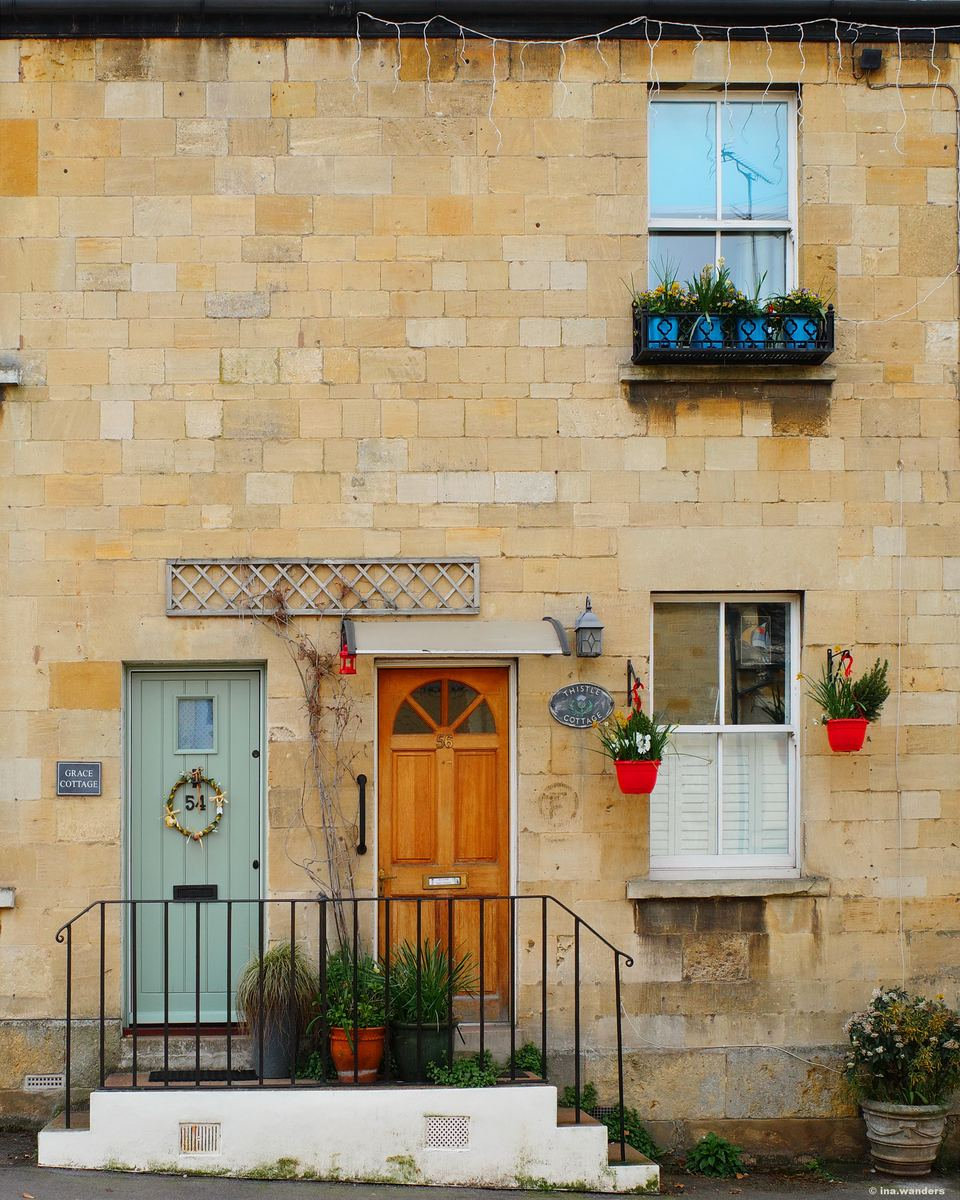
Hanging baskets and window boxes throughout the town were in a similar state of cheerful springtime excess, pansies and primroses spilling out of terracotta pots on nearly every doorstep, which suggests this is a town that takes its seasonal front-garden display fairly seriously year-round rather than only around a specific holiday. If you can time a visit to coincide with Easter, spring flowering, or one of the town's other seasonal moments, the doors alone are worth the detour.

North Street Bakery and the Timber-Framed Terraces
North Street Bakery, established in 1967 according to the lettering painted proudly across its curved shopfront window, is exactly the kind of independent bakery that makes we wish every English town still had one within walking distance of its high street. Loaves and baskets of bread are stacked in the bow window alongside seasonal displays, and the whole white-painted, black-trimmed frontage has the settled, slightly worn charm of a shop that has been doing one thing well for close to sixty years rather than reinventing itself every few seasons. It is a proper destination bakery rather than an incidental stop, and the queue on a Saturday morning suggests plenty of locals agree.
A short walk further along brings you to one of Winchcombe's most photogenic stretches: a run of genuinely old timber-framed buildings, black beams crossing white-painted panels in the classic Tudor pattern, dormer windows poking out from steeply pitched stone-tiled roofs, a restaurant simply numbered 5 North St occupying part of the ground floor behind bow windows. Buildings like this one are a reminder that Winchcombe's history runs considerably deeper than its current cheerful, well-kept high street lets on at first glance — this stretch of the town has looked recognisably similar, in outline if not in shopfronts, for the better part of five hundred years.

Mouse Hole Cottage and the Art of the House Name
If there is one small pleasure I would specifically recommend building a Winchcombe visit around, it is reading the house names. English villages have a long tradition of naming individual cottages rather than just numbering them, and Winchcombe takes this more seriously, and more whimsically, than almost anywhere else I have wandered through. My favourite find was a beautifully carved slate plaque reading Mouse Hole Cottage, complete with a hand-painted mouse nibbling on a spray of flowers beside a ladybird, mounted on weathered stone beside a heavy oak door with genuinely ancient-looking wrought iron hardware. It is a level of care and specific, personal whimsy that a house number simply cannot deliver, and it turns an ordinary residential street into something closer to a very slow, very charming treasure hunt.
Once you start noticing house names in Winchcombe, you cannot stop — nearly every terraced cottage and detached house along the quieter residential streets has one, ranging from the straightforwardly descriptive to the properly poetic, and reading through a cluster of them is a genuinely lovely way to spend twenty minutes that most visitors walk straight past without a second glance.

Visiting Winchcombe: Practical Notes
Winchcombe sits about seven miles northeast of Cheltenham and is easiest to reach by car, though regular bus services connect it to Cheltenham and Broadway for anyone without one; there is no railway station in the town itself, though the heritage Gloucestershire Warwickshire Steam Railway does stop there, which is worth building a visit around if you enjoy a proper steam train alongside your Cotswold stone. The town also sits directly on the Cotswold Way, the long-distance footpath running the length of the Cotswold escarpment, so it works nicely as a stopping point for walkers as well as a standalone day trip. Nearby Sudeley Castle, the former home of Catherine Parr, is an easy addition to a Winchcombe day out for anyone wanting a grander historic stop alongside the high street wandering.
Spring is a particularly good time to visit for the blossom and the flowering window boxes, though Winchcombe's genuine, unpolished charm holds up well in any season — this is not a town that depends on a single dramatic bloom or event to be worth the trip, more a place where the ordinary rhythms of a small Cotswold market town are the whole point. Give yourself at least a couple of unhurried hours to wander the high street and its side streets properly, and resist the urge to rush from landmark to landmark; the best of Winchcombe is in the doors, the house names, and the shopfronts you were not specifically looking for.
Painswick, south of Cheltenham, is another Cotswold village worth a day: a rococo garden, a churchyard of clipped yews and streets of front doors. I wrote it up as Painswick in the Cotswolds.
_______________________
Did you enjoy this article? If you'd like to contribute to the running costs of WithinLondon, click the button below:
All photos were taken by Ina/WithinLondon, unless stated otherwise.


Comments