Visiting the British Library: London's Best Free Day Out on Euston Road

Updated: 8 hours ago
Everybody in London walks past the British Library. It sits on Euston Road between St Pancras and the traffic, behind a brick piazza with a giant bronze man bent over a pair of compasses. And most people's entire relationship with it is using the toilets on the way to a train. I did that for years. Then I went in on a grey January morning with a camera and no particular plan, and I have not stopped recommending it since.
Visiting the British Library costs nothing, takes as long as you want it to, and gives you one of the strangest and best interior views in the city. This is what is actually in there, and how to get the most out of it.
The Building Everyone Loved to Hate
The library was designed by Colin St John Wilson, working with his wife and partner MJ Long, and it took so long to build that it became a national joke. The project ran for decades.
By the time Queen Elizabeth II opened it on 25 June 1998, it was the largest public building put up in the United Kingdom in the twentieth century. And it had been publicly savaged along the way, most famously by the then Prince of Wales, who said it looked like an academy for the secret police.
Time has been kind. In August 2015 it was listed Grade I, the top grade, which for a building not yet twenty years old was remarkable. The red brick was chosen deliberately to sit with Gilbert Scott's Midland Grand next door, and the more time you spend in it, the more sense that decision makes. From the piazza the two buildings should fight, and they do not.

The entrance hall is where the argument is settled. You come in, and the space goes up several storeys at once, in white plaster and pale stone, with a great sloping mass of that same red brick cutting diagonally across the back of it.
Escalators and staircases criss-cross in front. It looks less like a library than the inside of a ship, and there are always people sitting on the steps with laptops and coffee, treating a national institution as a very large living room.
The King's Library Tower Is the Whole Point
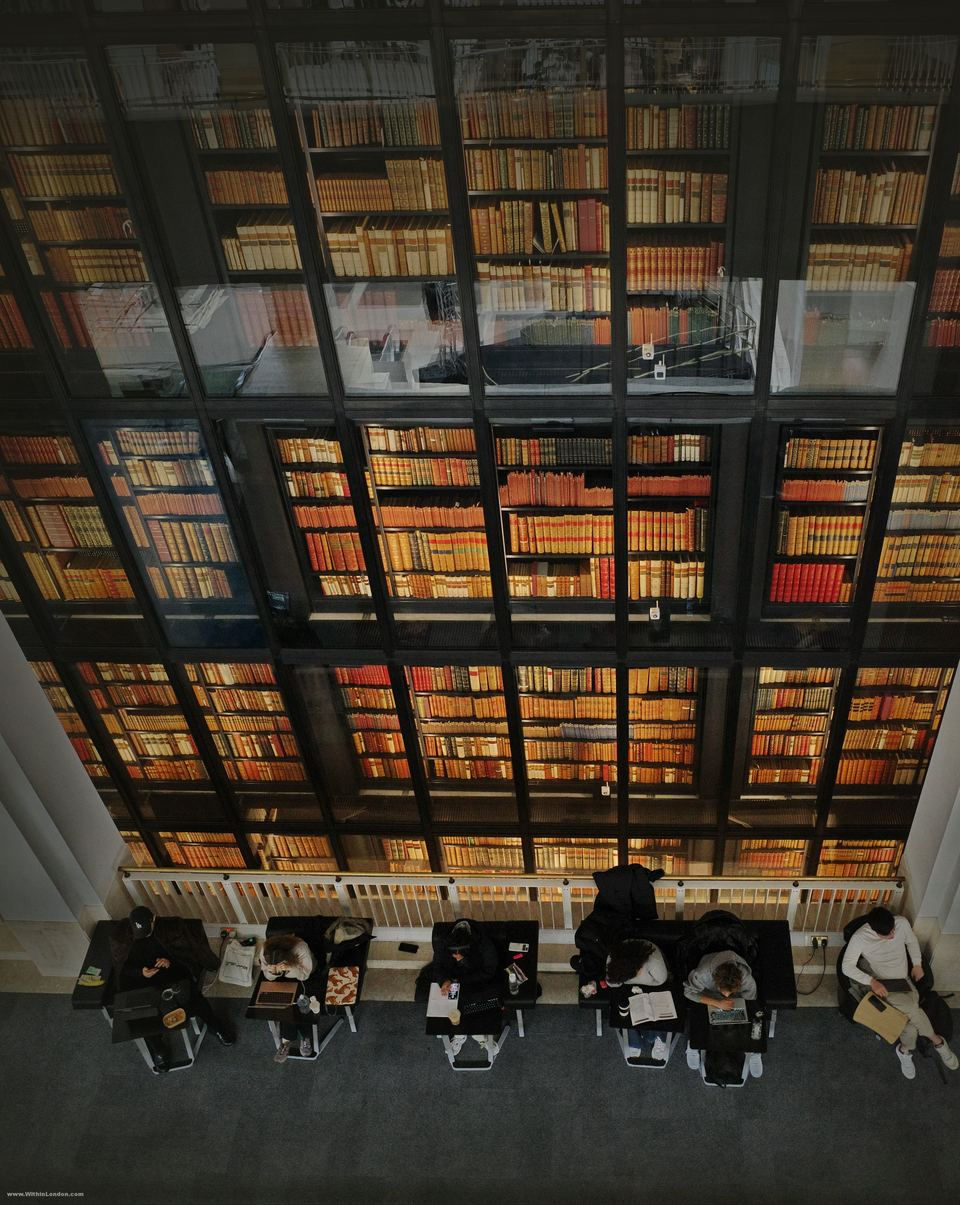
Go up one level and turn around, because the reason to come is right in the middle of the building. A six-storey tower of glass and bronze filled floor to ceiling with leather-bound books, running up through the heart of the library like a chimney.
These are the 65,000 printed volumes King George III collected between 1763 and 1820, along with pamphlets, manuscripts and maps, given to the nation by George IV. Wilson's idea was to put the collection in the middle of the building and let everybody see it. So instead of being locked in a basement, the king's library is the thing the whole plan is organised around.
From the landings you look straight into the shelves: calf and gilt, tan and oxblood and faded green, ranked in bay after bay behind glass, lit so that the spines glow against the dark frame.

I stood on three different floors photographing the same tower and got a different picture every time. From below, readers sit at desks with the books towering over them like weather. From above, you see the whole grid at once and the people at the bottom become very small. It is the best free view in this part of London and there is never a queue for it.
Visiting the British Library for Free: The Treasures Gallery
The Sir John Ritblat Gallery, signed simply as Treasures, is off the main hall and free to walk into. It is one dim, hushed room, and the contents are ridiculous.
Magna Carta. The Lindisfarne Gospels. The only surviving manuscript of Beowulf. Leonardo da Vinci's notebook. Handel's Messiah in his own hand. Jane Austen's writing desk and her tiny, crossed out drafts.
Charlotte Bronte's miniature books, written when she was a child, the size of a matchbox. And in the music cases, Beatles lyrics scribbled on the back of a birthday card and an envelope.
The rotation changes and the light levels are kept low to protect the manuscripts, so it takes a minute for your eyes to adjust. Give it forty minutes. Most people give it ten and miss the fact that this is, object for object, one of the great collections on public display anywhere, and it costs nothing.
Where Everyone Actually Sits
The thing that surprised me most was how much of the building is simply given over to people getting on with their day. There are eleven reading rooms at St Pancras, which need a Reader Pass. But the public floors around them are full of long tables, and every one of them was in use. Students, a man annotating sheet music, somebody clearly writing a dissertation surrounded by a fortress of paper. Two people conducting a whispered job interview.

Looking down from the upper landings you see it laid out like a section drawing. Desks under the columns, a cafe at one end with the smell of coffee drifting up, someone asleep upright in a chair. There are power sockets, there is wifi, nobody hurries you and nobody makes you buy anything. In a city that charges for sitting down, this matters more than it sounds.
There is also a shop that is genuinely good for prints and cards, a cafe on the ground floor, and a restaurant upstairs on the terrace level facing the King's Library tower. It is the nicest place in the building to eat a slow lunch.

The Paid Exhibitions Upstairs
Alongside the free gallery, the library runs one big ticketed exhibition at a time in the PACCAR Gallery. And they are consistently among the most interesting shows in London because they are built out of objects nobody else has.
When I visited, the entrance hall was still hung with the black banner for Secret Maps, which ran from 24 October 2025 to 18 January 2026.
It gathered more than a hundred items around the idea that maps hide as much as they reveal. A 1596 map attributed to Walter Raleigh, secret Ordnance Survey sheets from 1926, escape maps printed on silk and hidden inside hairbrushes in the Second World War. A 1970s guide to gay venues in London, indigenous mapping used to expose illegal mining in Suriname, and the sixteenth century Fool's Cap Map, which puts the whole world inside the head of a jester. Tickets were twenty pounds.
Check what is on before you go, and treat the free parts as the reason to visit rather than the consolation prize. If you are lining up a run of exhibitions, the Bayeux Tapestry's London showing is the other big draw in this category at the moment.
Getting a Reader Pass
If you want into the reading rooms themselves, you need a Reader Pass, and the only real requirement is a genuine research need that cannot be met elsewhere. Registration is done in the building, you need photo identification and proof of address, and it is free. Anyone can apply. You do not need to be an academic, and people are often put off by an assumption that they will be turned away, which is not how it works.
One practical warning. The library was hit by a serious cyber attack in October 2023 and has been rebuilding its technology ever since. The reading rooms are open and most collection items can still be ordered to a desk, and exhibitions, shops and cafes run normally. But digital collections, electronic resources and the reading room computers have been limited for a long time. If your visit depends on a specific item or on digital access, check the library's own service updates before you travel rather than after.
Visiting the British Library: Practical Notes
📍 Address: 96 Euston Road, London NW1 2DB.
🚇 Getting there: King's Cross St Pancras is a two minute walk, with the Northern, Piccadilly, Victoria, Circle, Metropolitan and Hammersmith and City lines, plus the mainline stations and the Eurostar. Euston is five minutes the other way. It is one of the best connected buildings in London, which is part of why it makes such a good place to kill two hours before a train.
⏰ Hours: broadly 9.30am to 8pm Monday to Thursday, 9.30am to 6pm on Friday, 9.30am to 5pm on Saturday and 11am to 5pm on Sunday, with occasional closures for maintenance. Check before a special trip.
🎫 Cost: free to enter, free to sit, free for the Treasures gallery. Only the big temporary exhibition is ticketed.
📷 Best time to go: weekday mornings are calm and the light in the entrance hall is at its best. Late afternoons on a Thursday, when it is open until eight, are the quietest I have found.
🗺️ Nearby: Coal Drops Yard, Granary Square and the canal are all ten minutes north, St Pancras itself is next door and worth walking into for the train shed. And King's Cross hosts the Classic Car Boot Sale a couple of times a year. If you like libraries that are also buildings, the Maughan Library's Round Reading Room and the British Academy are both worth chasing down.
Visiting the British Library is the rare London day out that asks nothing of you. Walk in, look up at the king's books, sit somewhere warm, and leave having seen Magna Carta. I cannot think of a better way to spend a wet morning in this city.
_______________________
Did you enjoy this article? If you'd like to contribute to the running costs of WithinLondon, click the button below:
All photos were taken by Ina/WithinLondon, unless stated otherwise.


Comments