Why the Tower of London moat is dry, and what has grown in it

Updated: 4 days ago
On Saturday 23 July 2022, just after eleven in the morning, the Tower of London moat was yellow from wall to wall. Twenty million seeds had been sown there that spring for the Queen's Platinum Jubilee. By late July the flowers stood knee-high against the stone, with visitors lined up along the railings to look down into them.
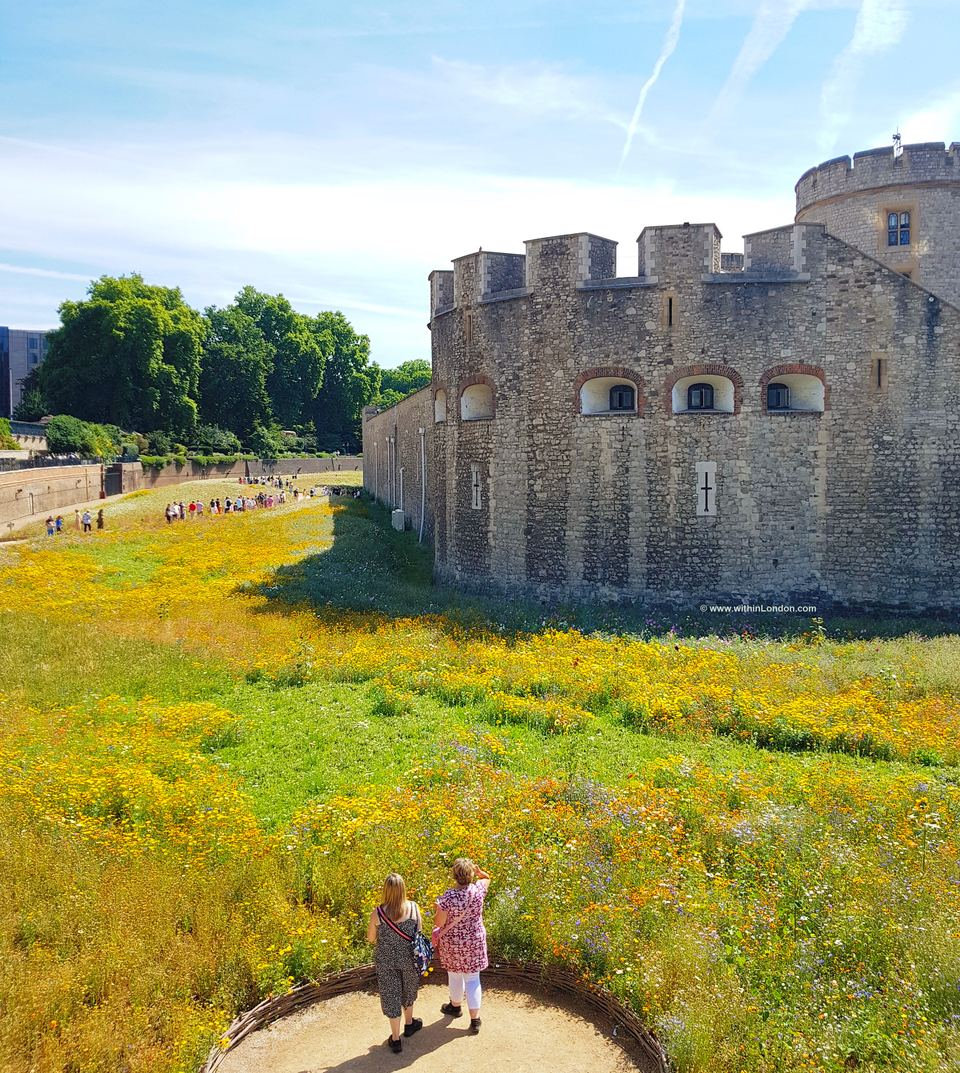
The moat has a stranger history than most people walking past on Tower Hill would guess. And in July 2026 its next chapter was approved.
How old is the Tower of London moat?
Older than most of the Tower itself. According to Historic Royal Palaces, William the Conqueror dug a first defensive ditch on the north and west sides of the White Tower in the 1070s and 1080s. Henry III began a moat all the way round in the 1240s.
Edward I gave it the shape it still has. In the 1270s he widened and deepened it, and it was at least 50 metres wide in places. At high tide it was very deep. Sluice gates let the Thames in and out.
It was also a larder. Edward I stocked the moat with young pike in 1292. Archaeologists later dug up a wicker fish trap from the 15th or 16th century, preserved in the mud with fish skeletons still inside.
Why is the Tower of London moat dry?
Because by the 1840s it had become an open sewer. The water barely moved, and Historic Royal Palaces quotes a report complaining of putrid animal and human waste. An outbreak of disease between 1843 and 1845 made the case for action.
The man who acted was the Duke of Wellington, Constable of the Tower from 1826 to 1853. In those same years he had the moat drained and turned into a dry defensive ditch. Parts of it were filled in. Apart from accidental flooding, the Tower of London moat has been dry ever since.
What has the moat been used for since it was drained?
A long list of things, few of them military. From the 1890s vegetables were grown in the sunny southern stretch. In 1897 hundreds of soldiers camped there for Queen Victoria's Diamond Jubilee.
During the Second World War the moat was dug up as allotments, part of the Dig for Victory campaign, and people living at the Tower grew food there. For the Silver Jubilee in 1977 it was planted with 470,000 begonias. For several winters it has also held an ice rink, with skaters going round under the curtain wall.
Most of the time, though, it was simply lawn. Flat, green, mown, and looked at from above.
What were the poppies and flames in the moat?
The display that made the moat famous came in 2014. Blood Swept Lands and Seas of Red, by the artist Paul Cummins and the designer Tom Piper, filled it with 888,246 ceramic poppies between July and November 2014. Each poppy stood for one British military death in the First World War.
Historic Royal Palaces says 21,688 volunteers planted them and around five million people came to see them. Every evening at sunset, the names of 180 of the dead were read out, followed by the Last Post.
Four years later, from 4 to 11 November 2018, Beyond the Deepening Shadow marked the centenary of the Armistice. Thousands of flames were lit in the moat each evening. A Yeoman Warder lit the first one, and volunteers worked round the rest over four hours. Tom Piper designed it, with a choral sound piece by Mira Calix.
What was the Tower of London Superbloom?
Superbloom was the 2022 Platinum Jubilee display, open from 1 June to 18 September 2022. Over 20 million seeds from 29 species were sown in the moat. The seed mix was chosen by Nigel Dunnett, Professor of Horticulture at the University of Sheffield. The landscape architects were Grant Associates.
The mix started with poppies, corn marigolds and cornflowers. Sunflowers, cosmos and rudbeckias were added to keep colour going into early autumn. Visitors could go down a 17.5-metre, four-lane slide into the moat, and follow paths through the flowers.
Erland Cooper wrote a soundscape for it called Music for Growing Flowers. There were willow sculptures by Spencer Jenkins and metal insects by Quist. A Queen's Garden held cast glass pieces inspired by the Queen's coronation gown. Tickets for the moat paths started at £10 for an adult, and the public paths above were free.
Historic Royal Palaces does flowers on this scale elsewhere too. The tulip festival at Hampton Court Palace is the spring version.
What did the Superbloom look like in July 2022?
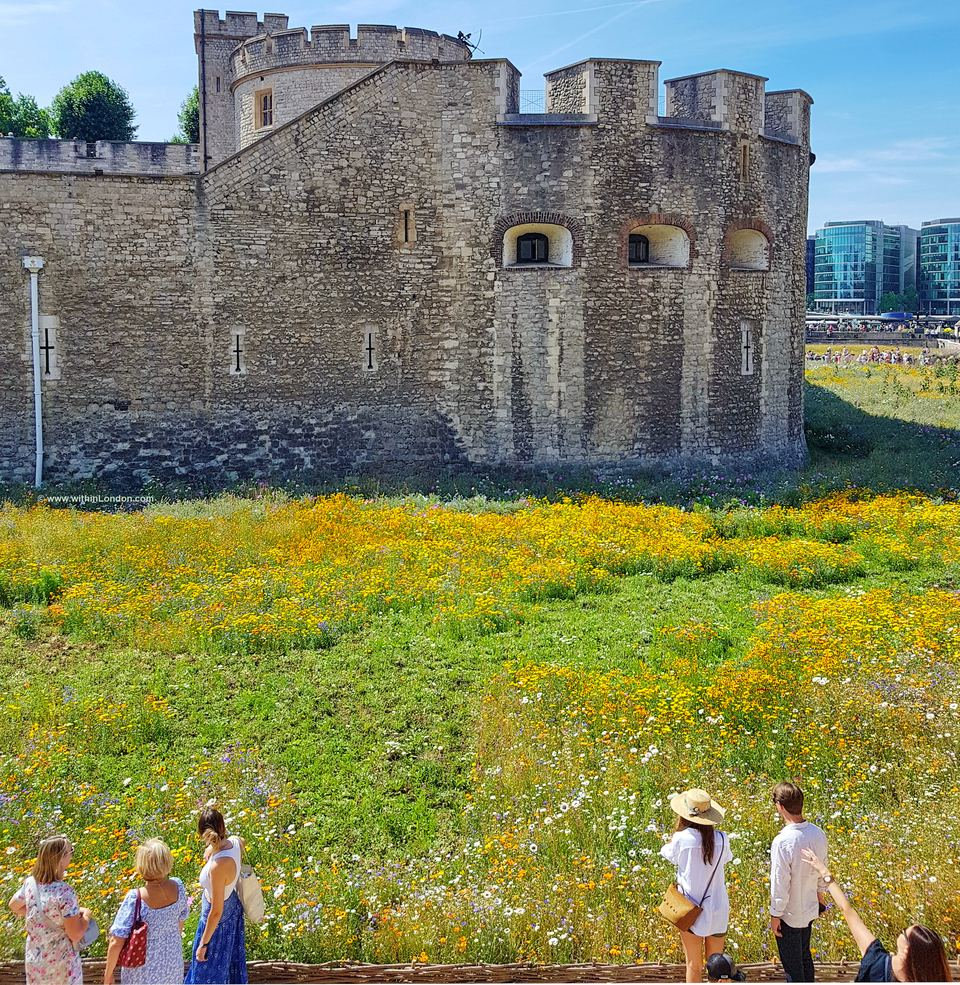
By 23 July it was mostly yellow, with white and pink mixed in and patches of green where things had not yet come up. That Saturday fell four days after the peak of the July 2022 heatwave. The flowers were still standing.
From one corner the Shard rose over the far end of the moat. People lined the paths at the top of the bank, looking down without a ticket.
Down at the railings, visitors in sun hats stood in a row with their phones out. The moat walls here are high, and the flowers came almost up to the ledge.
What happened to the Tower of London Superbloom after 2022?
It did not disappear. Historic Royal Palaces left the seed heads standing so the moat could re-seed itself, and calls the natural landscape a permanent legacy of the display. In the summer of 2023 the flowers came back as The Moat in Bloom, from June into September.
That second year was not a fresh sowing. Nigel Dunnett told Gardens Illustrated that only the strongest self-seeders would come through, and some species appeared in greater numbers than in 2022. Entry to the moat that summer was part of the standard Tower ticket.
There was a lesson in 2022, too. The irrigation tanks ran dry during that summer's heatwaves, and stone walls trap heat. Keeping plants alive down there is harder than it looks from the railings.
Is water coming back to the Tower of London moat?
Some of it, yes. In March 2026 Historic Royal Palaces applied to Tower Hamlets Council to bring water back to parts of the moat for the first time since the 1840s. The council approved the plans in July 2026.
The design, by Grant Associates, adds ponds, wetlands, meadows and rain gardens along three sides. The west moat gets rain gardens fed by the old spouts, an open meadow and a gathering space. The east moat gets a nature pond for school groups.
The water will come from a 19th-century culvert under the moat, turned into an underground storage tank for stormwater, with a borehole as back-up in heatwaves. It is part of a £70 million programme at the Tower that Historic Royal Palaces calls Tomorrow's Tower. In September 2026 no opening date had been published.
Can you walk in the Tower of London moat?
Sometimes. The moat sits outside the inner walls, on the west side near the Middle Tower entrance. When it is open, access is included in the Tower of London ticket and free for Historic Royal Palaces members. In September 2026, though, the Historic Royal Palaces moat page listed it as closed, so check before you plan around it.
You do not need a ticket to look into it. The public paths along Tower Hill and down towards the river give a clear view over the wall, and that is where most of the people in my photos were standing. It pairs well with a walk over Tower Bridge or up to the free Sky Garden for the view from above.
Visiting the Tower of London Moat: Practical Notes
📍 Where: Tower of London, Tower Hill, London EC3N 4AB. The moat runs round the outside of the fortress; the entrance to the Tower is on the west side.
⏰ Opening: Hours vary by day. On Tuesday 29 September 2026 the Tower opened 09:00 to 17:30, last entry 16:30. Check the Historic Royal Palaces website for your date.
🎫 Admission: In September 2026 an adult ticket was £37 and a child (5-15) £18.50, with members free. Moat access, when open, is included. The views from the public paths are free.
🚇 Getting there: Tower Hill station (Circle and District lines) is about five minutes' walk. Fenchurch Street and London Bridge are 10 to 15 minutes away, and the DLR stops nearby.
☕ Food: There are cafés inside the Tower. For more choice, Leadenhall Market is about 15 minutes' walk north-west.
⏳ How long: Ten minutes to look down from the paths. Half a day for the Tower itself.
📷 Best time: June to September for flowers, if the moat planting survives the works. Mornings are quieter on the paths.
🗺️ Nearby: Tower Bridge, St Katharine Docks, Leadenhall Market and the Sky Garden.
♿ Access: Tower Hill station is step-free. The Tower offers wheelchair hire and a digital British Sign Language guide.
🧳 Left luggage: None. Suitcases, large bags and wheeled luggage are not allowed inside.
_______________________
Did you enjoy this article? If you'd like to contribute to the running costs of WithinLondon, click the button below:
All photos were taken by Ina/WithinLondon, unless stated otherwise.


Comments