Tower Bridge in Summer

Updated: Oct 6
I timed it badly and brilliantly at once. I'd come down to the river one evening in July, hoping to catch the light before it went. I arrived just as the bells started and the traffic barriers swung down across the road.
A boat was coming through. For a few minutes nobody could cross. Instead of grumbling, the whole crowd on the pavement turned to watch. Two grey-blue bascules eased upward like drawbridges in a story, gulls scattered off the parapets, and a little pleasure cruiser slid underneath with everyone on deck waving up at us.
Someone next to me said, half to himself, 'I've lived here twenty years and I still stop for this'. That's Tower Bridge on a summer evening in one image: a piece of Victorian machinery still doing its actual job, in front of an audience that never quite gets used to it.
A Very Victorian Icon
It's easy to assume Tower Bridge is ancient, because it has fused so thoroughly with the idea of London itself. It is Victorian, not medieval. It opened on 30 June 1894, more than eight centuries after work began on the White Tower beside it. The East End had grown so fast that the old City of London Bridge upstream couldn't cope. Any new crossing this far east also had to let tall-masted ships reach the wharves of the Pool of London.
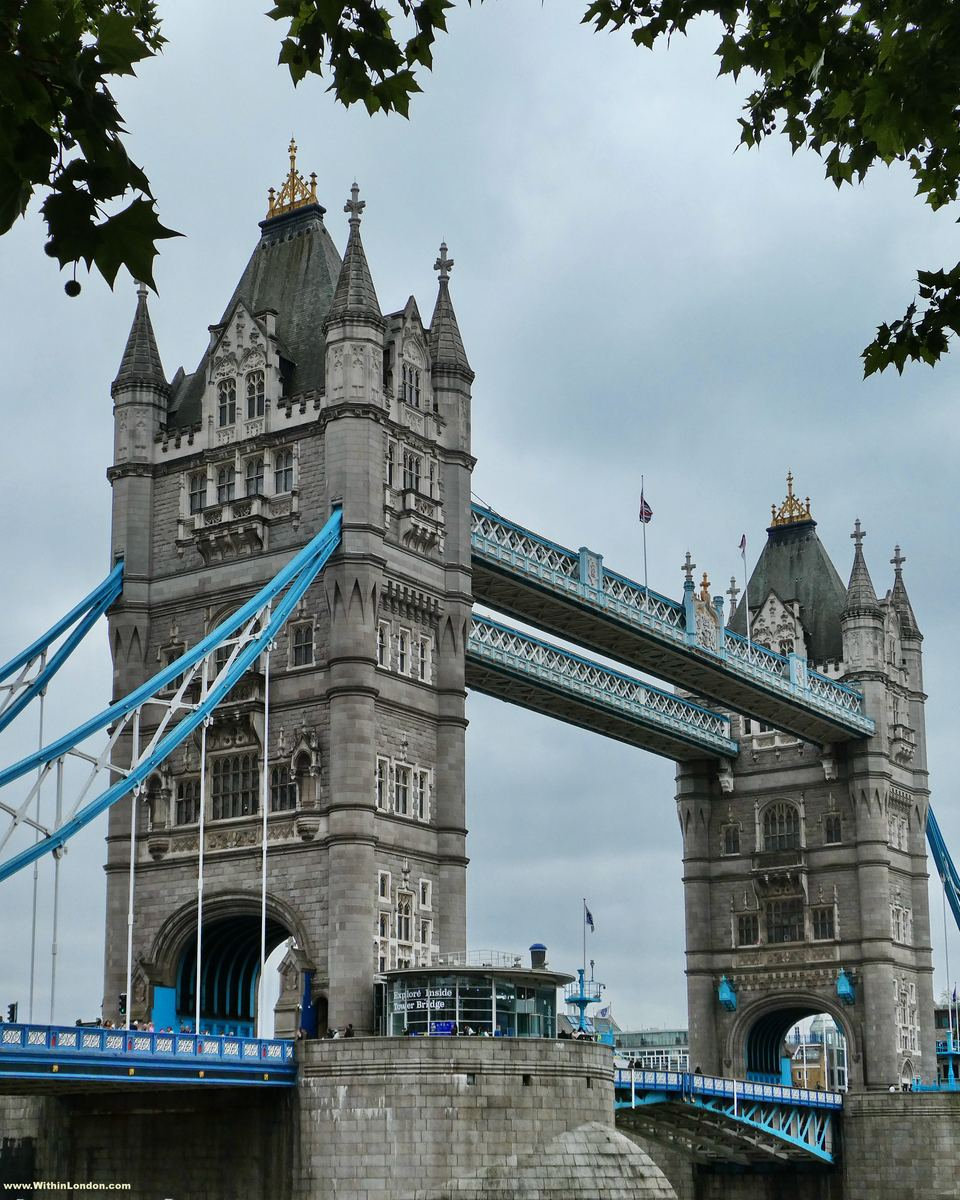
The solution, chosen after a public design competition, was a bascule bridge dressed in a Gothic suit of armour. Architect Sir Horace Jones designed the towers and walkways to match the Tower of London next door. The engineering, the part that actually had to work, was down to Sir John Wolfe Barry, with Henry Marc Brunel assisting.
Construction ran for eight years from 1886. Two piers sunk into the riverbed support the towers, and more than 11,000 tons of steel form the framework. The cladding of Cornish granite and Portland stone still reads as pale and crisp even under grey London skies.
The Engineering That Still Works
What makes Tower Bridge more than a pretty face is that the drama is functional. The road deck is split into two halves, called bascules, from the French for 'see-saw'. Each one pivots upward on a huge horizontal axle inside the towers. Counterweights mean a comparatively modest amount of power can lift a road bridge's worth of steel and tarmac.
In 1894 that power came from steam-driven pumps forcing water into hydraulic accumulators, which store energy under pressure so the lift itself happens quickly. The Victorian engines did their job for the better part of a century. In 1974, the original mechanism was largely replaced by an electro-hydraulic system, and it's electricity and oil doing the work today. Under the Tower Bridge Act of 1885, river traffic still has priority over road traffic.
In the first twelve months the bascules rose more than 6,000 times, roughly seventeen lifts a day. Lifts now run at about 1,000 a year, two or three most days, mostly for tall-masted sailing ships, historic vessels and the occasional cruise ship rather than cargo. The lift times are published on the official Tower Bridge website, and if you build one into your summer evening it feels like watching live theatre rather than a tourist gimmick.

Up on the Glass Floor
The best-known addition is the glass floor set into the high-level walkways that link the two towers, more than 40 metres above the Thames at high tide. The walkways were part of the 1894 design so pedestrians could still cross when the bascules were up. They closed to the public in 1910 and reopened in 1982 as part of the exhibition.
In 2014 the walkway floors were fitted with glass, so you can look straight down through your own feet at the buses, the cyclists and the brown swirl of the river below. It sounds like a gimmick until you're actually standing on it. There's a flicker of vertigo the first time a bus rumbles underneath, and on a bright summer day, with the light coming off the water, the view down is better than the view out.
The walkways are worth lingering in beyond the glass, too. Windows on both sides give you an aerial cross-section of the city. You can see the Shard and More London to the south, and St Katharine Docks and the white keep of the Tower of London to the north, with the working river running between them.

Inside the Exhibition and Engine Rooms
The ticket that gets you onto the walkways also gets you into the Tower Bridge Exhibition proper. That covers the north and south towers, the glass-floor walkways and the Victorian engine rooms at the southern end.
The engine rooms are the part I always tell people not to skip, because they're easy to treat as an afterthought on the way out. The original steam engines, boilers, and hydraulic accumulators are preserved here, all polished brass and ironwork. The machinery is explained clearly enough that you leave understanding how a Victorian engineer moved a road bridge with steam pressure and common sense.
Families get interactive displays through the towers, including the Tower Bridge Cat Trail for younger visitors and touchscreens explaining the construction. Even without children, the walkway views, the glass floor and the engine rooms make a visit that earns its ticket price rather than just ticking a box.

Tower Bridge in Summer: Evenings on the River
What summer gives Tower Bridge is time. In December this stretch of river empties by five o'clock; in July the light holds until nearly ten, and the embankment turns into an open-air living room. Walk down from Tower Hill on a warm evening, and the paths are thick with people who clearly aren't tourists. There are office workers with a can of something cold, runners on the Thames Path, and families with ice creams from the kiosk by the north tower.
The river gets busy too, with RIB boats and Thames Clippers cutting wakes across the water, the occasional tall ship or historic vessel waiting for its lift, and paddleboarders out among the current. From the south side you get one of the great free views in London. The two towers catch the last gold light, the blue-grey ironwork of the bascules stands out against a pale evening sky, and the whole scene wobbles in the water below.

I've stood there with a coffee at eight in the morning, when the bridge belongs almost entirely to joggers and delivery cyclists. I've stood there at nine at night, when it's shoulder to shoulder with people taking the same photograph. Both are worth doing, but summer is when this bridge shows its full range, from quiet and gilded to loud and alive.
On a sunny lunchtime in early June 2022, I found clear glass dining domes on a terrace by the north end of the bridge, each with its own table and chairs. Seen from under the trees, the towers filled the gap between them.

Whichever direction you come from, my advice is the same: leave enough time to just stand on the bridge for ten minutes and watch the river do its thing. That's usually the part people remember longest.
Visiting Tower Bridge: Practical Notes
📍 Where: Tower Bridge Road, London SE1 2UP
⏰ Opening: Daily, 9.30 am to 6 pm, with last entry at 5 pm.
🎫 Admission: Prices change, so check the official Tower Bridge website before you book.
🚇 Getting there: Tower Hill, on the Circle and District lines, is on the north bank beside the Tower of London. London Bridge, a short walk south, has Jubilee and Northern line trains and National Rail services.
📷 Best time: Tower Bridge in summer, on an evening, ideally timed to a bridge lift. Lift times are listed ahead on the official website at towerbridge.org.uk/bridge-lifts.
🗺️ Nearby: The Tower of London is next door, and I've written about its moat. City Hall and the More London riverside are a flat walk south, and Borough Market is close enough for lunch.
♿ Access: The official website has an access page; check it before you go.
_______________________
Did you enjoy this article? If you'd like to contribute to the running costs of WithinLondon, click the button below:
All photos were taken by Ina/WithinLondon, unless stated otherwise.


Comments