London City Hall: Where It Is Now, and What Happened to the Glass Egg on the Thames

Updated: Sep 30
Last updated: September 2026. First published in February 2021, when City Hall was still the building on the Thames. The photographs are from then and are staying – they are a record of somewhere that no longer exists. Everything else has been brought up to date.
London City Hall is not where most people still think it is. Since January 2022, the Mayor of London and the London Assembly have worked out of a glass building at the Royal Docks in Newham. About eight miles east of the riverside landmark that carried the name for twenty years.
The old one – Norman Foster's leaning glass egg between London Bridge and Tower Bridge, the Onion to the architecture press – is still standing. But it has been stripped back to its steel frame and is being rebuilt as something else entirely. The building in these photographs does not exist any more.
I took these on an Open House weekend, when you could walk in off the Queen's Walk, climb the ramp and end up on the roof looking at Tower Bridge. I am glad I did. It did not occur to me at the time that I was photographing something with an expiry date on it, which is the usual way these things go.

Has the Old London City Hall Been Demolished?
No – although the distinction is finer than it sounds. The frame is staying. Practically everything you would recognise is not.
Southwark Council approved the scheme in December 2024 and work began in August 2025. The glazed skin came off first, which left the frame standing bare on the riverside for months and was a genuinely strange sight if you had known the building before. The helical ramp has been removed and infilled. The footprint has been pushed 14.2 metres further south, and a new, better-insulated envelope goes on over the widened base, turning the old helmet shape into something closer to a tea cosy.
Gensler is the architect, St Martins Property Group the developer, and the contractor is Mace – the same firm that built it in 2002. On the drawings, it is not City Hall at all anymore. It is 110 The Queen's Walk.
So the honest answer is: not demolished, but taken back to its skeleton and rebuilt as a different building. The Twentieth Century Society, which has been trying to get it protected since 2021, puts it less diplomatically – its position is that every element of architectural significance is being lost. It has not had much luck.
Listing was refused at first assessment in March 2021. In April 2022 the government neither listed the building nor granted it immunity, which left it in limbo. A fresh spot-listing application went in during June 2024. The building has never been listed, and by the time anyone reconsiders there will not be much left to list.

Why Did City Hall Leave the Building on the Thames?
Rent. The Greater London Authority never owned the glass egg – it leased it. And the landlord since 2013 has been the Kuwait Investment Authority, which bought the whole More London estate for something in the region of $2.8 billion. In November 2020, Sadiq Khan announced the move, arguing that shifting into a building the GLA already owned would save around £55 million over five years. The Assembly formally left on 2 December 2021, and the move was finished in the third week of January 2022.
Not everybody thought it was a good idea. The counter-argument was that City Hall belonged in the middle of the city it governs, within sight of the Tower and the river. And that moving it out to the Docks put a barrier between Londoners and their Assembly. The counter-counter-argument is that hardly anyone was walking in off the street to watch a committee meeting anyway, and the rent was real money.
Both are fair. What is not in dispute is that the Royal Docks building is much further from a tube station most visitors have heard of.
Where Is London City Hall Now?
At Kamal Chunchie Way, in the Royal Docks, London E16 1ZE. If the building looks familiar, it is because it used to be The Crystal, a glass wedge on the dockside that opened in 2012 as a sustainable-cities exhibition centre. Designed by WilkinsonEyre and built for about £30 million.
Perkins+Will led the fit-out that turned it into a seat of government. It was, when it opened, the first building in the world to hold both a BREEAM Outstanding and a LEED Platinum rating. Which is a slightly pointed detail given the story of the building it replaced.
Getting there is easier than the postcode suggests. Royal Victoria on the DLR is the closest station, Custom House on the Elizabeth line is a short walk, and the cable car across the Thames comes down more or less next door. One name did make the journey east: London's Living Room, which used to be the room at the very top of the glass egg, is now a space on the ground floor.
Can You Visit London City Hall?
Yes, free and without booking anything. Parts of City Hall are open to the public on weekdays – Monday to Thursday from 8.30 am to 6 pm and Fridays from 8.30 am to 5.30 pm. Though it is worth checking london.gov.uk before you travel, because opening hours are the sort of thing that quietly changes.
You go through airport-style security on the way in, metal detector and bag scan. And after that you can look around the ground floor and use London's Kitchen, the café, which does breakfast and lunch on weekdays.
The better reason to go is a public meeting. If the Assembly or one of its committees is sitting, anyone can walk in and watch from the seating gallery, which is the bit of the old transparency-of-democracy idea that actually survived the move. Check the meeting calendar before you set off, because an empty lobby in the Royal Docks is a long way to come for a coffee. School and university groups can book free education sessions separately.
What the Old City Hall Was Like Inside
It opened in July 2002, cost £43 million, stood 45 metres high and was designed by Foster + Partners with Arup engineering it. The shape was a sphere pulled out of true and tipped southwards, with no front and no back, leaning so that the upper floors shaded the lower ones from direct sun.
It collected nicknames the way few buildings do. To the architecture press it was simply the Onion, and that is the one that stuck in print. It was still running in headlines twenty years later, when the Mayor announced he was leaving it.
Londoners variously saw a misshapen egg, a motorcycle helmet and Darth Vader's head. The two mayors who actually worked inside it were ruder: Ken Livingstone called it the Glass Testicle, and Boris Johnson upgraded that to the Glass Gonad. In twenty years nobody managed an affectionate name for it, which tells you something.

The ground floor was a big open drum with the Assembly chamber in the middle of it. And it was used for exhibitions and events as well as government, so on an ordinary weekday you could wander in and find a photography show going on underneath the people running London.


And then there was the ramp. A helical walkway 500 metres long spiralling up all ten storeys against the curved glass, usually and fairly compared to the Guggenheim in New York. It was the one part of the building everybody liked without qualification; it is the part the conservation argument was fought over, and it is the part that has been filled in.


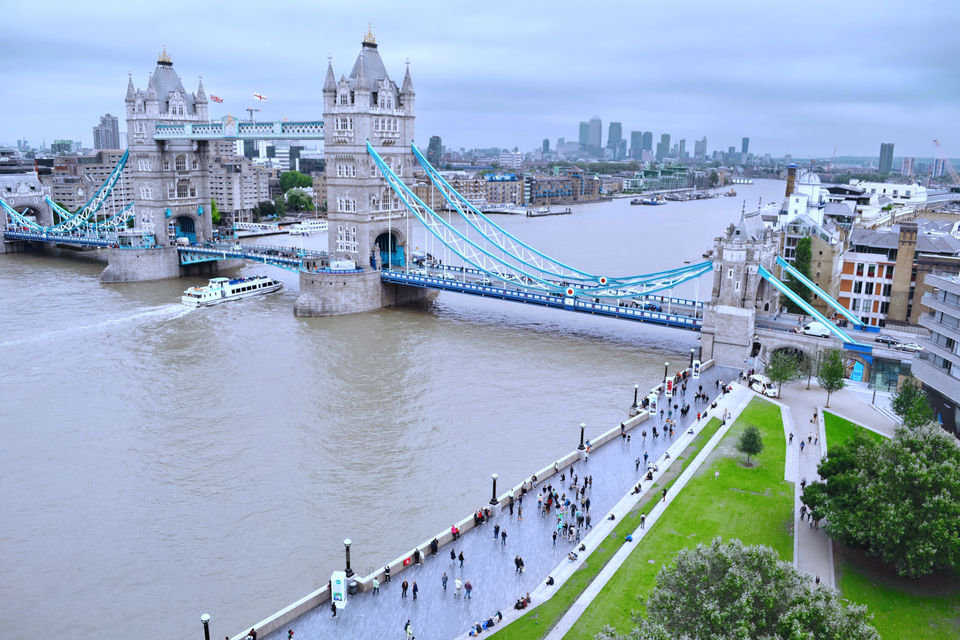
At the top was London's Living Room, and outside it a terrace. It was only open now and then – Open House weekends, occasional public events – which is exactly why people queued down the Queen's Walk for it. This was the view, and it is the single best argument for why the loss of this building is not only an architectural one.


Was It Actually a Green Building?
This is the part of the story that gets left out, so it is worth putting right. City Hall was sold as a landmark of low-energy design. The leaning form cut the surface area taking direct sun, the offices were naturally ventilated, there were solar panels, the public floors were laid with recycled tiles.
In use, it did not deliver. A display energy certificate in 2012 measured it at 375 kWh per square metre per year and rated it E – middling to poor, and awkward for a building whose whole pitch was its efficiency.
A fully glazed envelope is a hard thing to keep warm in February and cool in July, whichever way you lean it. That failure is part of why the replacement scheme was allowed to strip the glass off and start again. And it is a reminder that a building can be genuinely beautiful, genuinely well argued, and still not work.

What 110 The Queen's Walk Will Become
The approved scheme puts offices on the upper floors and turns the ground floor into shops, cafés and restaurants, with a food hall and five new units, adding roughly 3,800 square metres overall. LDA Design is redoing the landscape around it. And The Scoop – the sunken amphitheatre next door, built by Townshend Landscape Architects, which put on free open-air theatre and film from 2002 – is to be reworked as an events and commercial space.
It will probably be good. Reusing a frame rather than knocking it down and pouring new concrete is the right instinct, and that stretch of riverside has always been a bit dead outside office hours. It will also be a shopping centre where the Assembly used to sit, and the ramp will be a memory held mostly in photographs like these. Both of those things can be true at once.
Where to Get That View Now
The nearest free replacement for the City Hall terrace is the Sky Garden on the other side of the river, which costs nothing and looks back over the same stretch of Thames. For the bridge itself at close range, there is Tower Bridge in summer, a few minutes' walk along the river. The others are in my guide to the best views of London.
And if what you liked about City Hall was getting inside a building you normally cannot, that is still the best weekend of the London year. My guide to Open House London is where to start. And the ones I have written up since include the Argentine Ambassador's Residence on Belgrave Square, the British Academy, 113 Chancery Lane and New Scotland Yard.
📍 Where: City Hall today, Kamal Chunchie Way, London E16 1ZE.
🚇 Getting there: Royal Victoria on the DLR is the nearest station; Custom House on the Elizabeth line is a few minutes' walk, and the Thames cable car comes down beside it.
🎫 Admission: Free, no booking, weekdays only. If a public meeting is sitting, you can watch from the gallery. Check the opening hours and the meeting calendar on london.gov.uk before you travel.
The old building: 110 The Queen's Walk, London SE1 2AA. Until the redevelopment opens there is nothing to see there but hoardings – go for Tower Bridge and HMS Belfast instead.
🗺️ Nearby: Worth the walk, on the old site's doorstep:
Tower Bridge (239 m)
HMS Belfast (243 m)
Tower of London (364 m)
The Shard (545 m)
_______________________
Did you enjoy this article? Great! If you'd like to contribute to the running costs of WithinLondon, click the button below:
All photos were taken by Ina/WithinLondon, unless stated otherwise.


Comments