The Elfin Oak: London's 900-Year-Old Whimsical Tree

Updated: Sep 28
I first walked past the Elfin Oak without noticing it. That happens. It sits behind an iron cage near the Diana Memorial Playground in Kensington Gardens, and from a distance it looks like a dead stump under a sort of miniature bandstand. Then you get closer.

The carvings cover almost every surface: gnomes, witches, elves, fairies, a green woodpecker, a crow's nest with eggs being stolen. They are painted in greens, oranges and blues, and they each have names. This is one of the strangest and most delightful things in London, and almost nobody knows it is there.
What Is the Elfin Oak in Kensington Gardens, London?
The Elfin Oak is the hollow stump of an ancient oak tree. It is not a living tree and never grows. It came from Richmond Park, where it had stood for roughly 900 years. George Lansbury arranged for it to be moved to Kensington Gardens in 1928, as part of a push to improve London's public spaces.
Between 1928 and 1930, the Scottish artist and illustrator Ivor Innes carved 74 miniature figures into the natural forms of the bark. He worked with the shapes already in the wood, coaxing faces and bodies out of knots and hollows. The technique had a name: he called it griglans, a Cornish dialect word for heather, after gnarled heather stems that first gave him the idea on the Cornish coast.

Who Are the Little People Carved into the Elfin Oak?
Ivor Innes gave each figure a name and a story. Huckleberry the gnome carries a bag of berries up the Gnomes' Stairway to a banquet inside Bark Hall. Wookey the witch guards three jars of health, wealth and happiness. Grumples and Groodles the elves are caught stealing eggs from a crow's nest by Brownie, Dinkie, Rumplelocks and Hereandthere.
There is also Harebell the fairy, a green woodpecker, and a whole hidden community of creatures living in the crevices behind the bark. You need to crouch down to see some of them properly.

Who Made the Elfin Oak – and Why?
The idea came from George Lansbury, then head of the Office of Works. Lady Winifred Fortescue funded the project and donated the trunk from Richmond Park. Innes spent two years on the carvings.
In 1930 Innes's wife Elsie published a short children's book based on the finished figures, describing the oak as a home for the Little People. Ivor illustrated it. The book and the carvings drew from the same tradition as J.M. Barrie's Peter Pan stories, which are also set in Kensington Gardens.

What Happened to the Elfin Oak After 1930?
The Elfin Oak was declared Grade II listed in 1997. By then the paint had faded badly and several figures had been damaged.
The comedian Spike Milligan was a lifelong fan and campaigned for its restoration twice – once in the mid-1960s and again in 1996. The most recent restoration was carried out by DBR Conservation, funded jointly by The Royal Parks and the Friends of Hyde Park and Kensington Gardens. The cage was redesigned to make the carvings easier to see, removing the old mesh lining and reducing the number of bars.
Did the Elfin Oak Appear on a Pink Floyd Album?
It did. David Gilmour was photographed standing in front of the Elfin Oak for the inside cover of the band's 1969 album Ummagumma. The photograph is one reason many people who have never been to Kensington Gardens already know what the Elfin Oak looks like.

When Should You Visit the Elfin Oak?
It is free to visit any time the park is open. Come on a quiet weekday morning and you can get close without other visitors in the way, which matters because the figures are small and the detail rewards time.
Late October is a good moment to make a day of it. The trees along the Broad Walk turn gold and amber in the last weeks of the month, and the walk from Queensway to the playground is half the reason to go. See the full guide to the best autumn foliage in London.
Visiting the Elfin Oak: Practical Notes
📍 Where: Broad Walk, Kensington Gardens, London W2 4RU. The Elfin Oak stands beside the Diana Princess of Wales Memorial Playground, on the north side of the playground entrance.
⏰ Opening: Kensington Gardens opens at 6am daily and closes at dusk. The Elfin Oak is accessible whenever the park is open. Free to visit.
🚇 Getting there: Queensway (Central line) is the nearest station, about a 10-minute walk south through the park. Bayswater (District and Circle lines) is a similar distance.
⏳ How long to allow: 15–20 minutes to look at the carvings properly. Combine it with the Diana Memorial Playground next door and the walk along the Broad Walk and allow an hour or two.
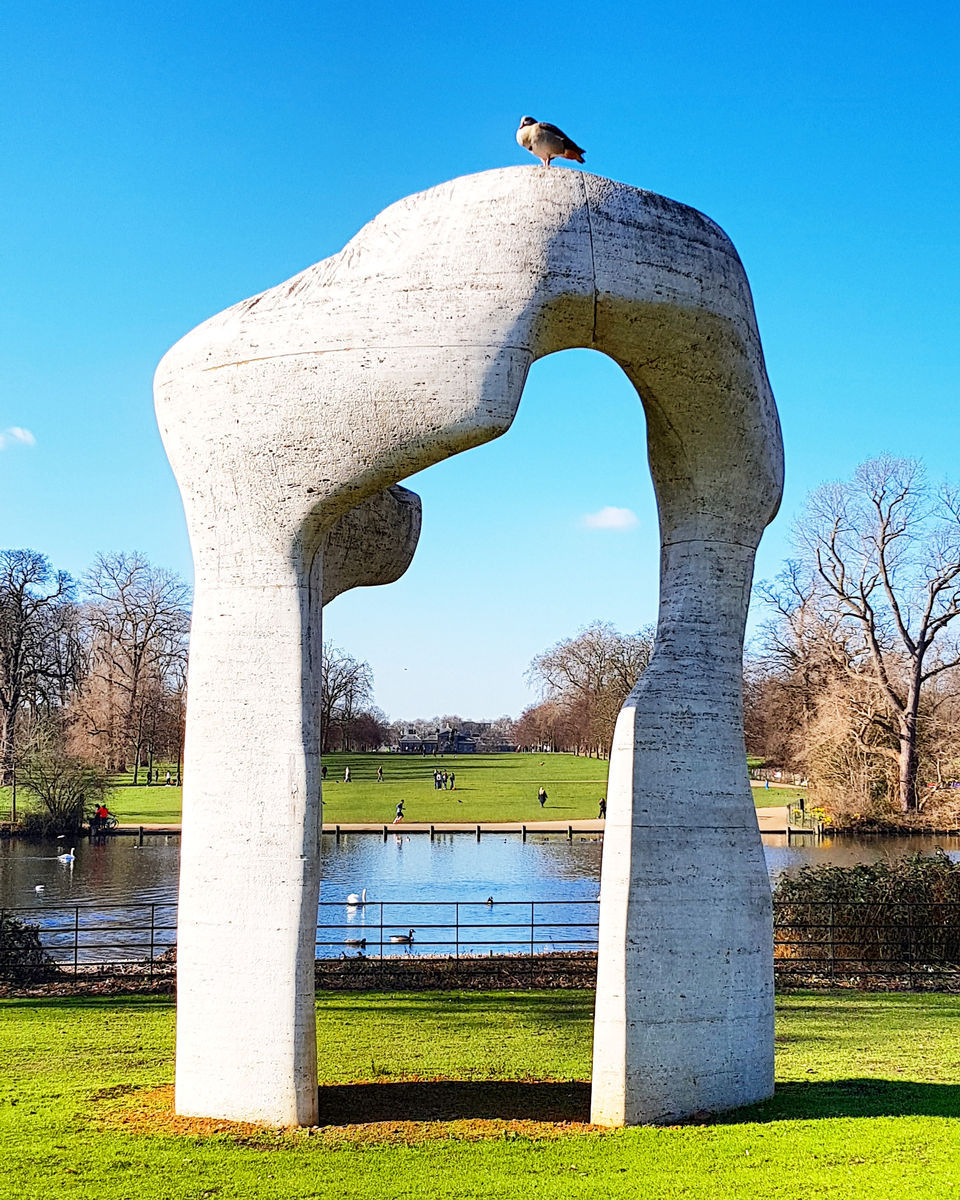
🗺️ Nearby: The Arch by Henry Moore is a 10-minute walk south along the Long Water. The Serpentine Gallery is close by. Kensington Palace is at the south end of the Broad Walk.
*All photos were taken by Ina / WithinLondon.
_____________________________
Did you enjoy this article? Great! If you'd like to contribute to the running costs of WithinLondon, click the button below:


Comments