Stow-on-the-Wold in Autumn

Updated: Sep 9
I got to Stow-on-the-Wold just after half past eight in the morning, before the coach parties, before the antiques shops had unlocked their doors, when the only sound on the market square was a single delivery van idling outside the wine bar. The sun was still low enough to lay itself flat along the stone, turning the honey-coloured fronts of the buildings the colour of the inside of a digestive biscuit, and every doorstep on the street I'd parked on was ankle-deep in leaves that nobody had swept yet.
A beech tree hung over the pavement outside an estate agent's window, still half green, half gone the colour of an old brass doorknob, dropping leaves onto my shoulders as I walked under it. I'd come to Stow before, in the flat grey light of a January afternoon, and it had felt like a postcard someone had left out in the rain. This time, in late October, it felt like the postcard had been switched on.
The Highest Town in the Cotswolds
Stow-on-the-Wold sits at nearly 800 feet above sea level, which doesn't sound like very much until you've stood in the market square with the wind coming at you from four directions at once and understood exactly why the old rhyme calls it "Stow-on-the-Wold, where the wind blows cold." It's the highest town in the Cotswolds, perched at the point where several ancient roads cross, including the Fosse Way, the die-straight Roman road that runs from Exeter to Lincoln.
That crossroads position is really the whole reason Stow exists in any recognisable form: a town founded, so far as anyone can tell, in the eleventh century on the site of an Iron Age hillfort, built for people and animals passing through rather than for people staying put. For centuries, what passed through Stow was mostly sheep.
The Cotswolds grew fat on wool in the medieval and early modern periods, and Stow's market square became one of the great sheep fairs of England, held twice a year under a royal charter. Daniel Defoe, writing in the early eighteenth century, reported that as many as twenty thousand sheep might change hands here in a single day.
If you want a sense of scale, that's not twenty thousand sheep dotted around a field — that's twenty thousand sheep funnelled through a market town built for a fraction of that number, driven in along the narrow alleyways that still thread off the square, alleys locals call "tures," purpose-built centuries ago for herding livestock and now just handy shortcuts between the shops. Stand in one of those tures on an autumn morning, walls close enough to touch on both sides, ivy gone red overhead, and it isn't hard to imagine the noise and the wool-grease smell of a market day two hundred years gone.

The Market Square and Its Stocks
Everything in Stow still radiates outward from that square, which is less a square than an elongated, slightly lopsided open space lined with golden-stone townhouses, most of them dating from the eighteenth and nineteenth centuries even though the buildings behind their Georgian fronts are often a good deal older.
There's a market cross near one end, put up, tradition says, as a reminder to traders to deal honestly with one another — a fair-trading totem long before the phrase meant anything to do with coffee. And there are stocks, the actual wooden stocks, still standing on the green, a solid, slightly absurd reminder that a town this pretty was once a place where minor criminals were pelted with rotten vegetables in public.
The Old Stocks Inn, one of the handsome old coaching inns facing the square, takes its name directly from them. In autumn the square does something particular with all that space: the low sun gets right into it in a way it can't in high summer, raking along the building fronts and pooling in gold on the cobbles, while the same wind that gives the town its nickname sends leaves skittering across the stones in drifts.
I watched them catch against the base of the market cross and pile up against shop doorways like something arranged for a film set, except nobody had arranged it. It's simply what an exposed hilltop market square does to falling leaves every October, and has done for a very long time.

The Battle of Stow-on-the-Wold
The square has seen worse than weather. On the morning of 21 March 1646, this quiet gathering place was the site of the last pitched battle of the First English Civil War. A Royalist force of around three thousand men under Sir Jacob Astley, trying to fight its way through to reinforce the king at Oxford, was intercepted on a hill just outside town by a Parliamentarian army under Sir William Brereton.
The fighting began uphill and went badly for the Royalists from early on; when Brereton's cavalry broke their lines, what had been a battle became a rout, with Royalist soldiers fleeing down into Stow itself and through its streets, the fighting spilling into the very lanes I'd been walking that morning.
Something like two thousand Royalists were killed, wounded or captured, against negligible Parliamentarian losses, and the survivors were marched into St Edward's Church, which served as a makeshift prison for the defeated men — you can still see damage to the stonework that's said to date from the skirmish.
It was in the market square itself, according to local tradition, that the exhausted Sir Jacob Astley finally sat down on the base of the market cross and delivered his surrender with a weary, oddly gracious line to his own men: "You have done your work, boys, and may go play, unless you fall out among yourselves." Six weeks later King Charles surrendered to the Scottish army at Newark, and the war, in its first phase, was effectively over.
It's a strange thing to stand in a market square full of tea shops and gift shops and think about two thousand men fighting and dying on the hill just above it, but that's the layering that a town this old carries around without much fuss — the stocks and the antiques shops and the battlefield all occupying the same quarter mile.
St Edward's Church and the Doors of Durin
A short walk from the square, tucked behind buildings in a way that makes you stumble on it rather than approach it head-on, is St Edward's Church, the building that gave the town its original name of Stow St Edward. Its north door is the single most photographed thing in Stow, and deservedly so: an ancient, iron-studded wooden door set into a stone porch, with two yew trees planted so close on either side that over roughly three centuries they've grown to frame the doorway like a pair of gnarled, patient sentries, their trunks folding around the stonework as though the door had grown up between them rather than the other way round.
It is, without question, one of the most atmospheric church entrances I've ever stood in front of, and I understand completely why it has acquired the nickname the "Tolkien Door." The story goes that J.R.R. Tolkien, who spent fourteen years as a professor at Oxford and is known to have explored the Cotswolds, saw this door and used it as the inspiration for the Doors of Durin, the moonlit, ivy-covered entrance to the Mines of Moria in The Lord of the Rings. I want to be honest about this rather than just repeat it as fact, because it deserves that honesty: nobody has ever authenticated the connection.
There's no diary entry, no letter, no direct quote from Tolkien himself confirming it. It survives as local legend, a lovely and entirely plausible one given the timelines and Tolkien's known habits, but a legend all the same, and every guide to the church that deals with it honestly says so in roughly those terms. What isn't legend is the way the door looks on an autumn afternoon, when the yews are at their darkest green against gold leaves scattered across the porch floor, and the low light barely reaches into the recess where the door itself sits in permanent, cool shadow.
You don't need Tolkien to find it magic. It would have felt like the entrance to somewhere else entirely even if no one had ever written a word about it.

The Particular Magic of Stow in Autumn
I've now seen Stow in three seasons and I'll say plainly that autumn is when it stops being merely handsome and starts being genuinely moving. Part of it is simple colour: this is a town built almost entirely from a warm, biscuit-gold limestone, and for about six weeks a year that stone gets to stand next to leaves in every shade that competes with it rather than clashes — the acid yellow of a Virginia creeper starting to turn, the full crimson of the same vine three weeks later, when it's gone from decorating a wall to nearly consuming it.
I found a doorway on one of the back streets, a soft grey door with a hand-painted sign reading Stow House, wearing a cascade of creeper that had turned every shade from green through gold to a deep wine-red, all on the same plant, all in the same frame. A few doors along, a green front door at Park Cottage sat under a canopy of ivy gone entirely butter-yellow, with stone urns either side gone rusty with age and scattered with the first fallen leaves.
Neither of those doors would earn a second glance in June. In late October they stop you dead. Part of it, too, is the quality of the light itself. Because the town sits so high and so exposed, autumn sun comes in low and stays low, even at what should be the middle of the morning, so it rakes along stone facades instead of falling flatly onto them, throwing every gap between the stones into relief and setting the honey-coloured fronts properly glowing rather than just sitting there being pretty.
And then there's the quiet. Stow can get busy in summer, coach parties and all, but come on a weekday morning in autumn and you get long stretches of the square and the side streets almost entirely to yourself, just you, the leaves, and whoever is unlocking the shop three doors down. Walking past The Bell, one of Stow's old ivy-covered inns, with its Virginia creeper gone fully red against the grey stone and its picnic tables sitting empty in the cold, waiting for lunchtime, I had the strange sense of having the whole town lent to me for an hour.
That's the autumn trade-off here: you give up the long evening light of summer, and in exchange you get streets you can actually feel, and a stillness that makes the history — the sheep fairs, the battle, the church, all of it — feel closer rather than more remote.

Antiques, Independent Shops and Autumn Afternoons
Stow has been a shopping town for as long as it's been a market town, just with the merchandise changed from fleece to furniture. It's one of the great antiques centres of the Cotswolds, its narrow streets lined with dealers specialising in everything from serious eighteenth-century furniture to smaller, more affordable curiosities, alongside independent galleries and boutiques that have quietly filled in the gaps between them.
I ducked into Artysan Cotswolds, a shop just off the square with a deep plum-purple frontage and a hare on its hanging sign, its mullioned windows stacked with lamps, framed prints and cushions, olive trees in pots either side of the door and the last of the summer's bedding plants still flowering defiantly against the cold.
Farther along, The Cotswold Farm — part farm shop, part kitchen café — had spilled its produce out onto the pavement in wooden crates: courgettes, tomatoes, a small mountain of oranges, and a bundle of carrots with the leaves still on, tied with string like something from an illustration rather than a shop.
A vintage red three-wheeler, all polished chrome and open cockpit, was parked outside as though it had trundled straight out of the 1930s to do the morning shopping, and it summed up something true about Stow: the past here isn't roped off in a museum case, it's parked on the double yellow lines.
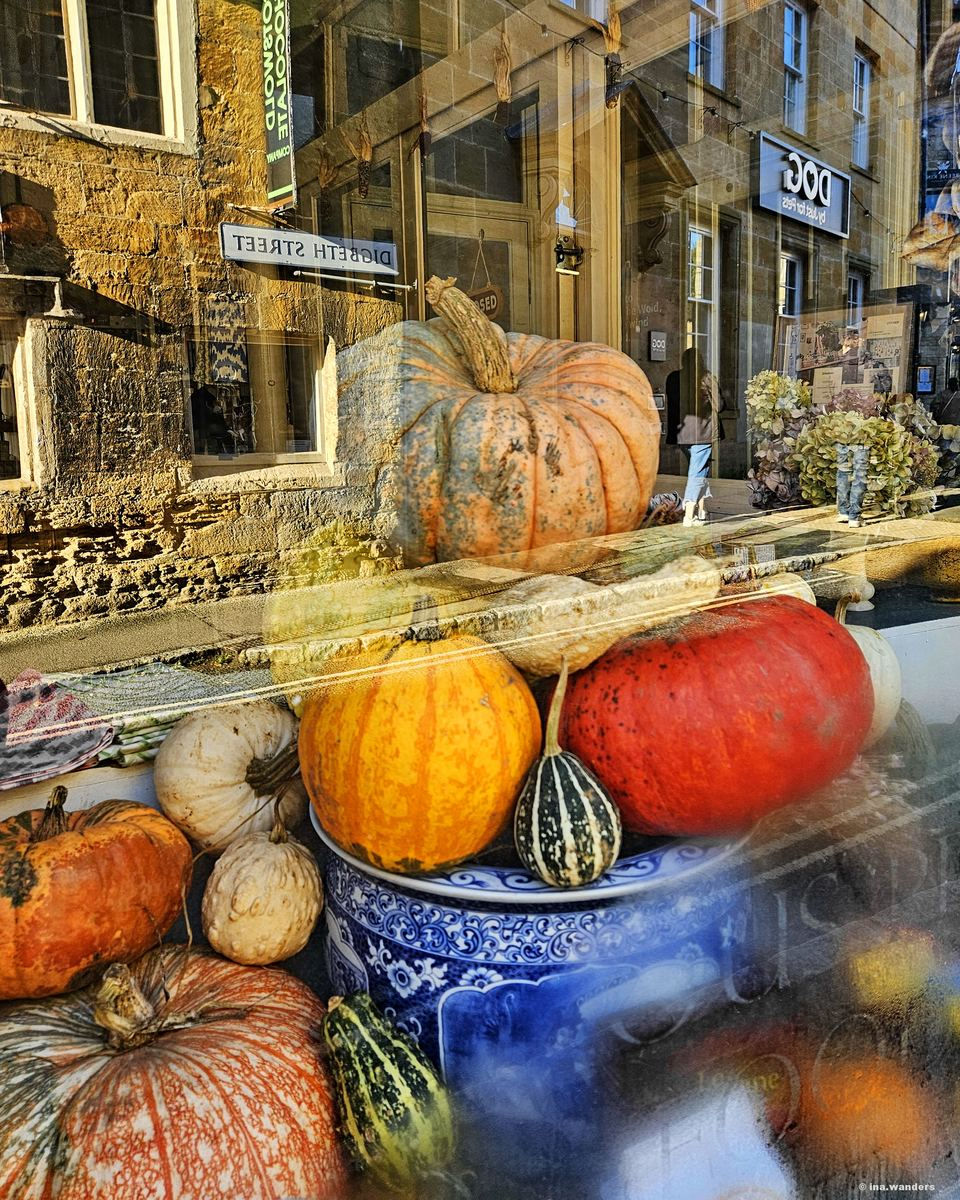
A few doors down, a shop window on Digbeth Street had gone all-in on the season, stacking heirloom pumpkins and gourds in a huge blue-and-white china bowl — a great warty orange one, a squat white one, a striped green gourd no bigger than a fist — with the street and its stone frontages reflected in the glass behind them, so that autumn and antiques photographed themselves in the same frame without any help from me.
This is the real, easily overlooked pleasure of shopping in Stow in autumn: nobody is rushing, the light is doing half the work of making everything look good, and a fifteen-minute browse for nothing in particular turns into an hour without your quite noticing.
Visiting Stow-on-the-Wold in Autumn
Stow-on-the-Wold sits roughly ninety miles northwest of London, and if you're driving, budget around two to two and a half hours depending on traffic, generally out via the M40 and across on smaller roads through the Cotswolds themselves, which is honestly no hardship — the last stretch of the drive is a scenic prelude in its own right.
If you'd rather not drive, the easiest route by train is to Moreton-in-Marsh, which has a direct service from London Paddington taking around ninety minutes; from there it's a short taxi ride or a Pulham's Coaches bus into Stow itself, about four miles away. For colour, aim for late October into early November — that's when the Virginia creeper on the older stone buildings turns from green through gold into a full, saturated crimson, and when the beeches and horse chestnuts around the square and along the churchyard path are at their most golden.
Go early: I'd get there for opening time on a weekday if you can manage it, both for the low, raking light that makes the stone glow and for having the square largely to yourself before the day's visitors and coach parties arrive. Bring a proper coat regardless of what the forecast says for the rest of the county — the town's nickname is not decorative, and the wind at 800 feet feels different from the wind in the valleys below it.
Once you're there, it's easy to build a full day around Stow and its neighbours: Bourton-on-the-Water is a gentle walk or a short drive away, its willow-lined river especially handsome with autumn colour reflected in the water, and the Slaughters — Upper and Lower — are close enough to combine in the same afternoon if you don't mind a slightly longer detour.
All of it sits within a few miles of Stow's hilltop, which makes the town less a single stop than a natural base for a day of exactly this kind of amber-lit, leaf-scattered wandering, before the light drops early, as it does this time of year, and everyone heads back inside to somewhere warm.
_______________________
Did you enjoy this article? If you'd like to contribute to the running costs of WithinLondon, click the button below:
All photos were taken by Ina/WithinLondon, unless stated otherwise.


Comments