Autumn in the Cotswolds: The Prettiest Villages and When They Turn Gold

Updated: 3 minutes ago
The first time I drove into the Cotswolds in late October, I had to pull over. Not for anything dramatic. A lime tree had dropped what looked like its entire year's work onto a stretch of pavement in Bourton-on-the-Water. Someone had already been out with a broom, and the leaves had come straight back down again. The whole thing was so yellow it looked staged.
I have been back every autumn since. The Cotswolds in summer are lovely and completely mobbed. In autumn they do something better: the honey-coloured limestone that these villages are built from stops being merely pretty and starts having a conversation with the trees. Everything is in the same register. Gold walls, gold leaves, low gold light by four in the afternoon.
This is what I have learned about where the colour actually is, village by village, and roughly when to turn up. All the photographs here are mine, taken across several autumn visits. What you see is what I saw rather than what a tourist board wishes you would see.

When Do the Cotswolds Turn Gold?
The honest answer is that it moves every year, and anyone who gives you a fixed date is guessing. But the pattern is reliable enough to plan around.
September is the quiet month. The children are back at school, the villages empty out, the weather is often still generous with average highs around 18C, and the countryside is essentially still green. It is a wonderful time to walk and a poor time to photograph autumn colour.
October is when it happens. Temperatures drop to somewhere between 7C and 14C, daylight shrinks to nine or ten hours by the end of the month, and mist starts collecting in the valleys on the cold mornings. It is also the wettest month, which I have made peace with. Most Cotswolds sources point at mid to late October as the sweet spot. The beech woods along the escarpment near Cranham and Painswick typically peak in that window.
Then there is the southern-England caveat, which catches a lot of visitors out. Warmer nights down here mean the leaves hang on to their green longer than they do in Yorkshire or Northumberland. The brightest colour in this part of the country often lands in the last weeks of October and pushes into early November. Cool nights in early November can stretch the display further, particularly in sheltered valleys.
My own rule: aim for the last week of October, accept that you might be a week early or a week late, and take the weather you get. Some of my favourite photographs here were taken on grey, damp, thoroughly unpromising days. Wet stone and wet leaves are more saturated than dry ones.
One practical warning. Mid to late October is half term. Prices climb, cottages book out, and the road to Westonbirt Arboretum at weekends is its own special kind of misery. Midweek if you possibly can.

Is Bourton-on-the-Water Worth Visiting in Autumn?
Bourton is the village everyone tells you is too busy, and in August they are right. In late autumn it is a different place. The coach parties thin out, the Windrush runs clear and shallow under those low stone footbridges, and the trees along the green put on the best show of any village in this guide.
The big beech by the green is the one to find. It goes a deep rust-orange and holds its leaves long enough that you get the double effect: colour above and a thick carpet below, with people crossing the bridges through the middle of it.

Walk fifty yards to the road bridge, and you get the other version of the same tree. The arched bridge, the water running underneath it, the ironmongers and the gift shops on the far bank, and that canopy sitting over the whole scene like a lid.

What I actually like most about Bourton in autumn, though, is the domestic stuff. The red phone box and the red pillar postbox standing in leaves halfway up their bases. The bakery on Sherborne Street putting up pumpkin bunting in late October. A cocker spaniel installing itself in the doorway with the air of an animal who has done this before and expects to be fed.

If it rains, the Cotswold Motoring Museum and Birdland are both in the village, and Birdland's penguins do not care about the weather. Go early. Bourton wakes up slowly, and the light on the water before ten is worth the alarm.
What Does Burford Look Like in Autumn?
Burford is built on a slope, which is the whole point of it. The high street runs down towards the Windrush, and every view is a view of roofs: stone tiles, moss, brick chimneys, television aerials nobody has bothered to hide, all stepping down the hill in layers.
In autumn the beeches and limes along the upper part of the town frame that view. Stand near the top and shoot down through the branches and you get the layered thing that Burford does better than anywhere else round here.
It is also, and I say this with affection, a village where you will be outnumbered by dogs. On my last visit, an elderly woman came past under the limes with two basset hounds moving at the precise speed bassets move, which is to say barely. It felt like the Universe stopped for a second to tell me the leaves were late this year.

The high street has proper shops rather than only gift shops, which makes it a better place to actually spend an afternoon than some of its more famous neighbours. The Tolsey, the little Tudor building on pillars halfway down, is a free museum open on afternoons from April to October. I have a separate Burford and Witney day trip if you want the town in spring.
Where Is the Best Autumn Colour in Northleach?
Northleach is the one everybody drives past. It sits just off the A429 between Bourton and Cirencester, most people take the bypass, and as a result it has kept something the honeypot villages have lost.
It also has, in my opinion, the single most spectacular piece of autumn colour in the Cotswolds, and it is not a tree. The Wheatsheaf Inn's entire stone frontage disappears under Virginia creeper. In the third week of October that creeper goes a red so deep and so total that the building reads as one solid block of crimson with a black pub sign hanging off it.

Come round the side and the creeper is a different plant altogether. Red at the top, orange and yellow lower down, the windows peering out of it, and the inn's blue sign bolted to the wall. Two visits a fortnight apart give you two different buildings.
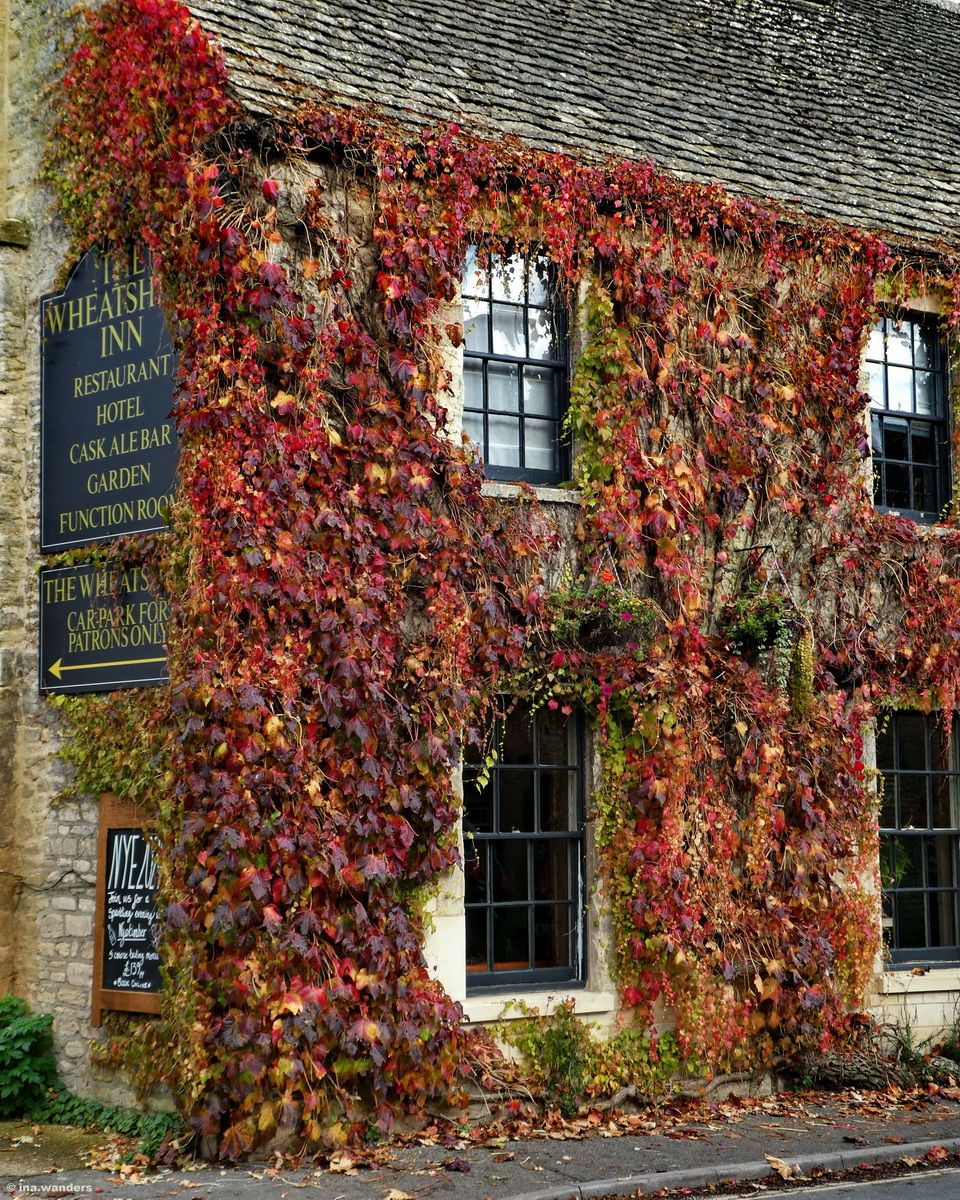
It is not the only one. There are cottages along the same street with the same treatment, running red through orange into purple, all of it against that pale limestone and, if you are lucky, a hard blue autumn sky.

Northleach also has one of the great wool churches, St Peter and St Paul, worth twenty minutes for the brasses alone. And the market square is genuinely quiet, which after Bourton on a Saturday feels like a form of hospitality.
Is Bibury Busy in Autumn?
Bibury has a reputation problem caused entirely by being too photogenic. Arlington Row gets the attention and the crowds and the parking chaos, and it deserves the first of those. The row was built around 1380 as a wool store for the abbey and turned into weavers' cottages in the seventeenth century, and the National Trust owns it now.
But the bit I go back for is the Swan, sitting where the road bends over the River Coln, with creeper turning the whole frontage red and a small island garden in front of it. In October there are still deckchairs out on that island, striped and hopeful, which I find quietly funny given the temperature. The Coln itself runs so clear you can count the weed on the bottom.

Late in the day the sun comes in low from the west and lights the Swan's dormers and the creeper under them, while the trees behind the roof are already in shadow. That is the ten minutes to be standing on the bridge.

Look up as you pass. There is a carved stone scallop-shell hood over one of the doorways, weathered and lichened, framed by creeper on one side and dark ivy on the other. Nobody photographs it because everybody is facing the other way at the cottages.

One serious practical note: Bibury is the hardest of the famous villages to reach without a car. There is no Sunday bus and no realistic train approach. Plan accordingly. The trout farm by the bridge has been there since 1902 and is open all year if you need somewhere to put children.
What Is Stow-on-the-Wold Like in Autumn?
Stow sits high and gets the weather first. On a cold bright morning in late October the chimneys are going, and the smoke sits in the air because there is no wind up there to move it. The creeper on the cottage walls has gone red against a completely clean blue sky. There are also wheelie bins in shot, because it is a real town where people live, and I have decided I like that about it.

The pubs on the square do the same trick on a bigger scale. One of them has creeper over its entire gabled front, going from green to red in patches. Picnic benches and folded umbrellas sit out on the pavement in the sun as if it were still August.

Stow deserves more than a paragraph, and it has one: I wrote about it properly in a separate autumn piece, including the pumpkins and the best of the antique shops. Here I will just say that the doors are the thing. Stow House in particular, with its pale grey door and the creeper above it turning yellow and pink and red all at once. Leaves pile up on the step faster than anyone can sweep them.

Which of the Slaughters Is Better in Autumn?
Lower Slaughter is the one on the postcards. The River Eye runs through the middle of it, more stream than river, with little stone footbridges and the old mill's brick chimney at the far end. Everything is within two hundred metres of everything else.
The colour here is on the walls again. Cottages along the river have creeper going scarlet around their doors, and the fallen leaves collect on the brick paths and the iron gates. The mill itself closed as a museum and café and has been under renovation since, with only a kiosk at the gate, so do not plan lunch around it.

Then there is Upper Slaughter, a mile up the river on foot and four minutes by car, with almost nobody in it. The village has no shop and no pub, and famously lost no men in either world war, one of the very few doubly Thankful Villages in England.
The cottages are steep-gabled and tall-chimneyed, the sort of stone that goes almost white in low sun, with beech leaves piling against the dry-stone walls.

What it also has is a doorway I think about more than is reasonable. A dark green door, reached through an archway cut into a beech hedge that goes pure gold in late autumn, box balls either side of the path. On the iron gate, a small sign reading CAUTION! Fragile Wall and Gate, which is the most Cotswolds sentence ever committed to metal.

Walk between the two along the Eye and then on to Bourton on the Wardens' Way. It is about a mile and a half from Lower Slaughter to Bourton, flat, and mostly beside water.
Is Castle Combe Worth the Detour in Autumn?
Castle Combe is the outlier here. It is in Wiltshire rather than Gloucestershire, at the southern end of the Cotswolds, and it is the village that wins every prettiest-in-England poll. I have written about it on a spring morning, when the point is the stream and the packhorse bridge. In late October the point is the Manor House.
The Manor House is a hotel now, a fourteenth-century manor with gables and tall chimneys at the top end of the village. Its whole front disappears under Virginia creeper. In the last week of October that creeper goes from green through orange to a red so dense that the stone only shows at the window frames.

Walk round to the side and it gets better. One wing has been swallowed completely, deep crimson from the lawn to the roofline, with a few windows looking out of it like eyes. Against a blue sky it is the single most saturated thing I have photographed in the Cotswolds, and I say that having stood in front of the Wheatsheaf at Northleach.

The village below it does autumn more quietly. The lane along the top has a dry-stone wall on one side and a beech going gold on the other. The fallen leaves lie undisturbed on the path because so few people walk up there. Everyone is at the bridge.

And there is a red pillar box, because there is always a red pillar box. This one is being slowly eaten by a vine that turns yellow in October, so the red shows through a screen of leaves. Go early on a weekday. Castle Combe has one small car park at the top of the hill and no room for anything else.

How Do You Photograph Cotswold Autumn Colour?
A few things I have worked out, mostly by getting them wrong first.
Grey days are not wasted days. Overcast light is even, it saturates red creeper beautifully, and it removes the harsh shadows that stone buildings throw in bright sun. The photograph of the phone box in the leaves at the top of this article was taken in drizzle.
Wet ground is your friend. Rain darkens tarmac and stone, which makes fallen yellow leaves pop in a way they simply do not on a dry day. If it has just stopped raining, go out immediately.
Shoot the walls, not only the trees. The Cotswolds' distinctive autumn feature is Virginia creeper on limestone, not woodland. That is what makes a picture here look like here and not like Vermont.
Get low with fallen leaves. Standing at eye level and pointing down flattens a leaf carpet into nothing. Crouching turns it into a foreground.
Go before nine or after four in late October. The days are short enough by then that golden hour arrives at a civilised time, and the villages are empty at both ends of it.
And look behind you. Half the things in this article, the shell doorway, the beech archway, the smoking chimney, were found by turning round while everyone else was pointing at the famous thing.
Visiting the Cotswolds in Autumn: Practical Notes
🚉 Getting there: The Cotswold Line runs direct from London Paddington through Hanborough, Charlbury, Kingham and Moreton-in-Marsh, roughly hourly. Moreton-in-Marsh is about an hour and thirty-five minutes and the best base without a car; the Pulhams 801 bus runs from the station to Stow in about twenty minutes and Bourton in about thirty. Driving is two to two and a half hours to the northern villages, depending on the M40.
🎫 Cost: The villages are free. Advance train fares released about twelve weeks ahead can start around £15 to £20 one way, against a walk-up fare of roughly £42. Westonbirt Arboretum charges £19 to £22 for adults in the autumn colour season.
Getting between villages: On Wednesdays and Fridays the Villager Bus links Burford with Bourton-on-the-Water, Stow-on-the-Wold, Chipping Norton and Kingham. Outside those days, and for Bibury and Northleach in particular, a car makes life very much easier. Bibury has no Sunday service at all. Park at the edges and walk in; in Bourton the parking is competitive.
📷 Best time to go: Late October for peak colour, with a fallback into the first week of November. September for empty villages and green trees. Avoid half-term weekends if crowds bother you, and check the Westonbirt and Batsford arboretum websites before committing, since they post updates on where the colour actually is.
⏳ How long to allow: Two villages a day is comfortable, three is a rush. Bourton and the Slaughters make one day on foot; Northleach and Bibury a second by car; Burford and Stow a third.
What to pack: October is the wettest month here and the light goes early. Waterproof shoes, a warm layer for the moment the sun drops behind a wall, and more memory cards than you think you need.
🗺️ Nearby: Westonbirt Arboretum near Tetbury is the region's headline autumn attraction with over 2,500 tree species, and Batsford near Moreton-in-Marsh is the quieter alternative. For woodland walks, Lineover Wood and the beech hangers above Painswick are hard to beat in the second half of October. On the Oxfordshire edge, Bampton is worth a detour for anyone who watched Downton Abbey.
The Cotswolds do not need autumn to be beautiful. But autumn is when the buildings and the trees finally match, and that is worth planning a trip around.
_______________________
Did you enjoy this article? If you'd like to contribute to the running costs of WithinLondon, click the button below:
All photos were taken by Ina/WithinLondon, unless stated otherwise.


Comments