Minchinhampton: The Cotswold Common Where Cattle Roam Free

Updated: Sep 9
Minchinhampton is one of those Cotswold towns that rarely makes the postcard racks, and I suspect the locals are quietly relieved about that. Perched on a plateau above the Golden Valley in Gloucestershire, a few miles from Stroud, it has a handsome market square and a proper working high street.
Its genuinely famous feature? Several hundred acres of open common where cattle and horses wander freely among the golfers, dog walkers, and picnicking families as though the whole arrangement were the most normal thing in the world. It is not, in the usual sense.
I spent an afternoon there and came away thinking it might be the most understated brilliant place I have visited in the Cotswolds all year: unshowy stone architecture, a proper bakehouse café worth queuing for, and a common so strange and lovely that it alone justifies the trip.
Henry's Bakehouse and Market Square
Minchinhampton's Market Square sits right at the heart of the town, framed by a mix of honey-coloured Cotswold stone buildings and a scattering of Georgian brick frontages that give the square a slightly different character from the more uniform stone terraces you find in towns like Winchcombe or Chipping Campden.
At one corner sits Henry's Bakehouse, a proper independent café and bakery with the kind of unfussy, well-used look that tells you it has been feeding the same regulars for years rather than chasing an Instagram aesthetic. I stopped in for a coffee and a pastry and ended up staying considerably longer than planned, watching the square's slow Saturday rhythm of dog walkers, delivery vans, and elderly residents stopping to chat in the doorways of the shops opposite.
The square itself still has a working market cross and enough genuine commercial life – a butcher, a pharmacy, a couple of independent shops – that it functions as an actual town centre rather than a heritage set piece. It is a smaller, quieter version of the market square you find in bigger Cotswold towns, and that smallness is very much the point: nothing here feels performed for visitors, which makes wandering it feel more like being let in on a secret than ticking off a sight.

Minchinhampton Common: Cattle, Golfers, and Ancient Earthworks
The single reason most people visit Minchinhampton, and the reason I did, is the common. Minchinhampton Common is around six hundred acres of open, largely unfenced grassland managed by the National Trust, and it has been common land – meaning local commoners hold ancient grazing rights on it – for centuries.
What that means in practice is one of the odder and more charming sights in the Cotswolds: cattle and sometimes horses wandering freely across the open grass, entirely unbothered by the golf course laid out around them, the walkers crossing their paths, or the cars occasionally threading along the roads that cross the common.
Nobody herds them anywhere in particular. They simply graze where they like, which on the day I visited meant a small group parked directly beside one of the golf course's fairways, watching a golfer line up a shot with what looked like polite disinterest.
Beyond the novelty of free-roaming cattle, the common is also a genuinely important landscape in its own right, dotted with Bronze Age barrows and the earthworks of an Iron Age hillfort known as The Bulwarks, along with sweeping views out over the Golden Valley toward Stroud.
It is a rare kind of place: a working golf course, a grazing common, a scheduled ancient monument, and a well-loved local dog-walking spot, all occupying the same open ground without any of those uses seeming to crowd out the others. Weekend mornings bring a steady trickle of joggers and cyclists crossing paths with the grazing animals, everyone moving around each other with the kind of easy familiarity that only comes from centuries of shared use.

A Cow on the Postbox
If the free-roaming cattle are Minchinhampton's headline attraction, the town's sense of humour about them shows up in smaller, more delightful ways too – my favourite being a black postbox in the town with a small hand-painted cow on its door, presumably added by a resident during one of the postbox-topper crazes that have swept English villages in recent years.
It is a tiny, unofficial piece of civic wit: a nod to the town's actual grazing common rendered in miniature on the door of a perfectly ordinary piece of Royal Mail street furniture, and it made me smile more than almost anything else on the visit.
Postbox toppers have become something of a local tradition across the country, often changing with the seasons or marking events, and finding one so specifically tailored to Minchinhampton's own identity felt like proof that the town knows exactly what makes it distinctive and is happy to have a laugh about it.
It is the kind of detail that rewards slow, aimless wandering rather than a quick drive-through – you have to actually be walking past at street level, looking at things rather than just through them, to catch it at all. Minchinhampton has quite a few of these small, specific, easy-to-miss touches scattered around its streets, and the postbox is as good a symbol as any of a town that takes its own quirks seriously without taking itself too seriously.

Rose-Covered Cottages and the Old School House
Away from the market square, Minchinhampton's residential streets are full of the kind of quietly handsome Cotswold stone cottages that never quite make it into guidebooks simply because there is so much competition for that honour across the region.
One in particular caught my eye: a former school house, its stone facade almost entirely obscured by a mature climbing rose in full bloom, pale pink flowers spilling across the wall and around the windows in a way that looked more like a deliberate cottage-garden set piece than an accident of good gardening.
Converted school buildings are a recurring feature of English village architecture – a reminder that most small towns once needed their own dedicated schoolroom long before children were bussed to larger consolidated schools – and Minchinhampton's version has aged into its second life as a private home with real grace.
It is worth taking the time to walk a few streets back from the market square rather than sticking only to the centre, because a lot of Minchinhampton's best small architectural moments are tucked away on quieter residential roads: a converted chapel here, a well-tended front garden there, stone lintels and mullioned windows on cottages that have clearly stood for a couple of centuries without ever needing to announce the fact.

The High Street: Hanging Baskets and Honest Stone
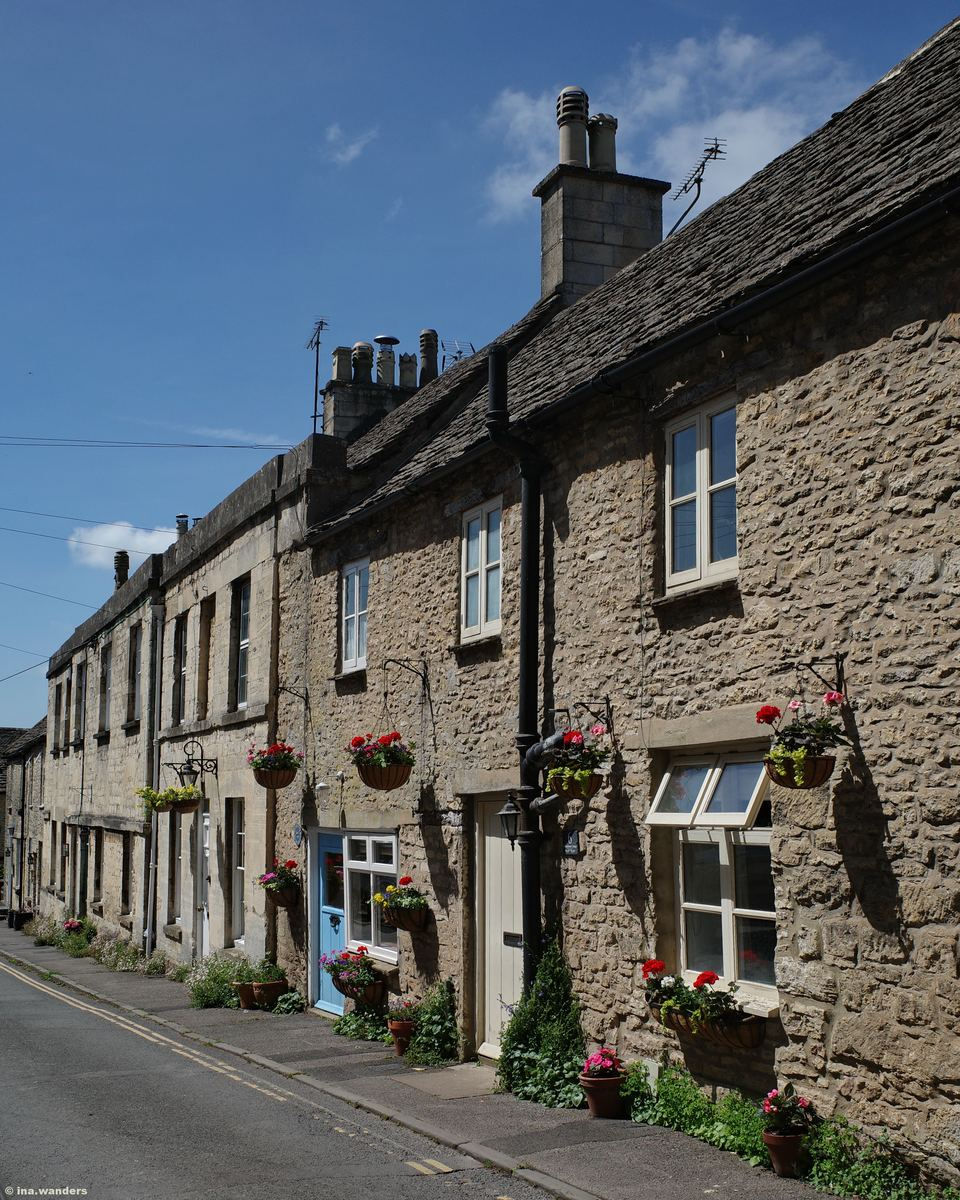
Minchinhampton's high street proper is a short, gently curving run of terraced stone cottages and small shopfronts, several of them dressed with hanging baskets and window boxes that were, on my visit, still holding onto the last of their summer colour.
It has a settled, unhurried feel that comes from being a town people actually live in rather than one that empties out the moment the day-trippers leave – washing lines visible in back gardens, cars parked outside front doors, a genuine mix of ages and dogs on the pavement rather than the more curated feel of some of the Cotswolds' more heavily visited villages.
What struck me most, walking the length of it, was how consistent the architecture is without ever feeling monotonous – the same warm limestone recurring window after window, doorway after doorway, but each cottage subtly different in its proportions, its roofline, its particular collection of pot plants by the front step. It is the kind of high street that rewards a slow, unplanned walk far more than a quick pass with a camera, and one of the better arguments I have come across recently for skipping the more famous Cotswold villages occasionally in favour of the quieter ones.
Visiting Minchinhampton: Practical Notes
Minchinhampton sits about four miles southeast of Stroud, which has the nearest railway station with direct trains to Gloucester and onward to London, so a short taxi or bus ride from Stroud is the easiest way to arrive without a car.
The common is free and open at all times, with several car parks along its edges, and it is worth allowing at least an hour to walk a proper loop of it if the cattle-spotting and Bronze Age earthworks appeal, longer if you want to combine it with a round of golf or a proper walk out toward the Bulwarks hillfort.
Give the town itself a further hour or two to wander the market square, high street, and back streets properly – it is a small enough place that you can see the highlights in an afternoon, but a relaxed one, not a rushed circuit.
Minchinhampton pairs naturally with a wider day out in this part of Gloucestershire – Stroud's Saturday farmers' market is one of the best in the region, and the wider Golden Valley offers plenty of walking routes if you want to turn the visit into a proper half-day ramble rather than a quick stop.
Whatever else you do, do not skip the common: free-roaming cattle sharing a golf course with dog walkers and Bronze Age barrows is not a combination you find very often, and it is worth the detour on its own.
_______________________
Did you enjoy this article? If you'd like to contribute to the running costs of WithinLondon, click the button below:
All photos were taken by Ina/WithinLondon, unless stated otherwise.


Comments