Maison Assouline: A Bookshop and Bar in Lutyens's Piccadilly Bank
Updated: 2 days ago
A black carpet covered in huge white letters and numbers. That was the first thing I looked down at, on a Saturday afternoon in February. Then I looked up, and kept looking up.
Above me was a white plaster ceiling, heavy with mouldings, and a row of tall windows letting in the grey winter light. Below it sat red leather benches, glass display cases and shelf after shelf of books far too big to read on the Tube.
This is Maison Assouline, the London flagship of the French-born publisher of luxury coffee-table books. It sits at 196A Piccadilly, in a small brick bank designed by Sir Edwin Lutyens. It is part bookshop, part cocktail bar, part gallery and part cabinet of curiosities.
I only have three photos from that afternoon. The building, though, has enough history for a much longer visit. So the bank, the street and the people behind the books matter as much as the shelves.
Maison Assouline on Piccadilly
Maison Assouline is a concept store run by Assouline, the publisher founded by Martine and Prosper Assouline. It opened in the autumn of 2014, the year the company turned twenty. It was the brand's first international flagship.
Inside you will find the full range of Assouline books, from travel titles to fashion monographs. There are also rare first editions, vintage objects and pieces from the brand's own furniture line. Behind the bookcases is Swans Bar, which serves cocktails, wine, coffee and small plates.
The shop describes its layout as two floors with a mezzanine. The mezzanine hosts monthly pop-up exhibitions on themes of art and culture. Private dinners and receptions also take place here, and the venue has hosted launches with luxury fashion houses.

The main hall is the old banking hall. It is double-height, which is why the ceiling feels so far away. The carpet with its printed letters and numbers looks almost like a page of type laid on the floor. For a publisher, that seemed a nice joke to me.
The red leather benches look very much like the classic Barcelona design, with that low, square, buttoned look. Scattered between them are display cases holding smaller objects, the kind you lean over rather than pick up.
Who Designed the Building at 196A Piccadilly?
The building was designed by Sir Edwin Lutyens for the London Joint City and Midland Bank, better known later as Midland Bank. The Survey of London records the agreement with Westminster City Council on 24 April 1922.
Another architect, Thomas B. Whinney, submitted the first designs. Lutyens was then brought in to design the elevations. Building work began in April 1923 and finished in January 1925. The builders were E. A. Roome and Co. of Hackney.
Lutyens is better known for the Cenotaph on Whitehall and for the government buildings of New Delhi. Here he worked on a far smaller scale. The Survey of London describes the bank as a cube roughly forty-two feet each way.
It has one main storey on a high base, with a low attic and a shallow pyramid roof of slate. On top is a ball and a weather vane. The walls are red brick with generous Portland stone dressings.
The site was a delicate one. The bank stands on the corner of the churchyard of St James's Church, designed by Sir Christopher Wren. Lutyens admired Wren enormously and called his own version of the style Wrenaissance.
According to Country Life, the bank's chairman Reginald McKenna backed the project personally. Lutyens looked to a sixteenth-century city gate for inspiration: the Porta San Zeno in Verona, by Michele Sanmicheli.
Portland stone was proposed at first, but Lutyens chose red brick to sit alongside Wren's church. The original interiors included a Wrenaissance ceiling and a walnut staircase. The aim was to impress foreign visitors staying in West End hotels.
Historic England listed the building at Grade II* on 5 February 1970. The list entry praises its carved stone festoons under the first-floor windows and its rusticated arched entrance. It calls the whole thing a witty design for a relatively small building.
The bank did not stay a bank forever. In 2003, the Swiss gallery Hauser & Wirth opened its first London space in the building. It opened with a major installation by the American artist Paul McCarthy.
Hauser & Wirth closed the Piccadilly gallery in December 2013. Within a year, the Assoulines had taken over and turned the former banking hall into a bookshop and bar.
I find that sequence rather pleasing. Money, then contemporary art, then books and cocktails. The room has always been about things people want to own and look at.
The building also survived the Second World War next door to real damage. In 1940 a bomb fell in the churchyard of St James's and destroyed the rectory and vestry. Incendiary bombs burned the church spire and most of its roof. The church was restored between 1947 and 1954.
Who Are Prosper and Martine Assouline?
Prosper and Martine Assouline founded their publishing house in Paris in 1994. It began as a family business in the basement of their Paris flat.
Their first book was La Colombe d'Or, about the famous hotel and restaurant in Saint-Paul-de-Vence in the south of France. Prosper took the photographs, and Martine wrote the text.
In 1996 they launched the Mémoire series, small monographs on fashion houses and designers such as Chanel, Dior and Vionnet. The company moved its headquarters to New York in 2007. By 2020 it had published more than 1,700 titles.
Their books are made to be displayed as much as read. Heavy paper, cloth covers, big photographs. Some special editions are handmade and cost thousands of dollars. Walking along the shelves at Maison Assouline, it felt a little like standing inside one of their books.
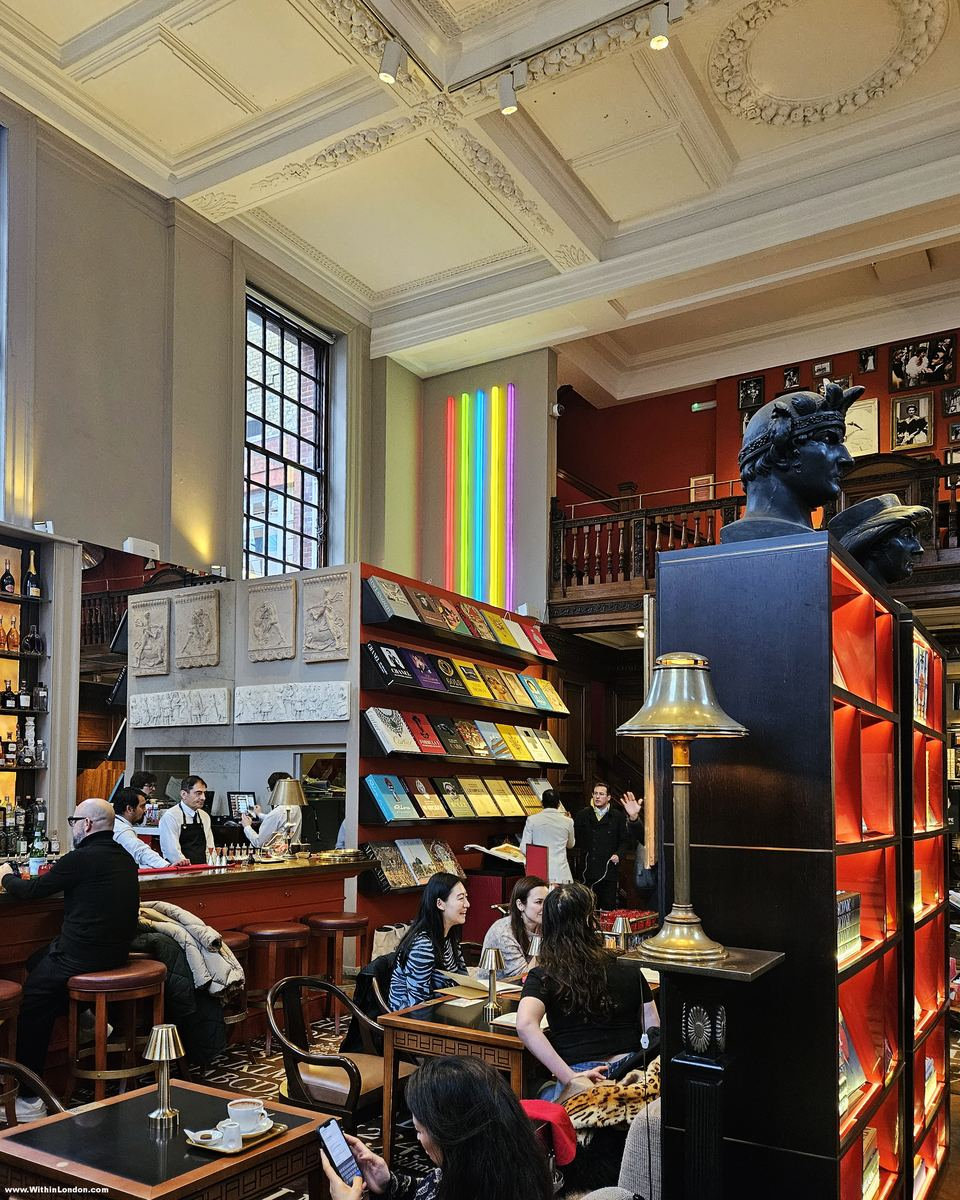
At the back of the shop, the mood changes. The lighting goes lower and warmer. On the afternoon I visited, people were sitting on stools at the bar and at small round tables. Above them, the gallery level had deep red walls.
A strip of rainbow light ran along one wall. On top of a bookcase sat a dark bust, and the inside of that bookcase glowed red. It is a very theatrical corner, and quite different from the pale hall at the front.
What Is Swans Bar, and Why Is It Called That?
Swans Bar opened with the shop in 2014. It takes its name from the swans, the nickname for a group of glamorous American society women of the 1950s and 1960s. The writer Truman Capote was their close friend and confidant.
The Assouline brand history gives the bar pride of place and links its style to the Jet Age. Cocktails are named after destinations and after Assouline books. The publisher has even printed a book called Swans Bar, full of its recipes.
One London guide, Londonaire, notes that the bar takes up more floor space than the shop itself. It also mentions a list of around seventy whiskies. Menus change, so check the Assouline website before you go if you have a particular drink in mind.
It was a quick look around, a few minutes with the camera, and then back out into the Piccadilly crowds. Even so, several tables were taken that Saturday afternoon.
What Else Is Worth Seeing on This Stretch of Piccadilly?
Maison Assouline sits almost opposite Burlington House, home of the Royal Academy of Arts. I once wrote about the artists turning Piccadilly into an exhibition space, and this corner is right in the middle of that scene.
A few minutes' walk west is Fortnum & Mason, the grocer with the famous clock and the eau de nil hampers. Between the two is Hatchards, founded in 1797 and often called London's oldest bookshop.
Carry on past Fortnum's and, just before the Ritz, you reach The Wolseley at 160 Piccadilly. It went up in 1921 as a car showroom for Wolseley Motors. Its architect, William Curtis Green, took his lead from a bank building he had seen in Boston. It has been a café and restaurant since 2003. So one short stretch of Piccadilly holds a bank that became a bookshop, and a showroom that looks like a bank.
Right next door, through the gate in the churchyard, is Wren's St James's Church. Its foundation stone was laid in 1676 and it was consecrated on 13 July 1684. Inside is a marble font attributed to Grinling Gibbons.
The poet and painter William Blake was baptised in that font in 1757. So was Ottobah Cugoano, the African-born writer and campaigner against slavery. The church's own history page names them both.
And the name Piccadilly? It comes from a tailor. Around 1612 a man called Robert Baker built a house in Windmill Field. He had made his money selling piccadills, the stiff collars and decorative edges of the time.
His neighbours mocked his success, and a letter of 1636 already calls the house Pickadell Hall. The nickname outlived the house and gave its name to one of the most famous streets in the world.
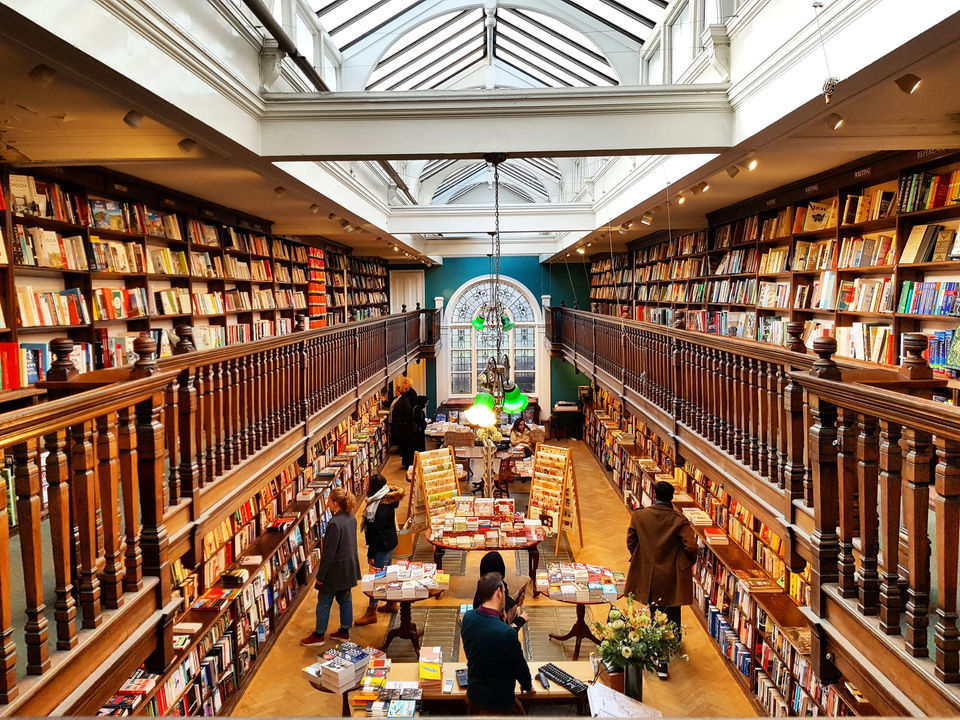
If you like beautiful bookshops, this stretch pairs well with a trip to Daunt Books in Marylebone, with its long oak gallery. For another historic building turned into something unexpected, Mercato Mayfair is a food hall inside a former church.
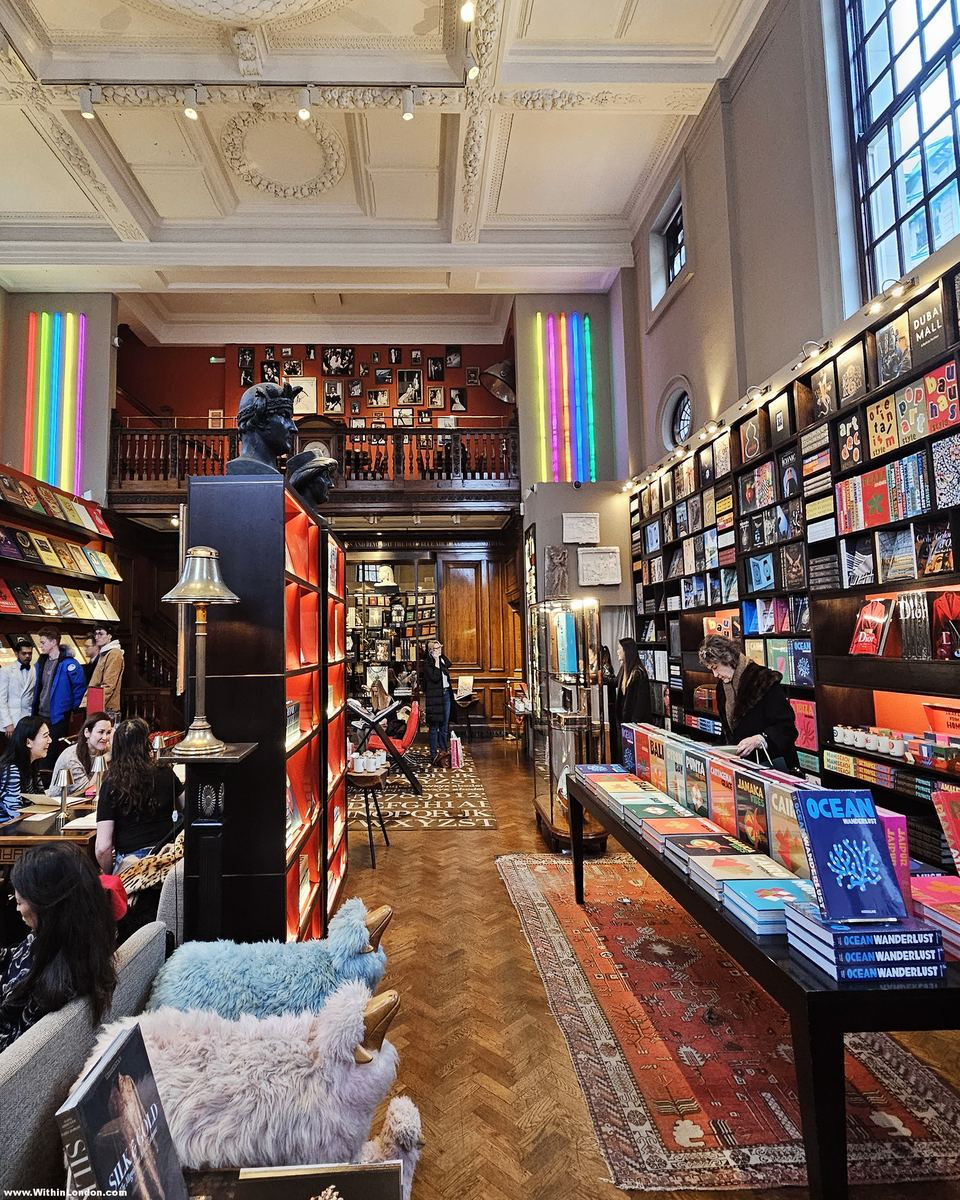
The shop has a quieter side too. Long walls of books, a table stacked with coffee-table volumes, and chairs softened with sheepskin throws. Persian rugs lie on a parquet floor. At the far end, more rainbow strips of light glow against the shelves.
Is Maison Assouline Free to Visit?
Yes. Maison Assouline is a shop, so there is no entry fee to walk in and browse. You pay only for what you buy or order at Swans Bar. The books are expensive, which is part of the point, but browsing costs nothing.
The pop-up exhibitions on the mezzanine change roughly every month. It is worth checking what is on before you go. For the bar, booking is sensible on busy evenings, and the venue can be hired for private events.
I think it works best as a stop within a longer walk along Piccadilly rather than a destination on its own. Pair it with the Royal Academy, St James's Church and a look at the bank's brick front from the churchyard.
Visiting Maison Assouline: Practical Notes
📍 Where: 196A Piccadilly, London W1J 9EY, on the corner of St James's churchyard, almost opposite the Royal Academy.
⏰ Opening: Monday to Wednesday 10.30am to 7pm, Thursday to Saturday 10.30am to 9pm, Sunday 12pm to 6pm (checked September 2026). Swans Bar hours can differ, so check the Assouline website.
📅 Open days: Open seven days a week. Hours can change for private events and holidays.
🎫 Admission: Free to browse. Drinks and food at Swans Bar are paid.
🚇 Getting there: Piccadilly Circus (Bakerloo and Piccadilly lines) is about five minutes' walk east. Green Park (Jubilee, Piccadilly and Victoria lines) is about ten minutes west. Many buses run along Piccadilly.
🚗 Parking: There is no parking at the shop. The area is inside the Congestion Charge zone, so public transport is much easier.
☕ Food: Swans Bar serves cocktails, wine, coffee and small plates inside the shop.
⏳ How long: Twenty minutes to browse, longer if you stay for a drink or an exhibition.
📷 Best time: A weekday morning for a quieter look at the banking hall. Step outside to see Lutyens's brick front from the churchyard.
🗺️ Nearby: Royal Academy of Arts, St James's Church, Hatchards, Fortnum & Mason, The Wolseley, Piccadilly Circus.
Have you ever stopped for a drink among the bookshelves at Swans Bar, or did the carpet of letters and numbers catch your eye first?
_______________________
Did you enjoy this article? If you'd like to contribute to the running costs of WithinLondon, click the button below:
All photos were taken by Ina/WithinLondon, unless stated otherwise.


Comments