Louis Vuitton Hotel London: Checked In to Mayfair

Inside the most talked-about pop-up in London, and why you need to visit before 21 June 2026.
There is a particular kind of magic that happens when a brand stops selling you something and starts making you feel something instead. Walking through the door of a Georgian townhouse on Berkeley Square in Mayfair, I wasn't expecting to feel that shift quite so immediately. But within moments of stepping inside the Louis Vuitton Hotel London, something clicked. This wasn't shopping. This wasn't an exhibition, either. It was something richer, more theatrical, and considerably more deliberate than either of those things. It was a world - one that Louis Vuitton has spent 170 years quietly constructing, and which has now, for a limited number of weeks, been given a physical address in one of the most storied postcodes in the capital.
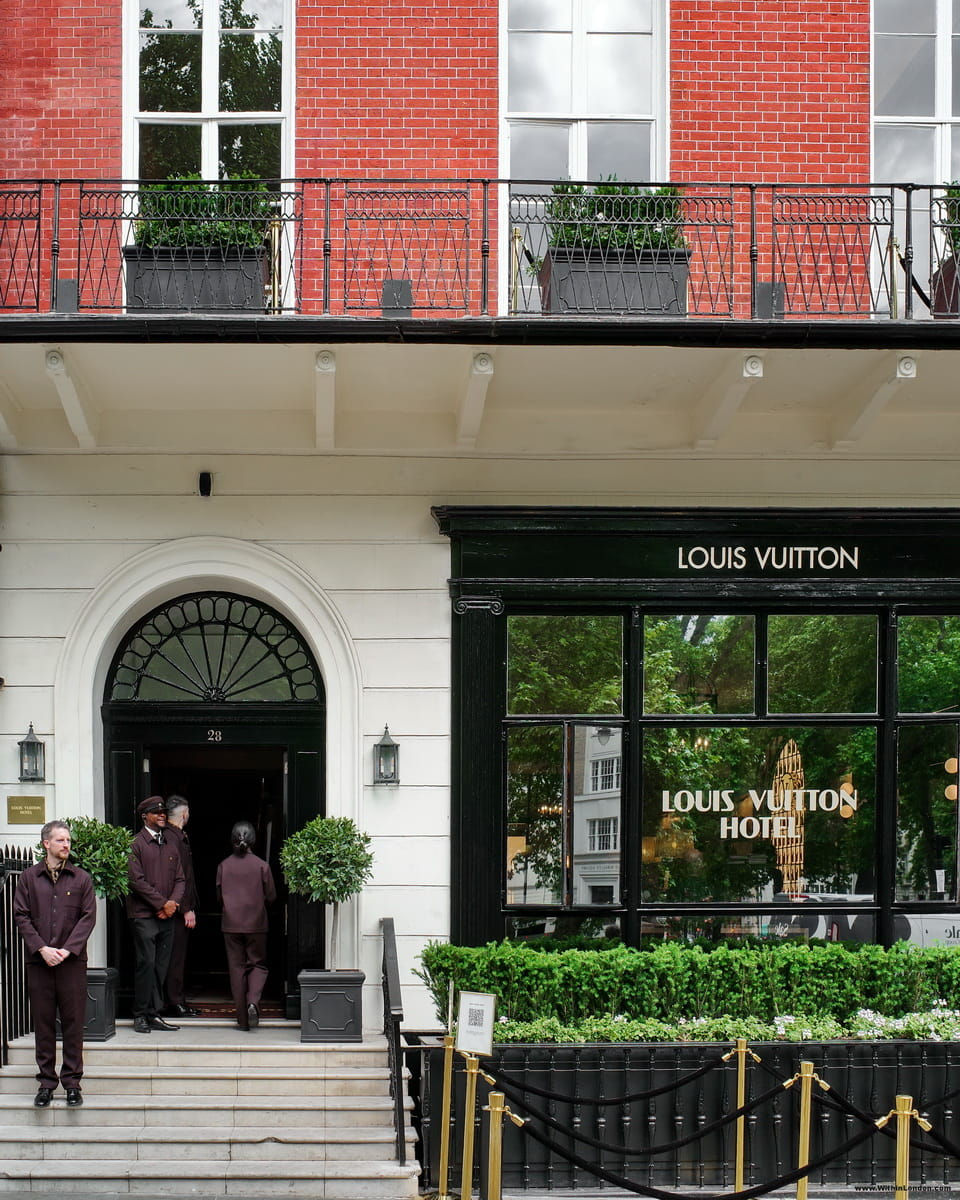
The pop-up runs until 21 June 2026 at 28 Berkeley Square, and if you haven't been yet, this is your sign to go. Reservations are recommended, though walk-ins are welcome, subject to availability. It is open Monday to Saturday from 11 am to 7 pm, and Sundays from noon to 6 pm - with Bar Noé staying open until 11 pm on Thursdays, Fridays, and Saturdays for those who want to extend the evening.
Why London, Why Now, Why a Hotel
To understand what Louis Vuitton is doing on Berkeley Square, you need to understand a bit of history - and the house has plenty of it. Louis Vuitton, the man, founded his workshop in Paris in 1854, initially as a maker of travel trunks. His genius was functional: he recognised that the traditional curved-lid trunk couldn't be stacked on the roofs of carriages and trains, so he designed flat-topped ones that could. In an era defined by the expansion of rail travel and early transatlantic crossings, it was a masterclass in reading the moment.
His son Georges took the brand international, opening the first London boutique in 1885 - making this city the site of Louis Vuitton's very first step outside of Paris. That historical footnote matters here because the choice of London for the only European iteration of the Hotel pop-up isn't arbitrary. It's a homecoming of sorts, a gesture back to the moment the brand first crossed a border with its luggage in tow.
Georges also introduced the Monogram canvas in 1896 - a pattern of interlocking LV initials, floral motifs, and quatrefoils, originally designed as an anti-counterfeiting measure. One hundred and thirty years later, that pattern has become arguably the most recognised motif in luxury fashion. The Hotel pop-up is the brand's centrepiece celebration of that anniversary. A cake, if you will, made entirely of brown canvas, brass hardware, and very good champagne.
A Georgian Shell, A Parisian Soul
The building itself is worth talking about before you even get to what's inside it. Number 28 Berkeley Square is a Georgian townhouse of the kind that Mayfair does particularly well - tall, symmetrical, restrained on the outside in the way that only the genuinely confident can afford to be. Until recently, it was home to Morton's, a long-standing private members' club.
Louis Vuitton has taken those bones and done something quietly extraordinary with them.
The design team's approach was not to erase the building's character but to put it in conversation with a distinctly Parisian sensibility. The result is something that feels neither like a boutique nor like a conventional luxury hotel, but like a third thing that doesn't quite have a name yet. The Monogram is everywhere, but it doesn't shout. It lines walls, appears in textiles, is pressed into surfaces and woven into carpets - always present, but integrated into the architecture rather than plastered across it. It is the difference between a brand wearing its logo and a brand living inside it.

Moving through the three floors, you notice how much thought has gone into the sequencing of spaces. There is a logic to the journey - a sense of arrival, exploration, and arrival again - that borrows deliberately from the grammar of hotel design. Check-in desks appear where you might expect a shop counter. Corridors feel like hallways between suites rather than aisles between display cases. The lighting shifts from floor to floor. It is disorienting in the best possible way, the kind of disorientation that makes you pay closer attention to where you are.
Five Bags, Five Worlds
The organisational conceit of the Hotel pop-up is elegant in its simplicity: each space within the building takes its cue from one of five iconic Louis Vuitton bag designs. The Speedy, the Keepall, the Noé, the Alma, and the Neverfull - all launched between 1930 and the 1990s - each became the conceptual blueprint for a room, a suite, or a bar. It is a curatorial decision that does two things at once: it gives the spaces visual coherence, and it quietly teaches you the history of the house while you're busy just looking around.
The Speedy, perhaps the most democratic of all Louis Vuitton's designs, gets two rooms. The first immerses you in the bag's full history - its origins in the 1930s, its adoption by Audrey Hepburn, its various evolutions in fabric, size, and silhouette. The second is the Speedy P9 Safe Room, a more contemporary space referencing Pharrell Williams's reimagining of the design since he took the role of Men's Creative Director in 2023. It's an interesting pairing - heritage and modernity sitting in adjacent rooms, making the case that the two are not in tension.
Then there is the Neverfull Gym on the top floor - a space that could easily have been gimmicky but somehow isn't. The Neverfull, introduced in 2007 and now one of the house's top-selling designs, was always about capacity and practicality - the bag that holds everything. Translating that idea into a physical room requires a certain lightness of touch, and the designers have found it. The result feels playful without being silly, which is harder to pull off than it sounds.
The Keepall, the grandfather of the weekend bag and arguably the shape that defined Louis Vuitton's identity as a travel brand, anchors a space that feels like the emotional heart of the whole installation. If you know anything about the house, standing in that room feels like standing at the source of something.
Café Alma and Bar Noé: Where Branding Becomes Hospitality
On the first floor sits Café Alma, named for the structured 1934 bag that was apparently one of Coco Chanel's favourites - and that, unlike most of the house's designs, has soft, curved lines rather than the more utilitarian shapes of the Speedy or the Keepall. The café offers lunch and afternoon tea, both bookable in advance, as well as drop-in champagne moments for those who want to stop rather than sit. The food and drink are genuinely good, which matters because in this kind of activation, a mediocre lunch can undo everything the rest of the space is trying to achieve.

Bar Noé is the jewel in the evening crown. The Noé bag has a history that predates most of what we think of as luxury fashion - it was created in 1932 to carry five bottles of champagne for a wine merchant client, which makes it perhaps the most honest bag in the history of the industry. A cocktail bar in its honour feels less like a marketing decision and more like a natural consequence. In partnership with KOKO, the bar evolves through the day - quieter and more intimate at lunch, shifting gear on Thursday through Saturday nights into something with DJs and a distinctly Mayfair-after-dark energy. It closes at 11 pm on those evenings, which is late enough to mean it.
The Branding Argument: What the Louis Vuitton Hotel London Is Really Saying
It would be easy to look at the Louis Vuitton Hotel London and see it simply as an expensive marketing exercise - which, in a narrow sense, it is. But that framing misses what makes it interesting, and what makes it worth writing about beyond the obvious Instagram content.
What Louis Vuitton is doing here is making a claim about what its brand actually is - and that claim is not about handbags. It is about travel, aspiration, and the idea that to own a piece of this house is to buy a ticket into a particular way of moving through the world. That has always been the Louis Vuitton proposition, but it is usually communicated through advertising, through the carefully selected faces of brand ambassadors, through the window dressing of Bond Street and the Champs-Élysées. Here, it is communicated through architecture, through the texture of materials under your hands, through the smell of a room and the weight of a door handle.
The hotel format is the crucial choice. A hotel is the ur-form of aspirational travel - it is where you go to temporarily inhabit a life that is not your daily one. By borrowing the language of hospitality, Louis Vuitton is making the invitation explicit: you are not here to browse, you are here to stay. The check-in desk, the café, the bar, the suites - all of it says the same thing: come in, settle down, let us show you how it feels to live inside this brand. It is experiential marketing, yes, but it is also something more interesting than that. It is a form of storytelling that uses space as its medium.
The Monogram, too, deserves its moment here. In lesser hands, saturating every surface of a building in your own logo would feel desperate or vulgar. Louis Vuitton gets away with it - has always gotten away with it - because the Monogram has earned its place in visual culture. It is not merely a brand mark; it is a design object in its own right, one that references Art Nouveau, Japanese family crests, and the decorative traditions of late nineteenth-century Europe all at once. Stretching it across walls and floors and textiles isn't repetition for its own sake. It is a demonstration that the pattern scales — that it works at the level of a luggage tag and equally at the level of an architectural intervention. That is not nothing.
The London Choice: History Repeating Itself
That this installation is happening in London - and specifically only in London within Europe - is not a coincidence, and not merely a commercial calculation about the size of the UK luxury market, though that clearly plays a role. The decision circles back to that 1885 expansion, when Georges Vuitton brought his father's trunks across the Channel and opened the brand's first address outside of France.
Mayfair, moreover, is the right postcode for what Louis Vuitton is trying to say. Berkeley Square sits at the quieter, more residential end of the neighbourhood - away from the more overtly commercial stretch of Bond Street, closer to the private members' clubs and embassies and garden squares that give Mayfair its particular character. A Georgian townhouse there doesn't feel like a retail destination. It feels like somewhere you might actually be invited.
The choice of the former Morton's building is also quietly pointed out. Private members' clubs are built on the same principles that Louis Vuitton is deploying here: exclusivity, heritage, the careful curation of who gets to be inside and what they find when they arrive. Taking over that space and opening it - making it reservable by anyone, not just members - is a move that flatters the visitor. You are not outside the velvet rope. You are, at least for an afternoon, on the other side of it.
What This Means for Luxury Brand Strategy
The Louis Vuitton Hotel sits within a broader shift in how the world's major luxury houses are thinking about their relationship with customers and cities. The pop-up activation has been a staple of brand strategy for years, but what is changing is the ambition and permanence of intent behind these spaces. Dior's café at Harrods, Prada's contributions to various cultural moments - these are not one-off experiments. They are the gradual construction of something that looks a lot like lifestyle infrastructure.
The question luxury brands are grappling with in 2026 is how to maintain desire in an environment of unprecedented visibility. When everything is photographed and shared and reviewed and discussed in real time, the mystique that used to attach to a product simply by virtue of its scarcity or inaccessibility has been substantially eroded. The answer, increasingly, is to shift the source of that mystique from the product to the experience around it. You can buy a Speedy on Net-a-Porter. You cannot buy the afternoon you spent in the Speedy Room on Berkeley Square.
That is the underlying logic of the Hotel. It is not a replacement for the product - the shop floor exists, the collections are displayed and available throughout the building. But it reframes the act of purchasing within a broader experience that feels more meaningful, more considered, more worth the premium. You are not buying a bag. You are buying a relationship with a house that has been making extraordinary things since 1854, and that relationship now has an address, a menu, and a cocktail bar with a very good DJ on Friday nights.
Should You Go? (Yes. Here's How.)
If you're in London before the 21st of June and you have any interest whatsoever in fashion, branding, architecture, or hospitality - or simply in experiences that are genuinely, thoughtfully made - then yes, you should go. It is free to visit the main spaces. The café and bar require reservations for seated dining, though champagne moments at Café Alma are available for walk-ins.

My advice: book a table for afternoon tea at Café Alma and arrive early enough to spend an hour or so moving through the building before sitting down. The two work well together - the exploration makes the tea taste better, and the tea gives you a moment to reflect on what you've just seen. If you can go on a Thursday, Friday, or Saturday, consider staying for Bar Noé in the evening. It is one of the better reasons to be in Mayfair after dark right now.
The address is 28 Berkeley Square, London W1J 6EN. Reservations can be made through louisvuitton.com. Walk-ins are welcome, subject to availability during regular opening hours.
The Last Word
There is a version of this pop-up that could have been crass - a logo-covered room that asked you to spend money while being sold a lifestyle. The Louis Vuitton Hotel London is not that. It is careful, considered, and genuinely interesting to move through. It takes the question of what a brand actually is - not what it makes, but what it stands for, what story it is telling about who you might become if you chose to be part of it — and answers that question in three dimensions.
In a city with no shortage of luxury retail and branded experiences competing for your afternoon, this one earns its place. Not because it sells you something, but because it shows you something. And what it shows you - the history, the craft, the ambition, the sheer confidence of a house that has been making beautiful things for 170 years and still has things to say - is worth an afternoon of your time.
Check in before it checks out. You have until the 21st of June.
- Louis Vuitton Hotel London, 28 Berkeley Square, Mayfair, W1J 6EN | Open until 21 June 2026 | louisvuitton.com All photography © Ina/WithinLondon.


Comments