Courtauld Gallery at Somerset House: A Visitor's Guide

Updated: 2 days ago
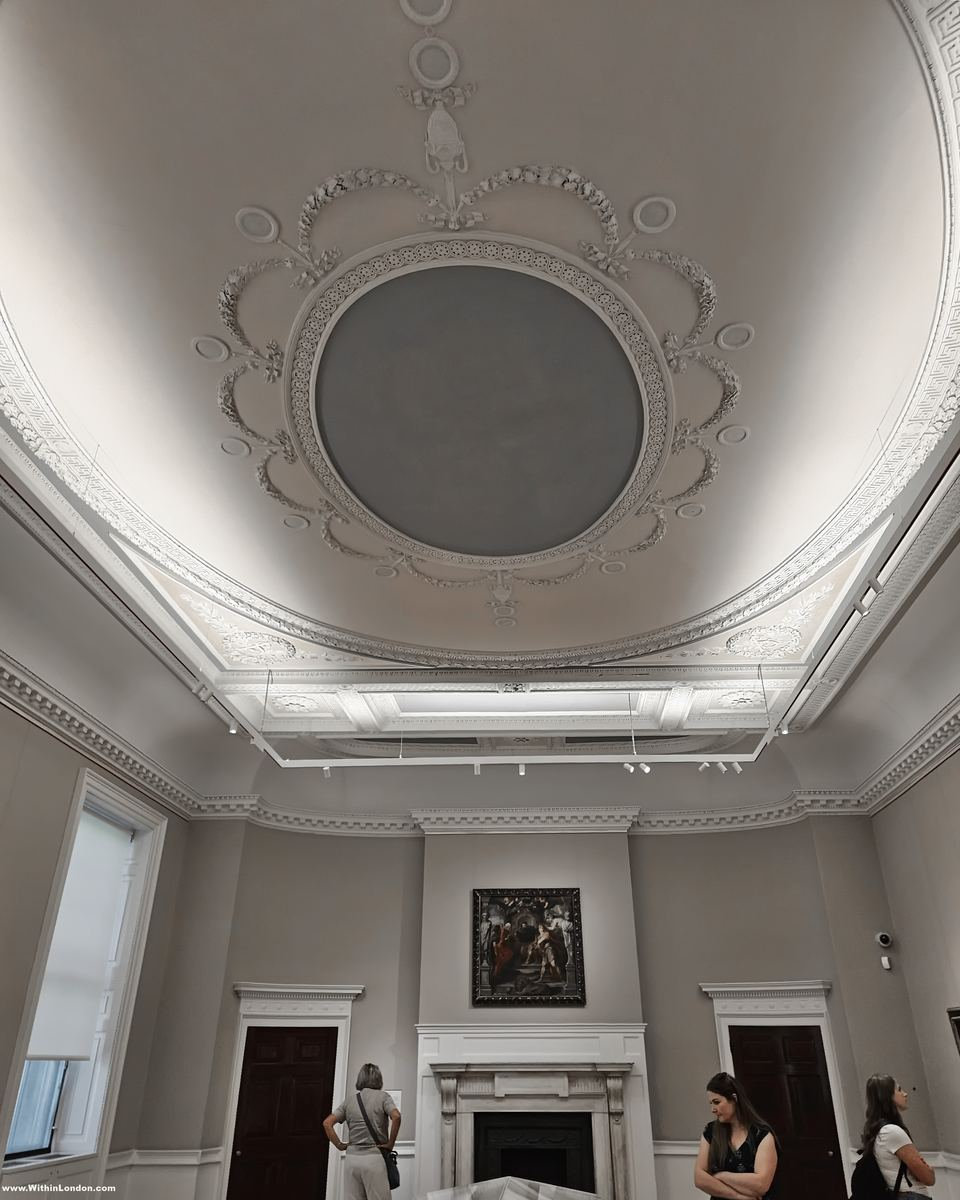
A tall white room, a ceiling of plaster garlands wrapped around a huge oval, and one painting hanging alone on the far wall. Below it, a handful of visitors, very small against all that height. That was the first thing I saw on a Sunday.
I keep coming back because there is always an exhibition on, and I use it as an excuse. The exhibition is rarely the point. What I actually come for is the permanent collection, the staircase, and the shop in the basement, one of my five favourite art shops in London.
The Courtauld Gallery and Samuel Courtauld
The Courtauld Gallery is the public gallery of the Courtauld Institute of Art, a college of the University of London. It exists because of one collector: Samuel Courtauld, a textile industrialist who made his money in rayon and spent much of it on French painting in the late 1920s. When he died in 1947, his house and his collection went to the Institute he had founded with Lord Lee of Fareham and Sir Robert Witt.
Why Is the Courtauld at Somerset House?
The Institute's first home was Home House, a Robert Adam townhouse in Portman Square, Marylebone. From 1958 the collection was shown separately, in a gallery in Woburn Square, Bloomsbury. In 1989 the Institute and its paintings moved together into the Strand block of Somerset House. They have been there ever since.
The building is older than any of its paintings. The first Somerset House was a Tudor palace begun by Edward Seymour, Duke of Somerset, in the 1540s. It was pulled down in the 1770s. Sir William Chambers designed the replacement, built from 1776 to 1796. Historic England lists the whole complex at Grade I.
The Strand block, the narrow wing facing the street, was the showpiece. Chambers built it for three learned bodies: the Royal Academy, the Royal Society and the Society of Antiquaries. He was one of the founders of the Royal Academy himself, which may explain why its rooms got such lavish treatment.

The decoration is everywhere once you start looking. One fireplace has a carved lion's head in the middle of the surround, with garlands hanging on either side. The Courtauld's own guide to the building points visitors to the ceilings, the fireplaces and even the ornate door handles.
What Was the Great Room at Somerset House Used For?
The Great Room is the top-floor gallery with the tall plaster ceiling. It was built for the Royal Academy's annual exhibition, which was held there from 1780. The Academy stayed until 1837, when it moved to Trafalgar Square. The Courtauld calls it London's oldest purpose-built exhibition space.
In the Academy's day the walls were hung from the skirting almost to the cornice, frame against frame. That crowded hang is the one you see in old prints of the Summer Exhibition. Above the door is a Greek inscription warning off anyone who is a stranger to the Muses.
The room is called the LVMH Great Room, after one of the funders of the redevelopment. It holds the Impressionist and Post-Impressionist paintings that most people come for, hung in a single line with plenty of wall between them.
Is the Spiral Staircase at the Courtauld the Original Chambers Staircase?
Yes. The curving stone staircase is part of Chambers' building, and Historic England singles out the staircases to the former Academy and learned society rooms. Look straight up it, past the blue and gold iron balustrade, to the skylight at the top.

It was designed as the way up to the Royal Academy exhibitions, three long, narrow flights to the Great Room. The Metropolitan Museum's notes on it say Chambers meant the climb to suggest an ascent to Parnassus. In practice it was steep and crowded.
Around 1800, the caricaturist Thomas Rowlandson drew a joke about it called The Exhibition Stare-Case. Visitors tumble down the stairs in a heap, while others above stop to stare. Copies are held by the Yale Center for British Art and the Metropolitan Museum. It is a good print to look up before a visit.
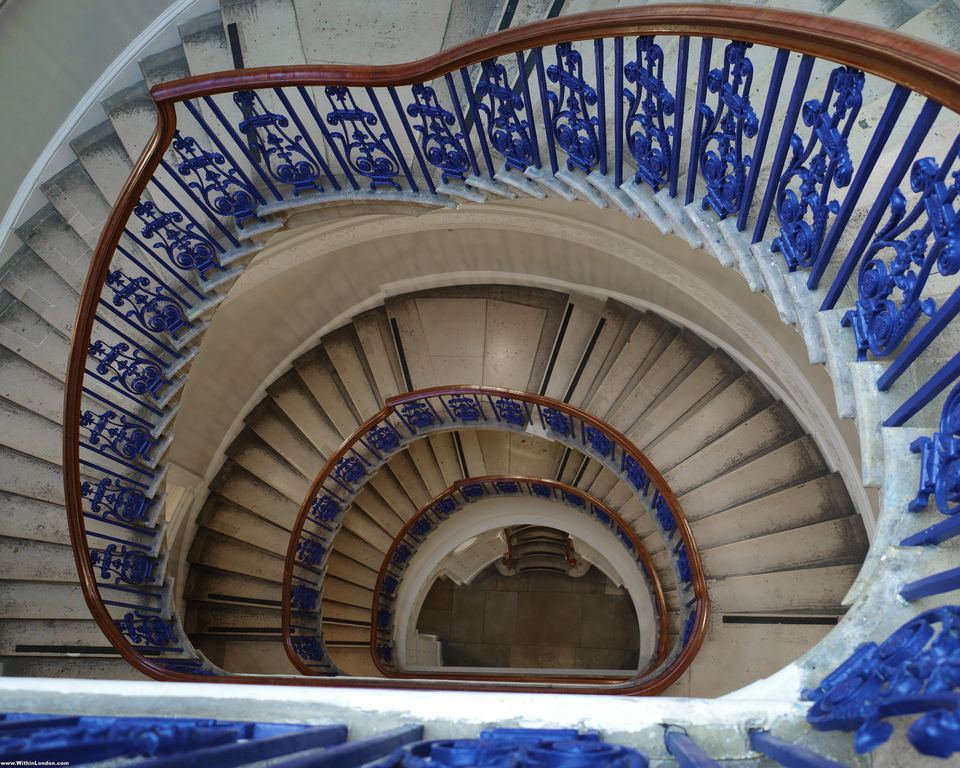
Looked at from above, you see the whole oval at once, each turn of railing curling inside the last, down to the stone floor at the bottom. The wooden handrail sits on scrolled iron painted Prussian blue.
The blue is recent. The RIBA Journal says the railings were returned to Prussian blue in the works that ended in 2021. It also calls the 1770s staircase too narrow for today's numbers, which is why the redevelopment added a second, cantilevered stone stair down to the lower ground floor, where the lockers and shop are.
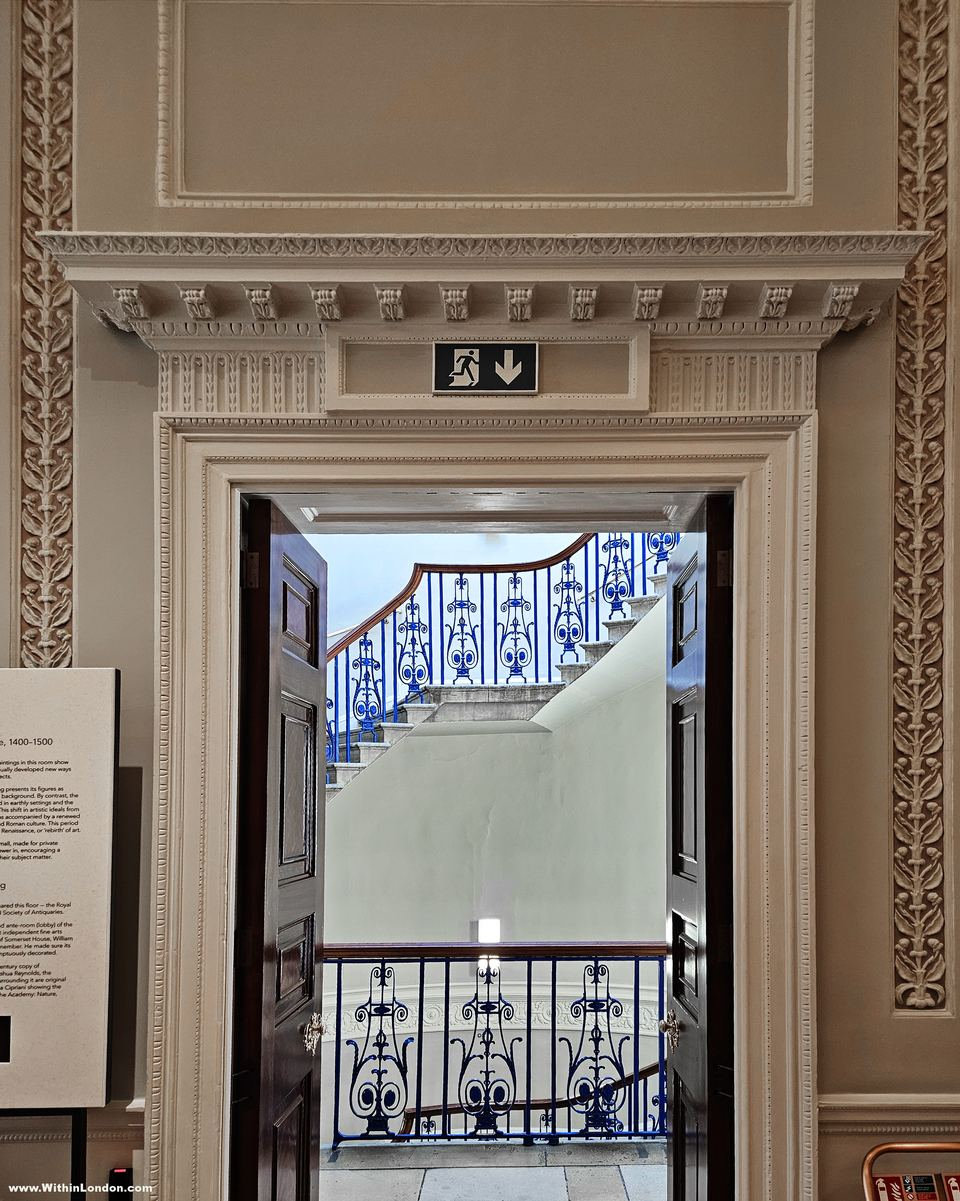
A lift serves all three floors for anyone who would rather skip the climb. The same blue ironwork shows up again through a classical doorway on another floor.
Down at -1, on the way to the shop, there is a smaller stair that is easy to walk past. An arch with a round window on either side, and a short flight of worn stone steps curling out of sight towards a narrow slot of light.

What Changed When the Courtauld Gallery Reopened in 2021?
The gallery closed on 3 September 2018 for a project called Courtauld Connects. It was the biggest modernisation in the gallery's history, at a cost of around £50 million. The Institute's teaching moved to Vernon Square, near King's Cross, while the work went on. The Courtauld Gallery reopened to the public on 19 November 2021.
Funders included the National Lottery Heritage Fund, LVMH and Sir Leonard Blavatnik. The whole second floor became the Blavatnik Fine Rooms. These were the old meeting rooms of the Royal Academy, the Royal Society and the Society of Antiquaries.

The Fine Rooms hold the older part of the collection, from the Renaissance to the 18th century. There is Italian and Northern Renaissance painting, a section for Peter Paul Rubens, ceramics and rare Islamic metalwork. Botticelli's The Trinity with Saints went back on show after a three-year conservation project.
If you like decorated interiors, Leighton House in Holland Park is another place where the rooms compete with the art on the walls.
The Paintings I Come Back to at the Courtauld
Two paintings are the reason I keep going back. Manet's A Bar at the Folies-Bergère, from 1882, has a barmaid standing behind a counter of bottles, with a mirror full of the crowded hall behind her. It was the last major painting Manet showed at the Paris Salon before his death in 1883. Monet's Antibes, from 1888, is the other: an afternoon of orange and pink light over a bay, held together by one wind-bent pine. Coming back to them is a kind of reality check for me.
The gallery has plenty more. Van Gogh's Self-Portrait with Bandaged Ear, Cézanne's card players, Gauguin's Nevermore, Renoir's La Loge. I go back to two paintings, not all of them, which is probably the more honest way to see a collection this size.

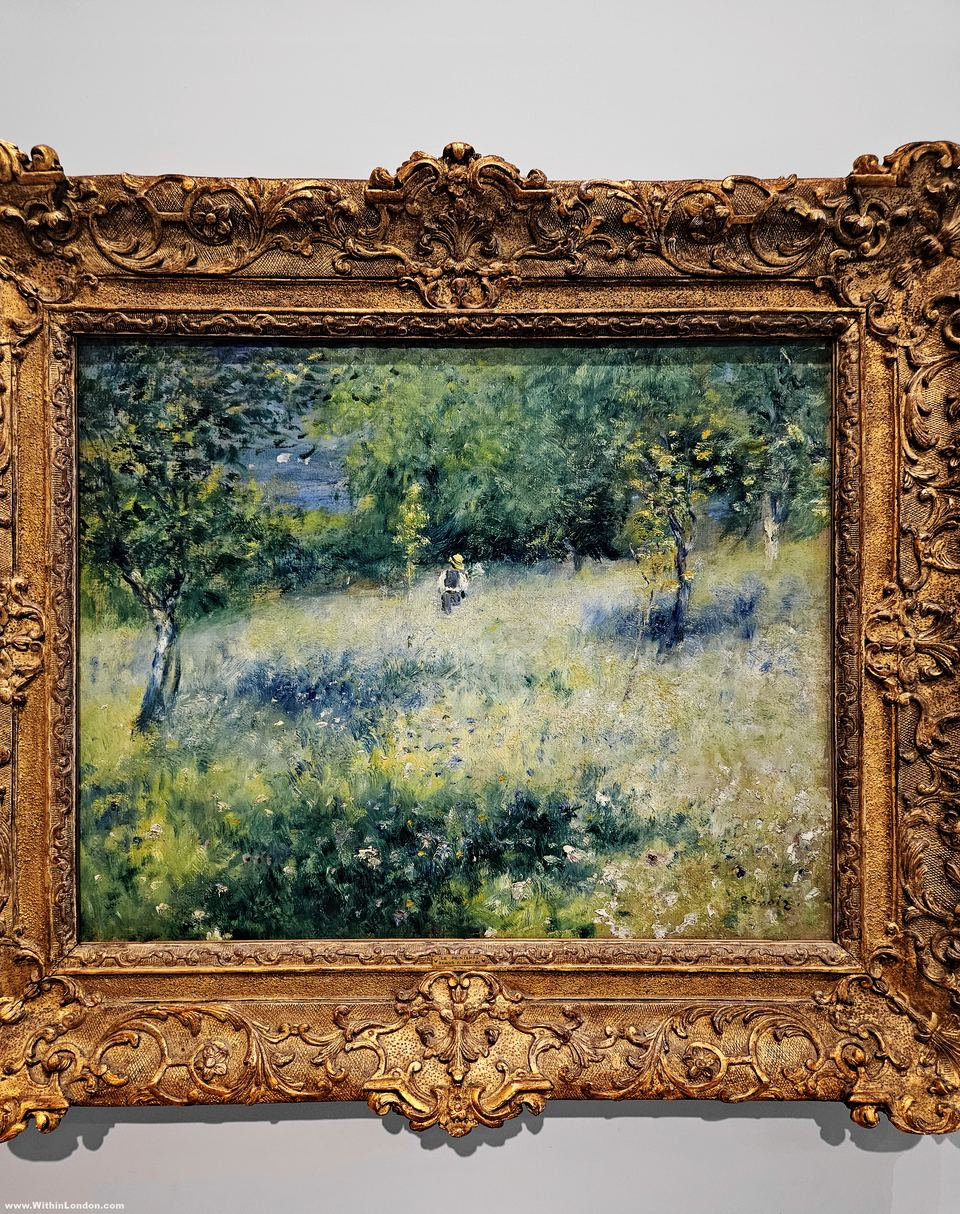
Renoir is not only here as a painter of people, though. One of his landscapes here is Spring, Chatou, from about 1873. It shows a sunlit meadow near the Seine, west of Paris, with young trees throwing deep green shadows. A small figure stands in the long grass. The painting is on long-term loan from a private collection and came to the Courtauld in 2020.
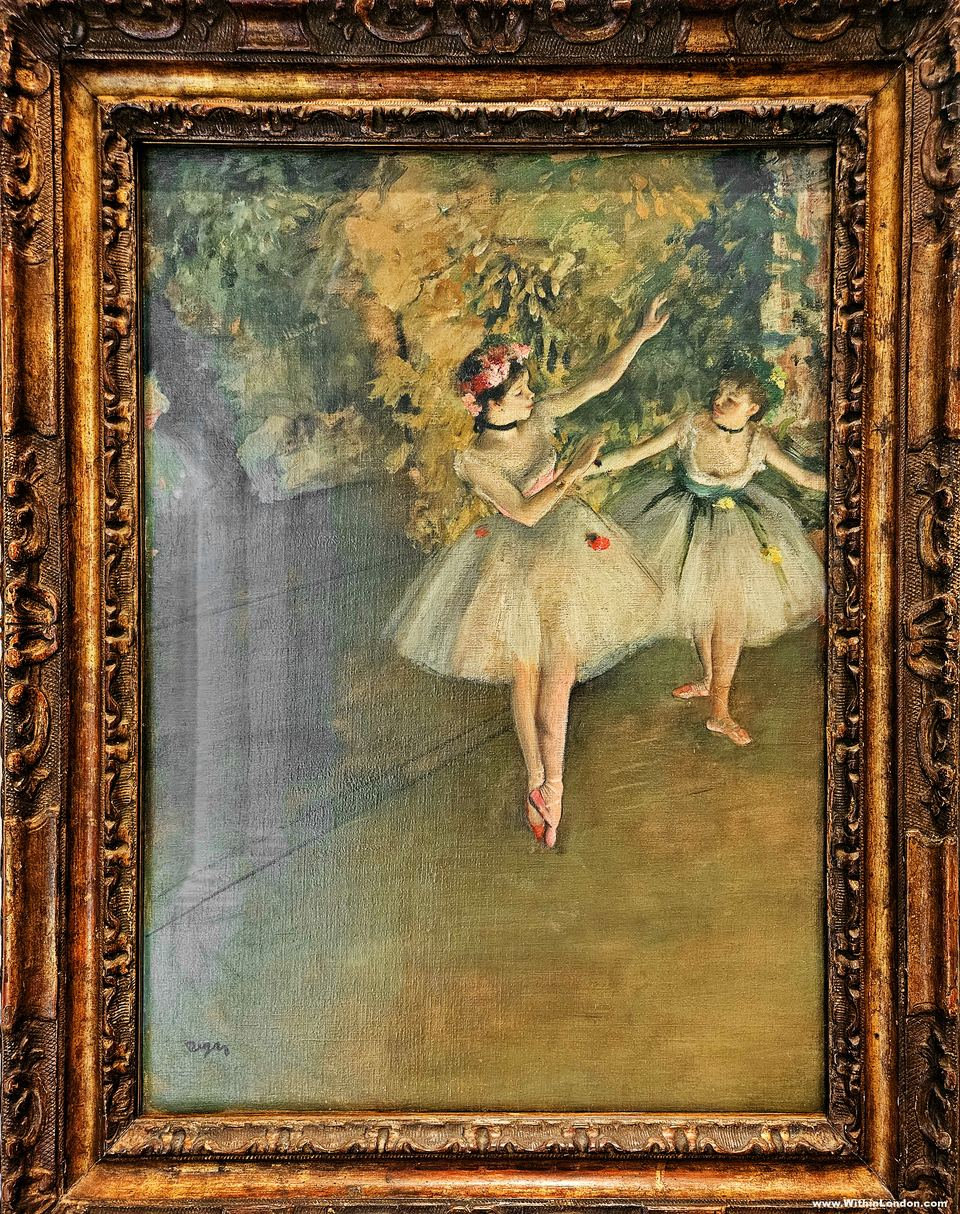
One of the Degas paintings is Two Dancers on a Stage, from 1874: two ballerinas in white hold their poses on a green-toned stage, seen from the side as if from a box. Degas made over a thousand works about the ballet. This one is small, about 61 by 46 centimetres, and easy to walk past in a room full of famous names.
The Courtauld Gallery also runs temporary exhibitions in separate rooms, with their own tickets. I wrote about one of them in Barbara Hepworth in colour at the Courtauld. If you enjoy collections shown in a historic house, the Wallace Collection is another one worth a morning. For a free building nearby, see my notes on the Royal Opera House in Covent Garden.
Somerset House earns a visit on its own account, exhibition or not. The courtyard turns into an ice rink every winter and fills with deckchairs and outdoor screenings in summer. It has hosted the London Design Biennale. Even on an ordinary day, the pedestrianised stretch of the Strand outside, finished in 2022, lets you stop and take it in without cars going past.
Visiting the Courtauld Gallery: Practical Notes
📍 Where: Somerset House, Strand, London WC2R 0RN. The gallery is in the north wing, on the Strand side of the courtyard.
⏰ Opening: 10:00 to 18:00, last entry 17:15 (checked September 2026).
📅 Open days: Every day, Monday to Sunday. Check the Courtauld website before you go for closures and exhibition dates.
🎫 Admission: Permanent collection £14 for adults (19+), or £16 with a donation (checked September 2026). Free for under-18s, students, teachers, Art Fund members, disabled companions and people on Universal or Pension Credit. Exhibitions are ticketed separately. Book online or buy on the day at the desk; the gallery is cashless.
🚇 Getting there: Temple (District and Circle lines) is the closest. Embankment, Charing Cross and Covent Garden are all a short walk.
☕ Food: The Courtauld Café is inside the gallery and takes card payments only.
⏳ How long: Allow one to two hours to look properly, longer if there is an exhibition on.
📷 Best time: I visit often. Opening time is the best bet for a quieter Great Room.
♿ Access: A lift serves all three floors, and the steps up from the Strand were smoothed into a ramp in the 2018 to 2021 works. Email galleryinfo@courtauld.ac.uk to ask about specific access needs.
🗺️ Nearby: The Somerset House courtyard and river terrace are just outside. Covent Garden and the Royal Opera House are about ten minutes' walk north.
_______________________
Did you enjoy this article? If you'd like to contribute to the running costs of WithinLondon, click the button below:
All photos were taken by Ina/WithinLondon, unless stated otherwise.


Comments