2 Temple Place: Inside Astor's Carved Estate Office, via the Temple

Two green bronze lamps stand at the bottom of the steps, and on each one a small boy is busy with something very modern for the 1890s. One of them holds a telephone. Behind them rises a pale stone front with an oriel window and a heavy wooden door, looking like a Tudor manor that has wandered onto the Embankment.
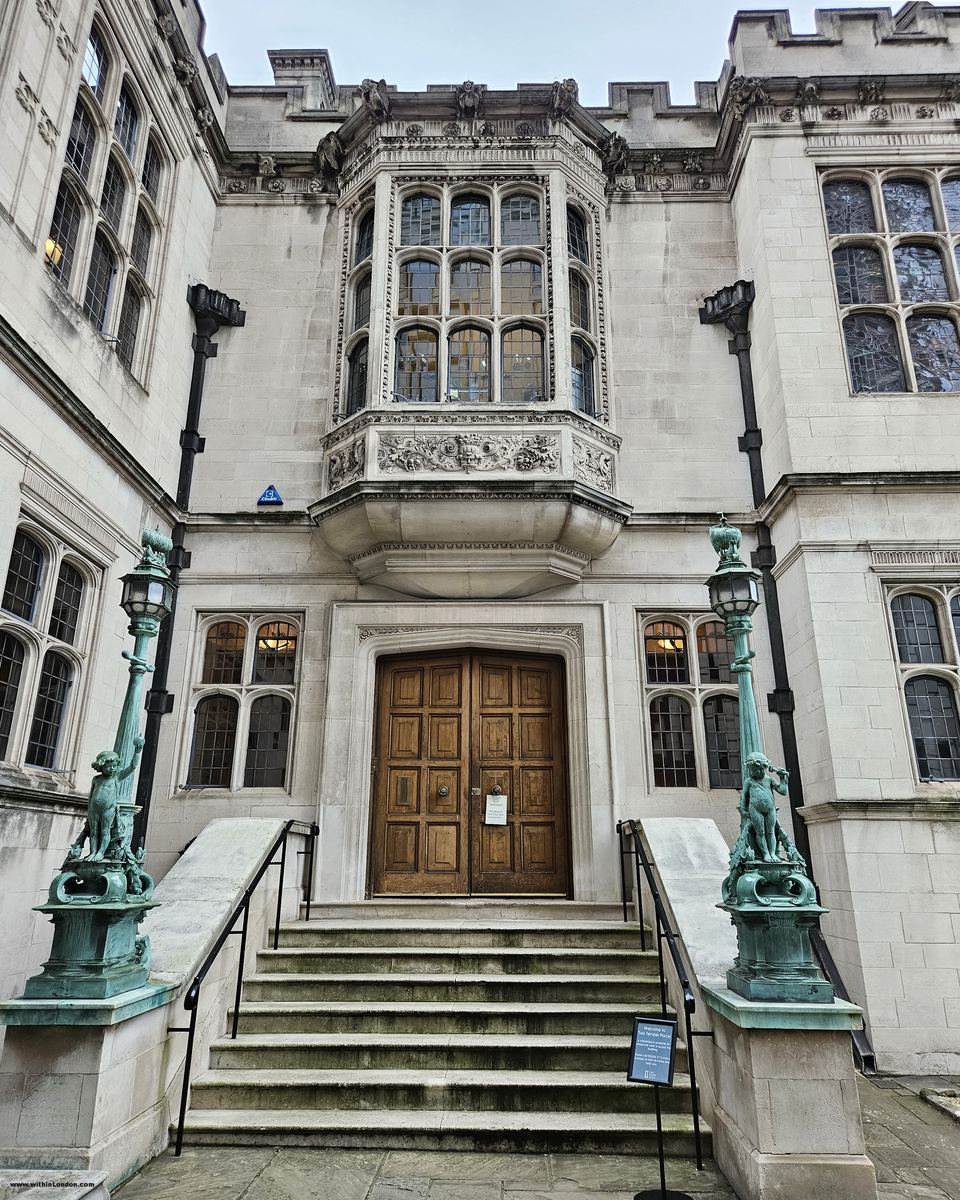
That was the end of my walk, though. It started in the lanes and courts of the Temple on a January morning. I walked past fountains, gardens and old chambers. Then I came out at the bottom of Middle Temple Lane and crossed to 2 Temple Place for the carvings, the stained glass and the staircase.
How Do You Walk Through the Temple to 2 Temple Place?
The Temple is the name for the two Inns of Court that sit between Fleet Street and the Thames: the Inner Temple and the Middle Temple. They take their name from the Knights Templar, who settled here in the late 12th century. The order was suppressed in 1312, and in time the site passed to lawyers. It has been a place of legal chambers and training ever since.
It is still a working legal quarter, a bit like the area around 113 Chancery Lane, a short walk north. But the lanes are open to walkers during the working week. Middle Temple publishes its gate times: the Embankment gate opens on weekdays from 06:00 to 20:00. At weekends, the Tudor Street gate is the way in.
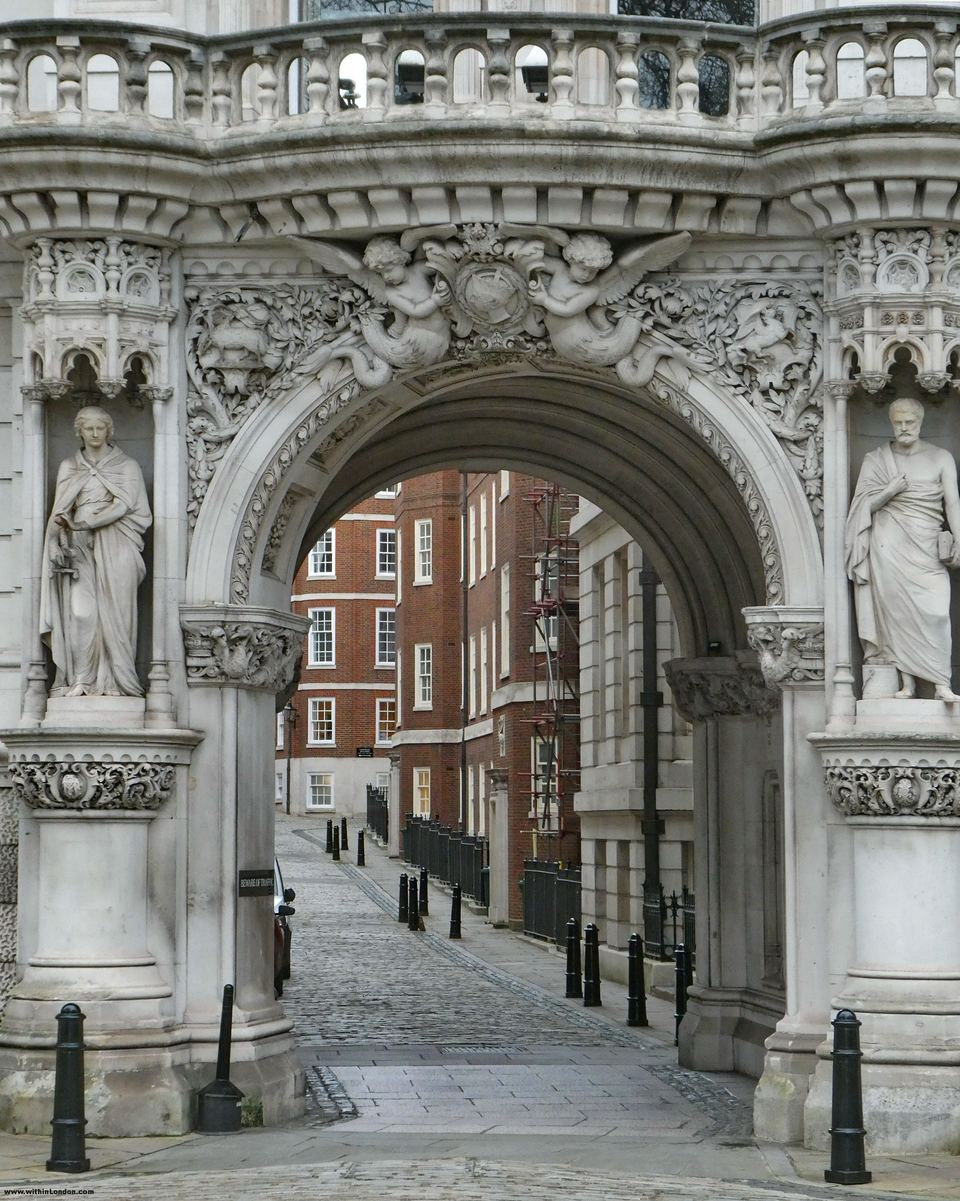
First comes an archway in white stone, with carved statues standing in niches on either side. Through it, a cobbled lane ran between red-brick buildings. It felt like a stage set, the kind of view that makes you slow down without meaning to.
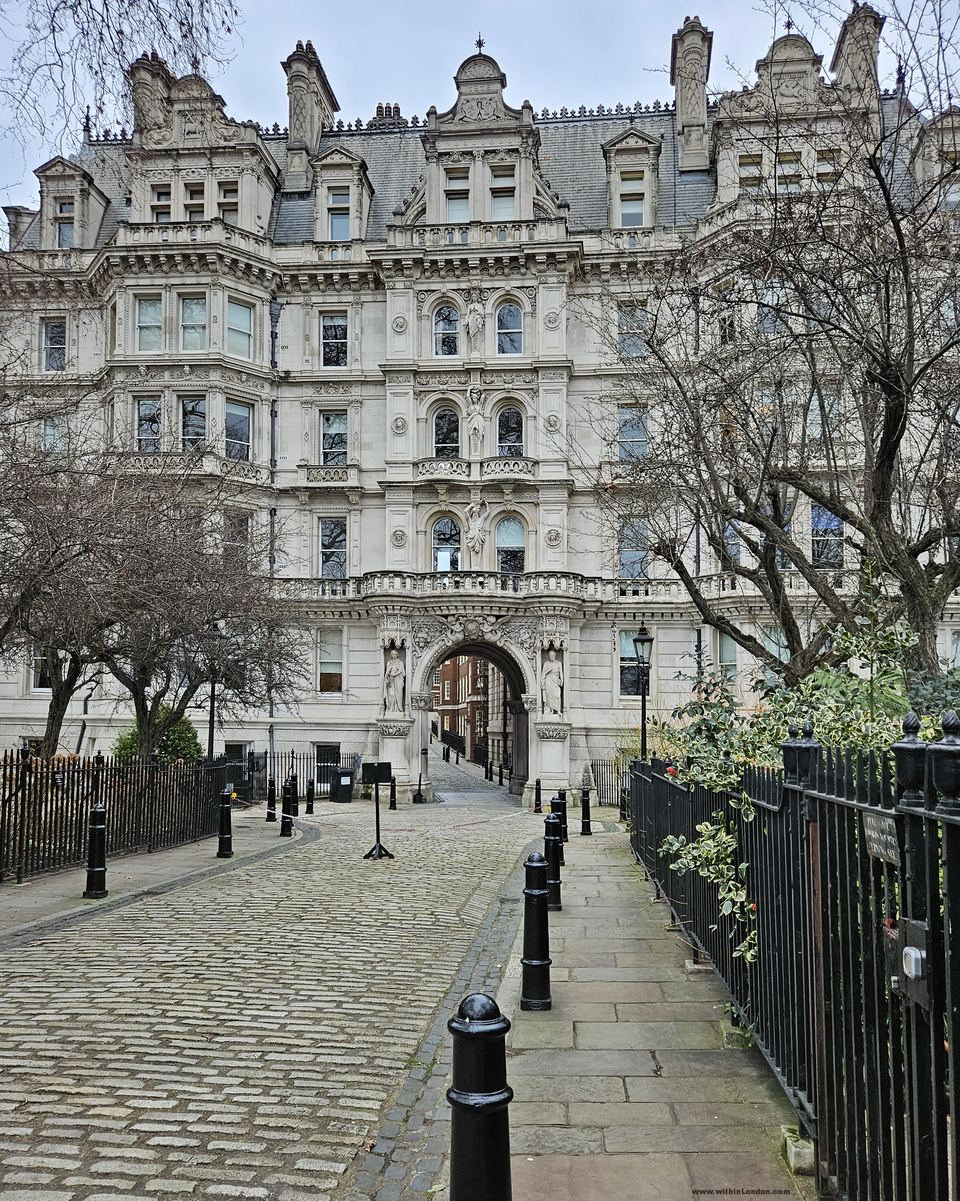
Further on, black bollards lined another cobbled lane that led towards a grand white stone building with an arched passage cut through it. The cobbles are uneven, so it is worth wearing sensible shoes. I noticed how quiet it was at that hour, even with Fleet Street only a few minutes away.
What Is Special About Fountain Court and the Temple Gardens?
Fountain Court is one of the quietest corners of the Temple. It is a small space with a round stone basin, a single jet of water and trees overhead, with red-brick chambers standing behind. In January the branches were bare, and the jet was low.
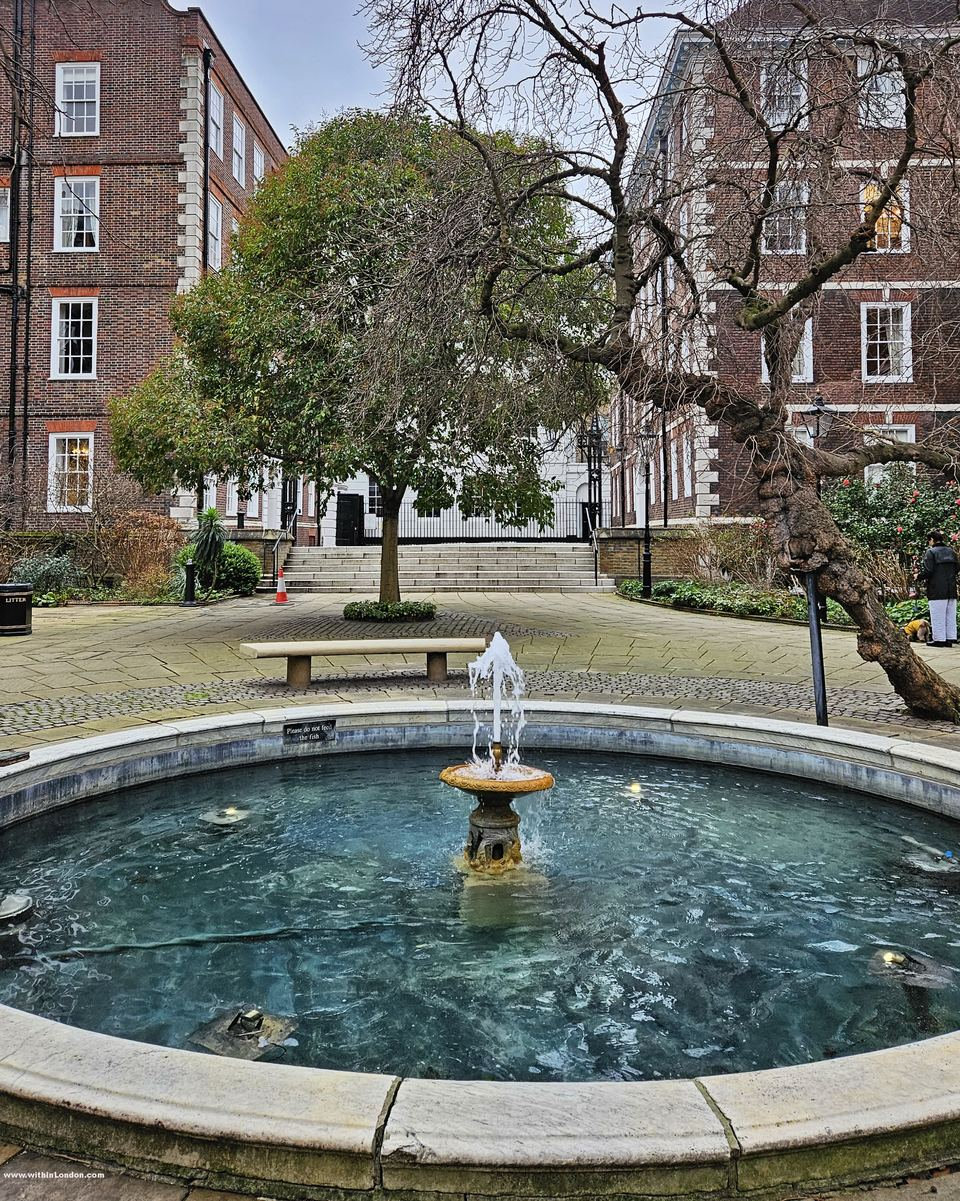
The fountain has a longer story than it looks. According to the Middle Temple's own archive, it was built in 1681. Parks and Gardens UK describes it as reputedly the oldest permanent fountain in London. The Middle Temple archive says its jets could reach about 30 feet at first.
It has changed shape several times. In 1861 it was rebuilt as an ornate tiered fountain, with three basins raised one above the other. In 1919 it was taken back to a simpler form. During the Second World War, in 1941, it was turned into a reservoir for the National Fire Service. The basin you see today was renewed as part of a Millennium project in the 2000s.
Charles Dickens knew the court well. He was admitted to the Middle Temple in 1839. He set a scene in Fountain Court in Martin Chuzzlewit, where the fountain "merrily" plays. W. B. Yeats also lived nearby and wrote fondly of it, according to the same archive.
Just beside the court is Middle Temple Hall, completed in the 1570s. A law student's diary records a performance of Shakespeare's Twelfth Night there on 2 February 1602. It is often described as one of the few buildings still standing where one of his plays was performed in his lifetime.
From Fountain Court I followed a paved walk along the side of the red-brick chambers. A black lamp post stood at the edge, lawns spread out below, and a tall tower rose in the distance. Even in winter, with nothing much in flower, the gardens gave the whole place a sense of space.
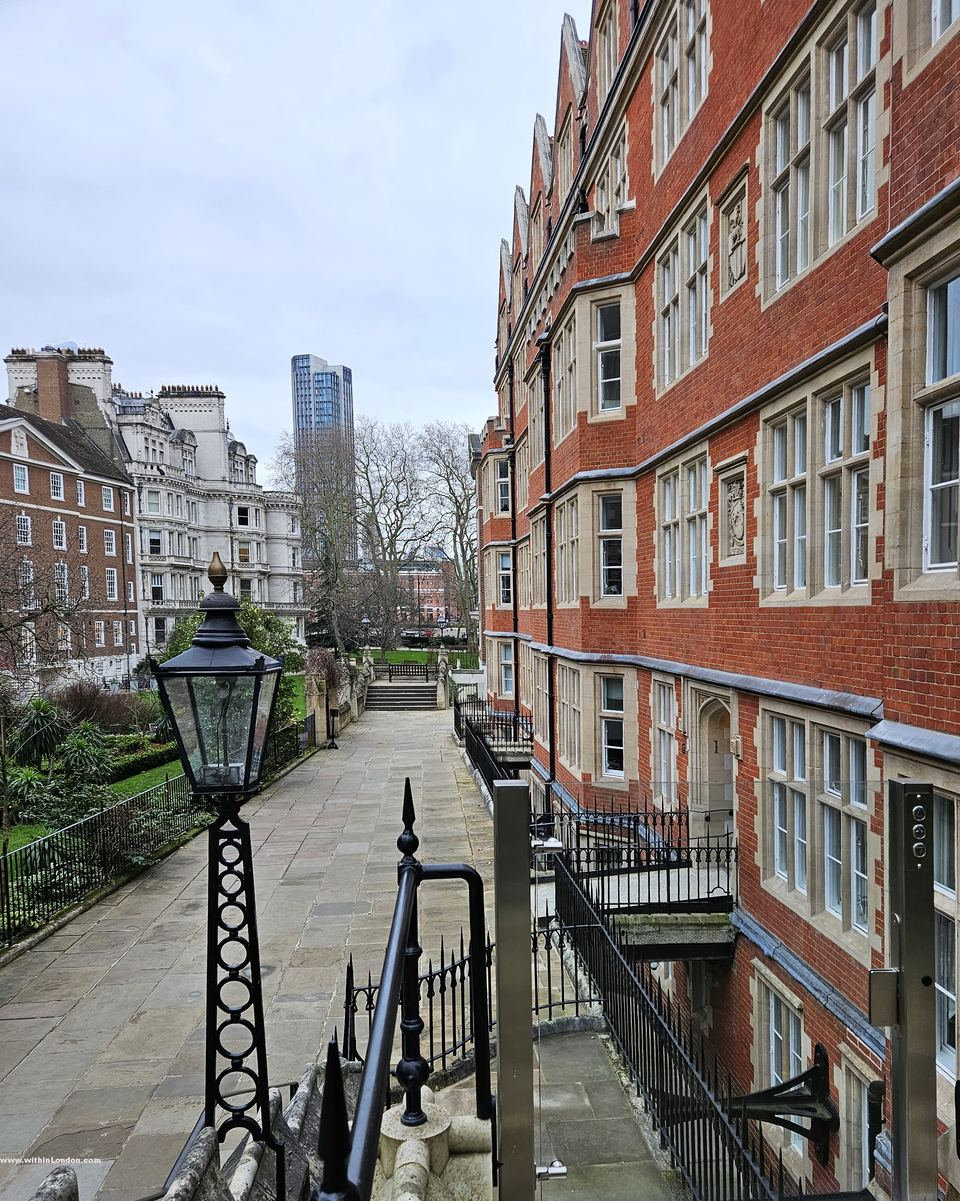
The gardens have their own legend. Shakespeare set a scene of Henry VI Part 1 in the Temple Garden, where rival nobles pluck red and white roses. That is the fictional start of the Wars of the Roses. Parks and Gardens UK notes that red and white roses are still planted there, though historians doubt the event ever happened.
The land itself grew in the 19th century. When the Victoria Embankment was completed in 1870, it pushed the river back. Middle Temple Garden more than doubled in size as a result. The Inner Temple Garden opens to the public on weekdays from 12:30 to 15:00, except bank holidays, and it closes for events and bad weather.
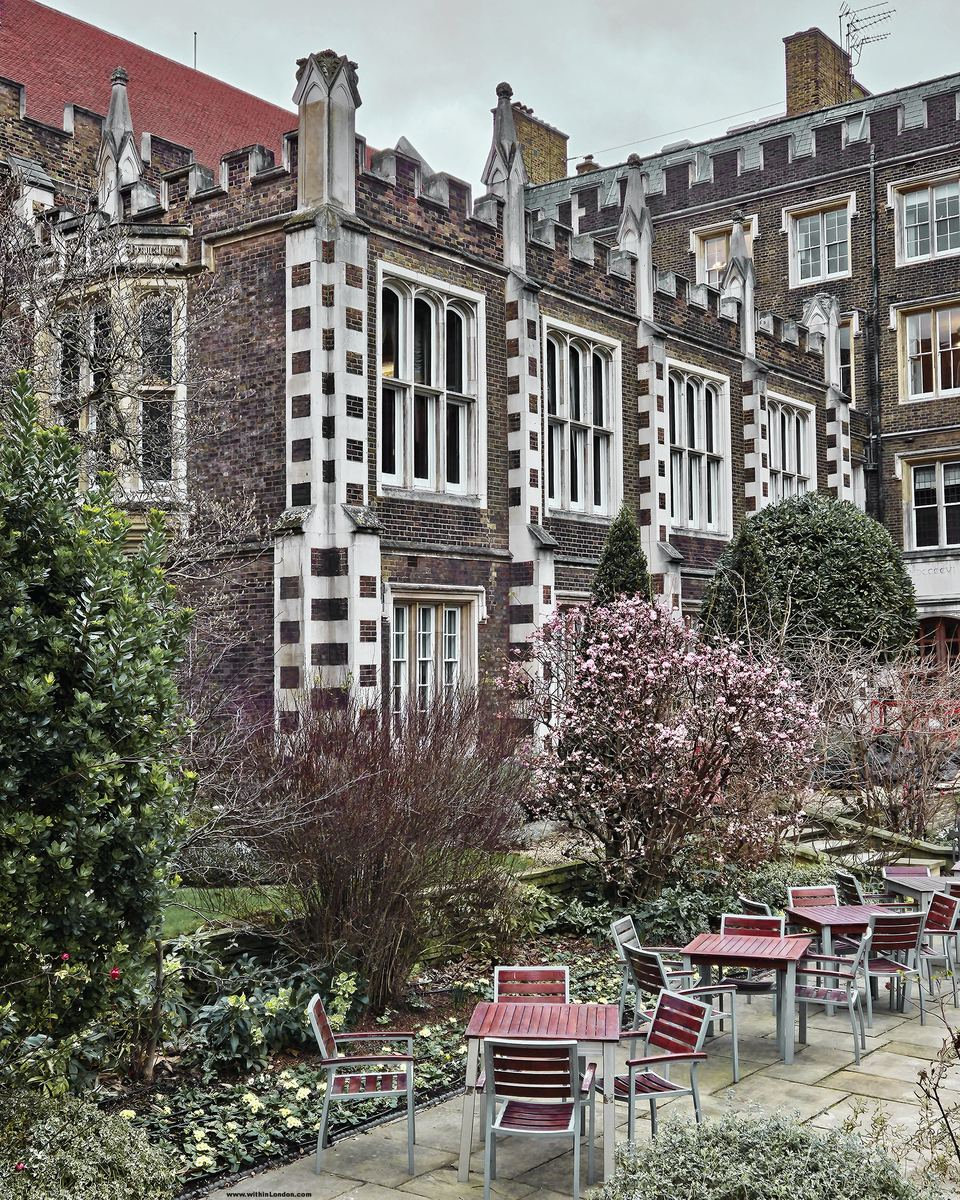
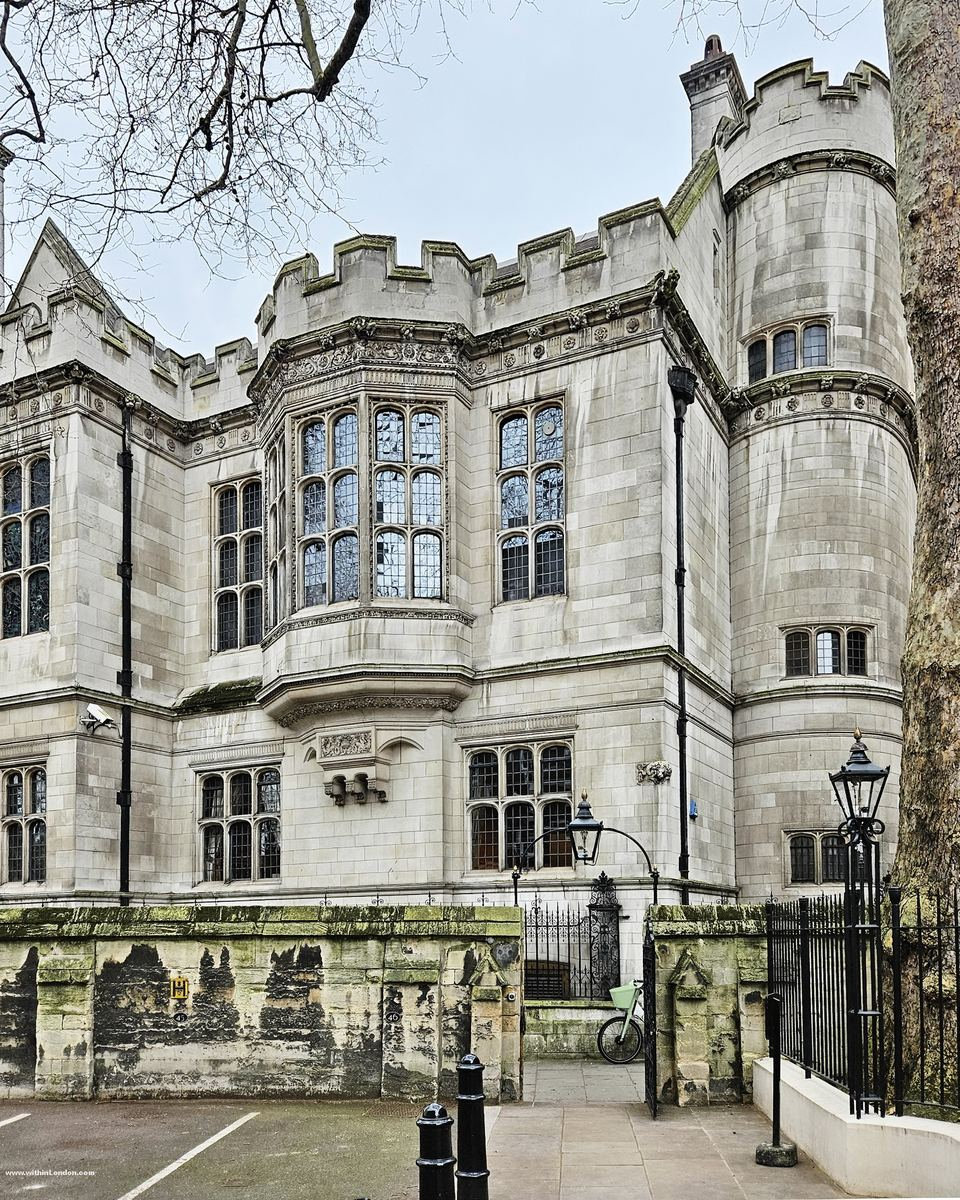
A little further on I stopped in front of a Tudor-style building in brick and stone with a crenellated top. A magnolia stood in front of it, and garden tables were set out on the terrace. Then, near the southern edge of the Temple, came a pale stone castellated building with a bay window, lamp posts and railings. I could not be certain what either building is called, so I'll leave them unnamed.
Who Built 2 Temple Place and Why?
2 Temple Place was built between 1892 and 1895 for William Waldorf Astor. He was one of the richest men of his time, an American who had moved to England in 1891. He wanted an estate office from which to run his property empire, with a private apartment inside it.
His architect was John Loughborough Pearson, a Gothic Revival master better known for churches, including Truro Cathedral. Historic England lists the building at Grade II* and calls it one of Pearson's last works. Its style is Early Elizabethan, carried out in Portland stone. The site had been a warehouse used by Gwynne's, a firm of pumping engineers, according to the building's own history page.
The house outlived Astor's use of it. It later belonged to Sun Life of Canada, then to the Incorporated Accountants, and from 1959 to the pharmaceutical company Smith & Nephew. In 1944 a V1 flying bomb hit a neighbouring building and badly damaged the entrance and west wing. The Bulldog Trust, a charity, took it over in 1998.
What Are the Cherubs With a Telephone Outside 2 Temple Place?
Back to those lamps. The two bronze lamp standards by the steps were made by the sculptor William Silver Frith. The little boys, or putti, on them are playing with the technology of the day. Several sources describe one of them talking into an early telephone, a playful nod to electricity and the latest ways of talking across distance in the 1890s.
Look up at the roof, too. A gilded weathervane in the shape of a ship tops the building. The Open House programme and other sources identify it as Columbus's Santa Maria. It is small from the pavement, but once you notice it, you keep looking for it.
What Is Inside 2 Temple Place?
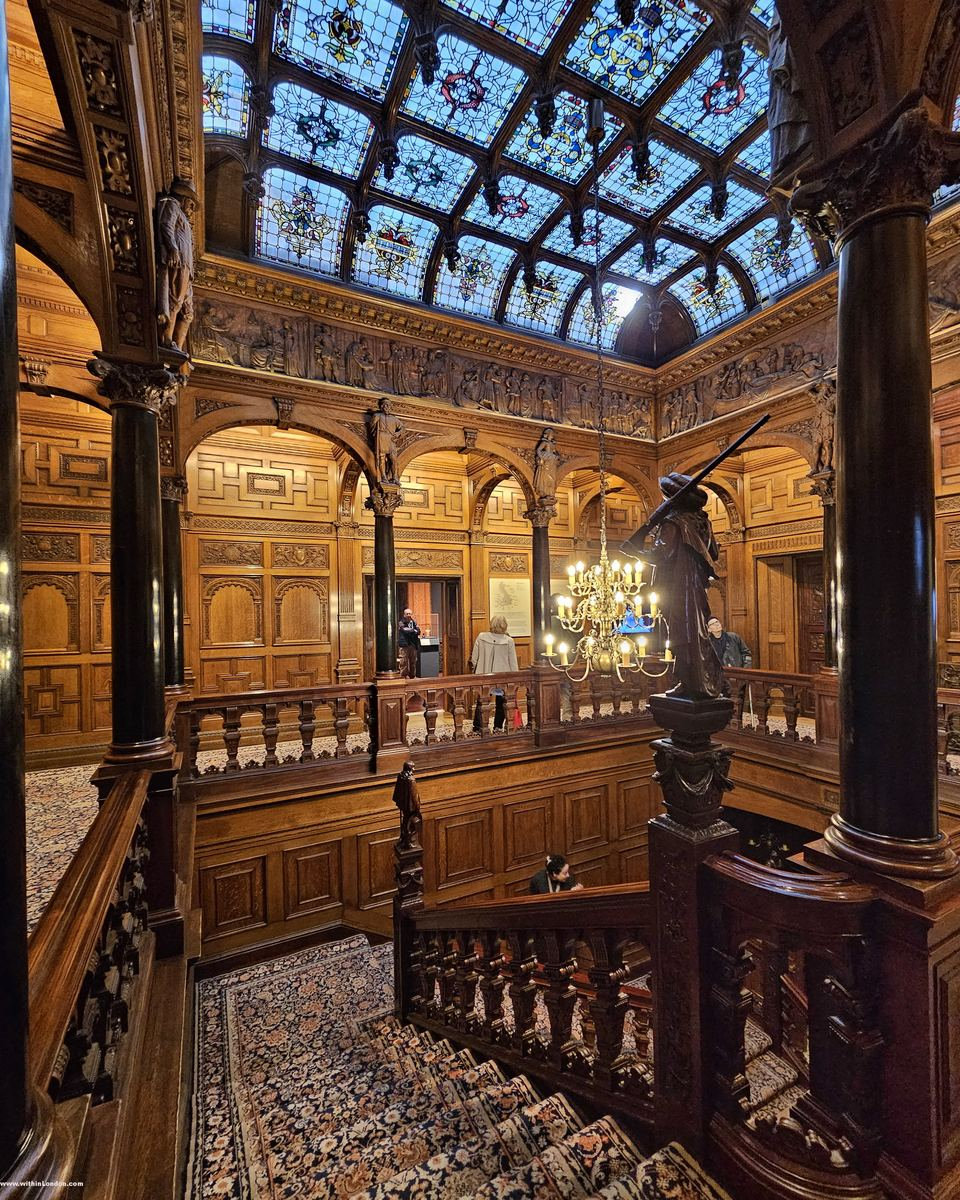
Inside, the first thing I saw was the staircase. I stood at the bottom and looked straight up, past carved wooden handrails and figures, to a skylight of coloured glass. A carved wooden figure stood on the newel post at the foot of the stairs.
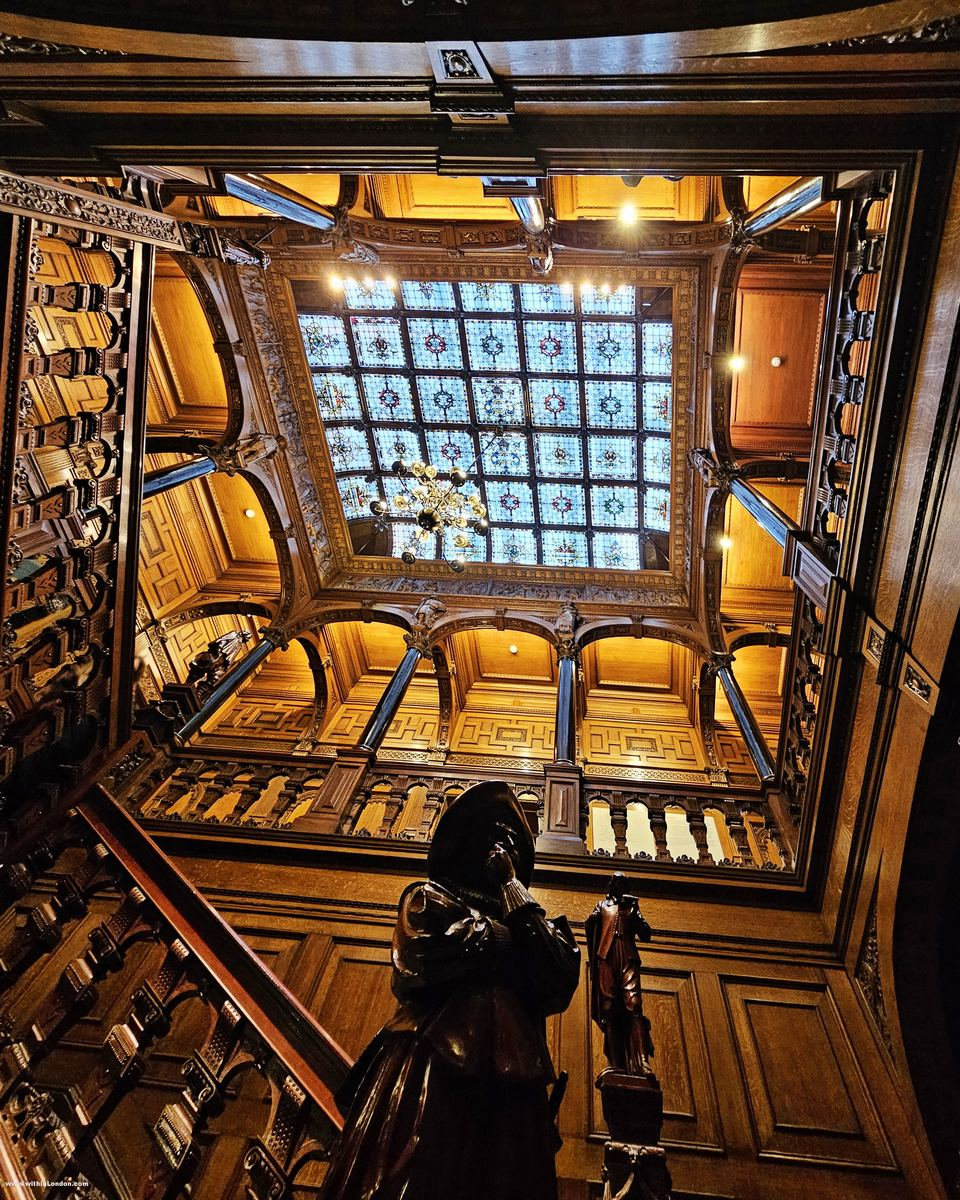
Those staircase figures are characters from The Three Musketeers by Alexandre Dumas. Astor wrote novels himself, so the choice is not a surprise. The Open House listing says the floor of the staircase hall is inlaid with marble, porphyry, onyx and jasper in the Cosmati style.
On the landing I walked along a carved wooden gallery of arches and columns, under a ceiling of stained glass. Historic England describes the columns there as ebony. The figures along the upper gallery come from American literature, from the novels of Fenimore Cooper, Hawthorne and Washington Irving. If you love a showpiece staircase, the one at the St Pancras Renaissance Hotel makes a good pair with this one.
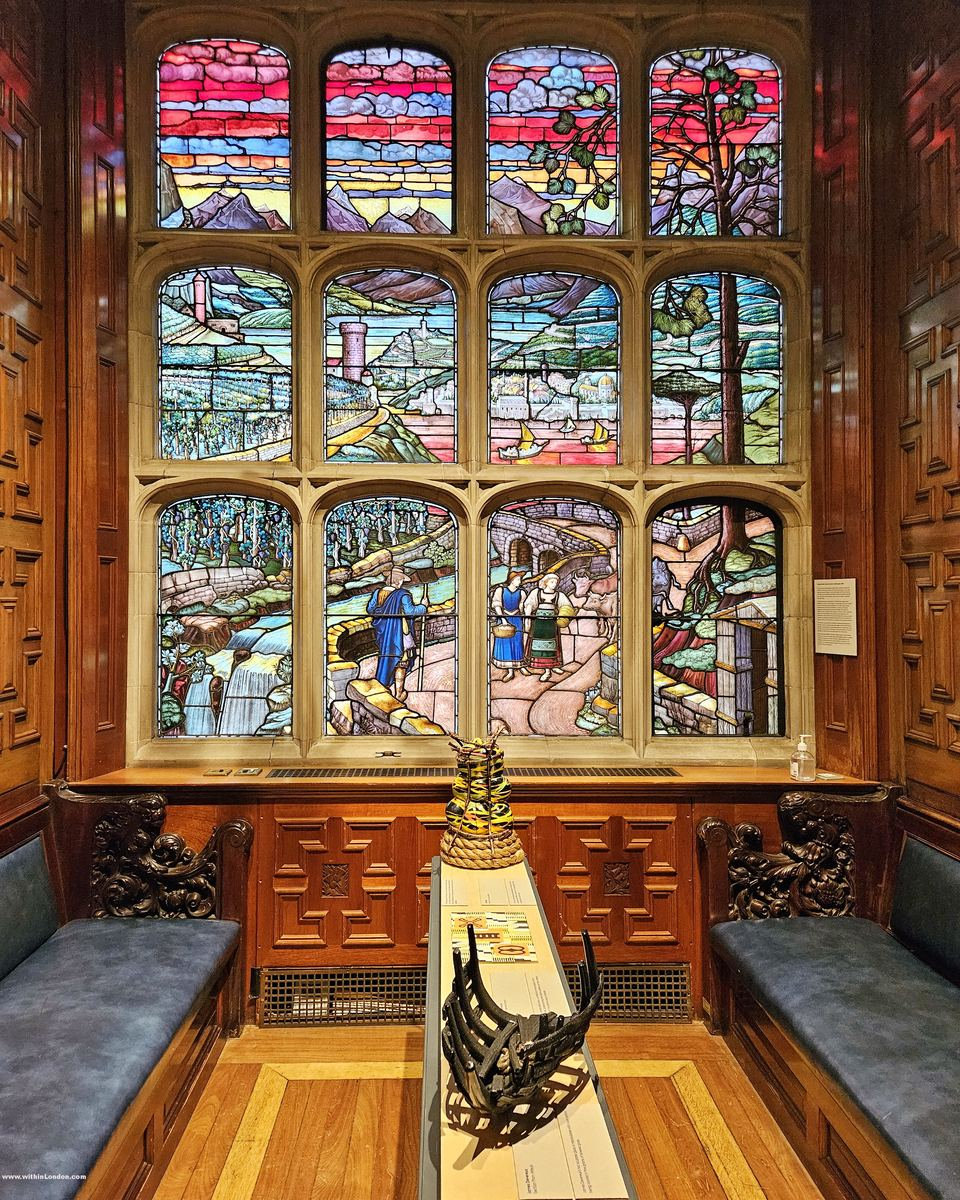
Then came the rooms that face the river. In one window bay the stained glass glowed in reds, blues and golds above dark carved panelling. Green leather benches ran along the walls, and a chandelier hung in the middle. It was just after midday, and the winter light was low enough to make the glass look warm.
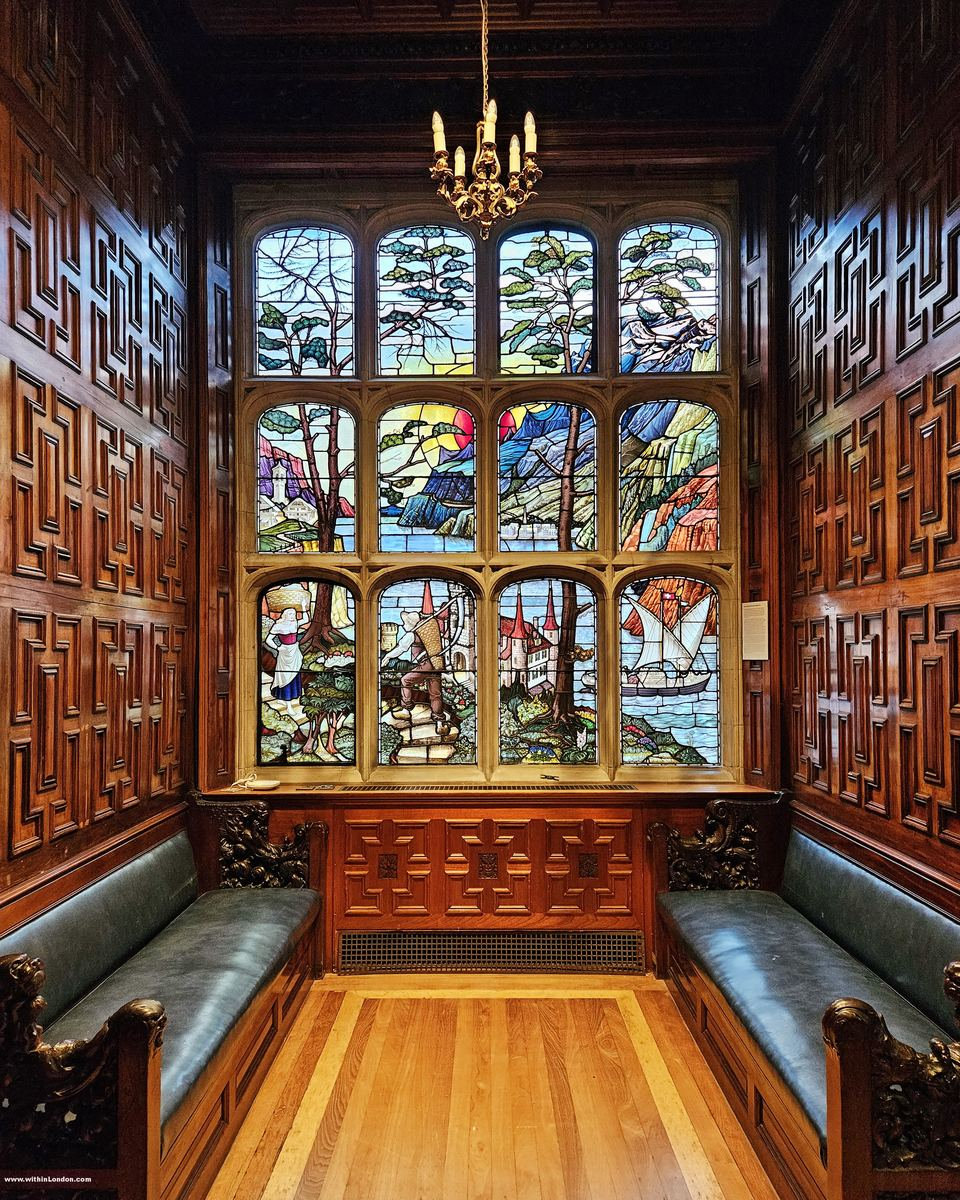
Historic England credits the stained glass in the oriel windows to the firm of Clayton and Bell, and describes it as showing landscapes. The main first-floor room is the Great Hall, Astor's own office. It has a hammer-beam ceiling carved in Spanish mahogany, a nod to the great medieval hall at Westminster.
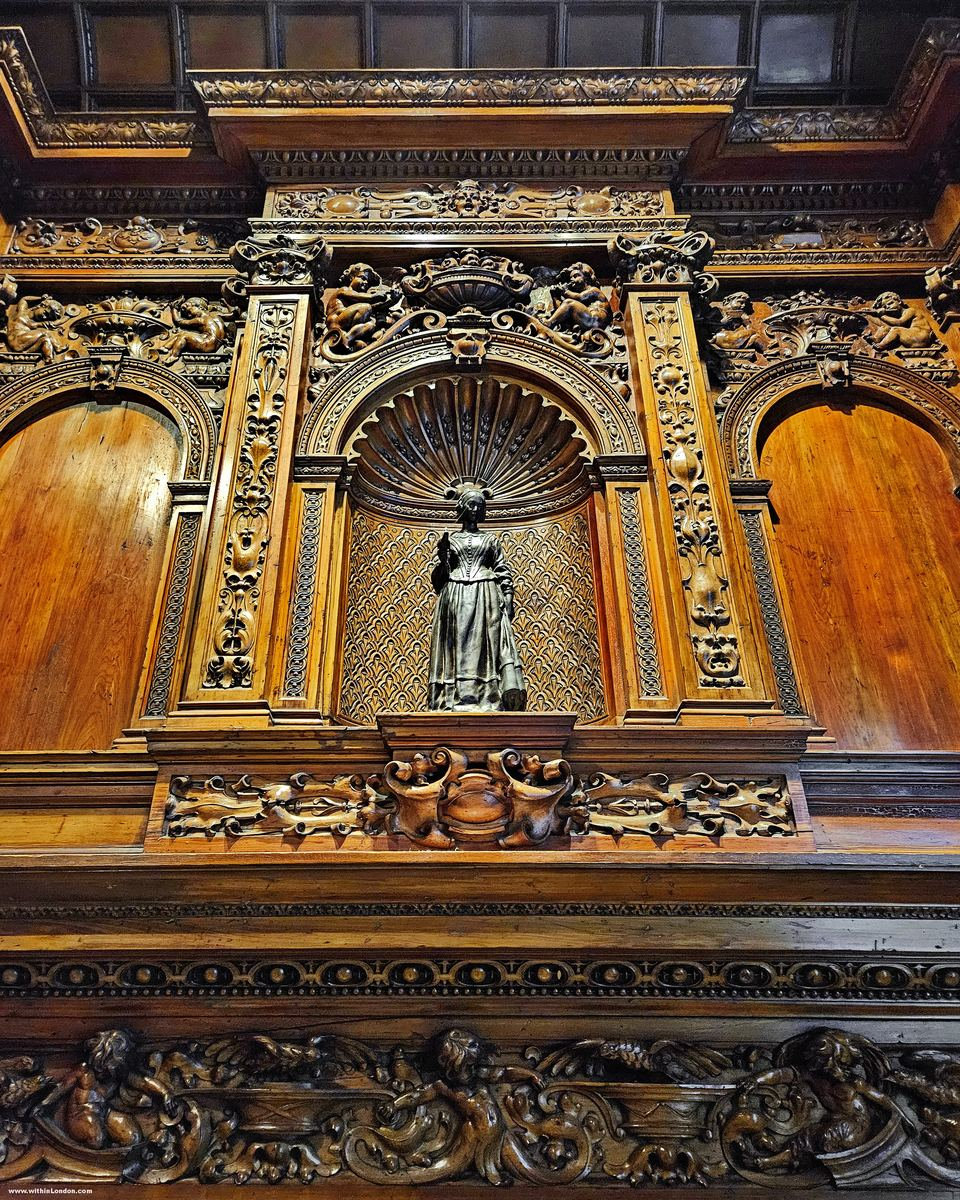
Everywhere I looked there was gilding. On one carved panel, a small bronze figure stood in its own niche, framed by gold leaf. I began to feel that nothing in this building was allowed to be plain.
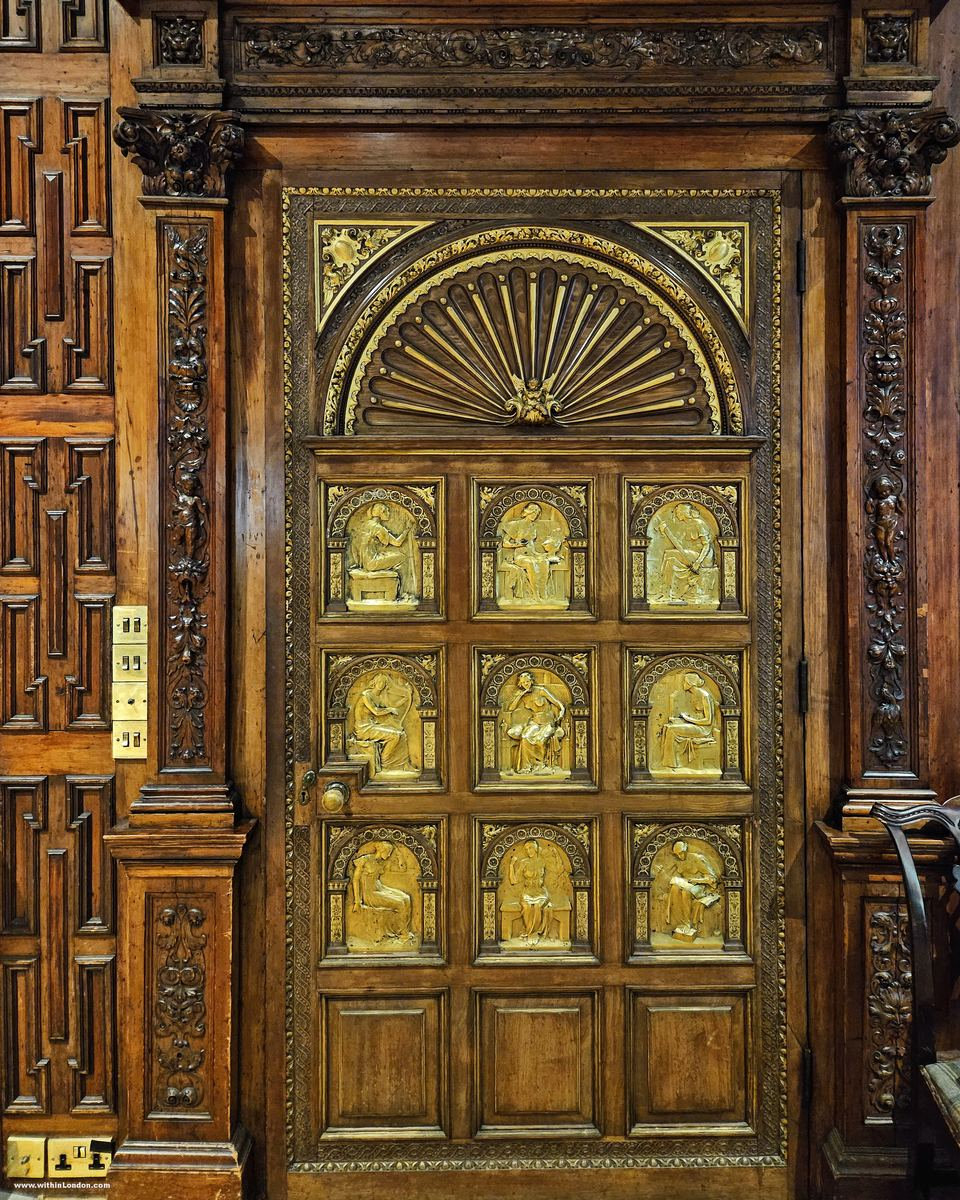
The most famous door in the building is a carved mahogany one by the sculptor George Frampton. Historic England says it has nine silver-gilt panels of seated female figures. The Open House notes describe them as heroines from the Arthurian legends. I photographed a door with gilded relief figures under a shell-shaped arch.
In the Great Hall a large stained-glass window of landscape scenes filled the end wall above carved panelling and benches. A display case stood in front of it. After the Gothic reading room at the Maughan Library, this was another reminder of how much Victorian Gothic hides behind plain London doors.
One more curiosity from the Open House notes: the Great Hall frieze has 54 gilded figures from history and literature, chosen by Astor himself. There are twelve more figures from Walter Scott's Ivanhoe.
When Is 2 Temple Place Open to the Public?
This is the part that catches people out. 2 Temple Place is not open all year. It opens on selected days only, mainly for one free winter exhibition each year, plus building tours, events and Heritage Open Days. The exhibition programme began in October 2011 with a show on William Morris.
Each winter show works with museum collections from around the UK. Earlier ones include The Glass Heart in 2024, Lives Less Ordinary in 2025 and The Weight of Being, which ran from 17 February to 19 April 2026. The next one, Gathering Rest, is listed for 23 January to 18 April 2027. It is about rest as healing and imagination.
Entry to the exhibitions is free, which makes it a good winter plan to pair with other free interiors nearby, like the Royal Opera House. For The Weight of Being, the building opened Tuesday to Sunday, with a late opening on Wednesdays and no booking needed. Hours for 2027 may differ, so check the official site first.
Visiting 2 Temple Place: Practical Notes
📍 Where: 2 Temple Place, London WC2R 3BD, on the Victoria Embankment side of Temple Place. The Temple lanes are just to the east.
📅 Open days: Selected days only. The winter exhibition Gathering Rest is listed for 23 January to 18 April 2027. Heritage Open Days and paid building tours happen at other times.
⏰ Opening: For the 2026 exhibition, hours were 11:00 to 18:00 Tuesday to Saturday, 11:00 to 21:00 on Wednesdays and 11:00 to 16:30 on Sundays, closed Mondays. Check twotempleplace.org for 2027 hours.
🎫 Admission: Free for the exhibitions. Tours and some events are ticketed.
🚇 Getting there: Temple station (Circle and District lines) is a couple of minutes away. Embankment, Charing Cross, Blackfriars and Holborn are all within walking distance. Buses 9, 15, 23, 26, 76, 87 and 341 serve the Strand.
🚗 Parking: No car park. Blue Badge parking is available on Temple Place, Surrey Street and Essex Street.
⏳ How long: About 20 to 30 minutes for the building on its own, longer with an exhibition. Allow another 20 minutes for the Temple walk.
📷 Best time: A weekday around midday, when the Temple gates are open and the winter light comes through the stained glass.
🗺️ Nearby: Fountain Court and Middle Temple Hall, the Inner Temple Garden (weekdays 12:30 to 15:00), Temple Church, Somerset House and the Royal Courts of Justice.
♿ Access: A stair climber gives wheelchair access at the entrance, with size and weight limits. A lift serves all floors, and there is an adapted toilet on the ground floor. Call 020 7836 3715 before visiting. The Temple lanes are cobbled.
🧳 Left luggage: An unstaffed cloakroom takes cabin-size bags only (55 x 40 x 25 cm).
Have you been inside 2 Temple Place during one of its winter exhibitions, and which carving caught your eye first?
_______________________
Did you enjoy this article? If you'd like to contribute to the running costs of WithinLondon, click the button below:
All photos were taken by Ina/WithinLondon, unless stated otherwise.


Comments