Villa Kerylos: The Greek Villa in Beaulieu-sur-Mer

Updated: 2 days ago
Can one afternoon make a place your favourite in the world? The Villa Kerylos did that for me. Not just my favourite on the French Riviera. Anywhere.
I went on 6 June 2025, after a morning at the Villa Ephrussi de Rothschild up on Cap Ferrat. The sun that day was brutal. Inside Kerylos it came through every window and lay across the marble floors in hard, bright squares. The rooms themselves were almost bare. I could have walked around there forever, and it still feels slightly surreal that I did.
The Villa Kerylos is a house built between 1902 and 1908 to feel like the home of a wealthy Greek on the island of Delos, two thousand years earlier. Here is what it is, who built it, and how to spend an afternoon inside it.
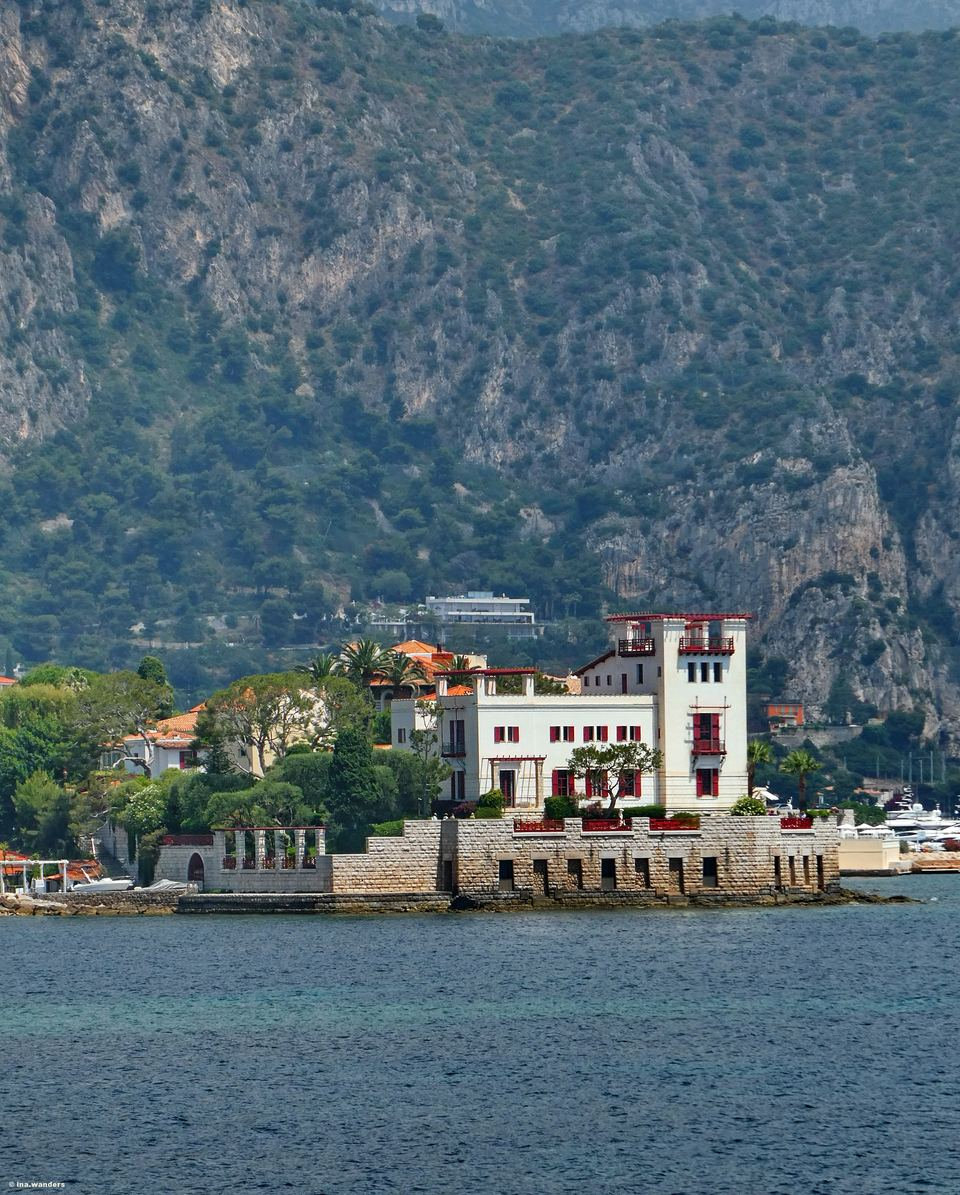
The Villa Kerylos in Beaulieu-sur-Mer
It is a seaside house on a rocky point in Beaulieu-sur-Mer, the small resort between Nice and Monaco. From the water it looks like a white villa with a tower and red shutters. Inside, it is ancient Greece as a scholar imagined it, with every chair, lamp and floor designed to match.
It is not a copy of any single building. The model was the houses of Delos from the second and first centuries BCE, which archaeologists were digging up at the time. The villa's own description calls it a reinvention rather than a reconstruction, and that is the honest word.
The name is Greek too. A kerylos is a sea bird, usually translated as a halcyon or kingfisher, and the ancient Greeks took it as a good omen. A fitting name for a house that sits almost in the sea.
It has been a museum since 1967. The house belongs to the Institut de France and is run by the Centre des monuments nationaux. It was listed as a monument historique in 1966.
Who Built the Villa Kerylos, and Why?
Théodore Reinach, born in 1860, was one of those Belle Époque scholars who seem to have had four careers at once. He was an archaeologist, a papyrologist, a coin expert and a musicologist. He deciphered the musical notation on a hymn to Apollo found at Delphi in 1892.
He also sat as a deputy for Savoie from 1906 to 1914. And he wanted to live, at least for part of the year, the way the people he studied had lived.
His architect was Emmanuel Pontremoli, born in Nice in 1865. Pontremoli had won the Grand Prix de Rome in 1890 and worked on excavations at Pergamon and Didyma. Between them, the two men knew exactly what a Greek house had looked like, down to the patterns on the floor.
Work began in 1902 and took six years. The painters Gustave-Louis Jaulmes and Adrien Karbowsky did the frescoes and friezes. The furniture was made new from ancient models. Klismos chairs with curved legs, couches, stools, tables inlaid with ivory and exotic woods.
The one thing Reinach did not borrow from antiquity was discomfort. The house had modern plumbing and underfloor heating, hidden behind all that marble. Greek in every visible detail, 1908 in the pipes.
It reminds me a little of Sir John Soane's Pitzhanger Manor in Ealing. Another house built so that one man could live inside his own ideas.
Reinach never meant Kerylos as fancy dress. For him Greece was not a decorating style but a way of thinking. Reason and measure, beauty, and a life spent in conversation with books and friends.
He believed Europe kept needing Greece to rescue it. Since the Renaissance, in his words, culture had repeatedly needed "a new inoculation of Hellenic serum". Without it, taste slid into mannerism or barbarism. Kerylos was his own dose, built to be lived in.
That is exactly how it feels. A time capsule of ancient Greece, injected into the French Riviera. You walk in from a seafront of palm trees and yachts and step into a sealed piece of Delos, two thousand years out of place.
The house tells you how to feel from the doorway. The Greek word ΧΑΙΡΕ, chaire, is set into the entrance floor. It was the everyday Greek greeting, and it means "rejoice".
The luxury is discreet on purpose. The money went into rare marble, ivory and precious woods, and into getting every detail right, rather than into display. The point was to calm you, not to impress you.
It was not only about taste. Reinach and his brother Joseph were both deeply engaged in the defence of Captain Alfred Dreyfus. For the Reinach brothers, Greek ideals of reason and justice were worth fighting for in their own century.
Reinach died in 1928 and left the villa to the Institut de France. His family went on living in it until 1967, when it opened to the public.
History did not keep faith with them. Reinach's son Léon, Léon's wife Béatrice de Camondo and their children Fanny and Bertrand were deported to Auschwitz in 1943 and 1944. None of them returned. It is worth knowing, standing in a house built as a monument to reason and calm.

What Is Inside the Villa Kerylos?
The house is built around a peristyle, an open courtyard ringed by columns, as a house on Delos would have been. There are twelve columns of Carrara marble. The walls behind them are painted with scenes from Greek myth. When I was there a small tree was flowering in the middle of the courtyard.
Everything opens off it. The rooms are tall and cool and, by Riviera standards, nearly empty. A table, two chairs, a lamp, a bronze. That simplicity is what I loved most. After a morning among the Rothschild gilding, it felt like breathing out.

Summer 2025 had an extra layer. The artist Gabriel Leger made fifteen works for the house, for an exhibition called L'Or du temps that ran from 18 May to 21 September 2025. A cascade of gold-coloured metal hung in one of the big reception rooms, between the lamps and the mosaic floor. It looked as if it had always been there.
There was bread on a table too, set out with brass vessels. It made me think about how little a person really needs. It turns out it was one of Leger's pieces, Le banquet de l'exilé, the exile's banquet. It did exactly what it was meant to do.
Then the walls. Some rooms are lined in marble veined with purple and grey, set in panels. Above them run bands of Greek key and painted squares in ochre, red and black. The colours are deep and warm, and nothing is there just to fill space.

Look at the bronzes too. On one shelf, under a stucco frieze of bearded masks, Heracles grapples with a deer. It is the Ceryneian hind, one of his twelve labours. Glass and bronze vessels stand along the shelf above him, and the wall behind is hung with deep blue cloth.

The Library Is the Best Room in the Villa Kerylos
The library was my favourite room. It felt like a monk's cell, or a temple of thought. A place built for the mind and for reading, with nothing in it that you did not need.
Two lines of Greek are painted high on the wall, above a band of Greek key. Roughly translated, they say: here, in the company of Greek orators, scholars and poets, I make myself a peaceful retreat in immortal beauty. Laurel garlands below carry the names of Greek writers in roundels, Euripides and Aristophanes among them.

The cupboards are fruitwood inlaid with ivory, boxwood and ebony, modelled on furniture found at Herculaneum. There is a reading stand, a long table and a curved chair you could happily fall asleep in. Busts and dark Greek vases stand along the sideboard.
And the light. The sun came through the tall windows so hard that every room split into bright and dark. Outside, the bay was an unreal blue. You sit in the shade with the whole Mediterranean blazing a few feet away.

What Is Upstairs at the Villa Kerylos?
The bedrooms are upstairs, and they are even plainer than the rooms below. A wooden bed frame, a linen mattress, a small table, a stool. The painted friezes do the decorating. In one room a peacock is painted into the frieze above the bed.

All through the house, the windows frame the sea. In one room the sunlight fell through the glazing bars and printed a grid across the mosaic floor, right over a little wooden desk. That square of light is the whole house in one picture.
In 2025 Leger had hung metal leaves over one of the beds, on fine wires from a frame. They looked like a branch dropping its leaves in autumn, rust and copper against the pale wall.

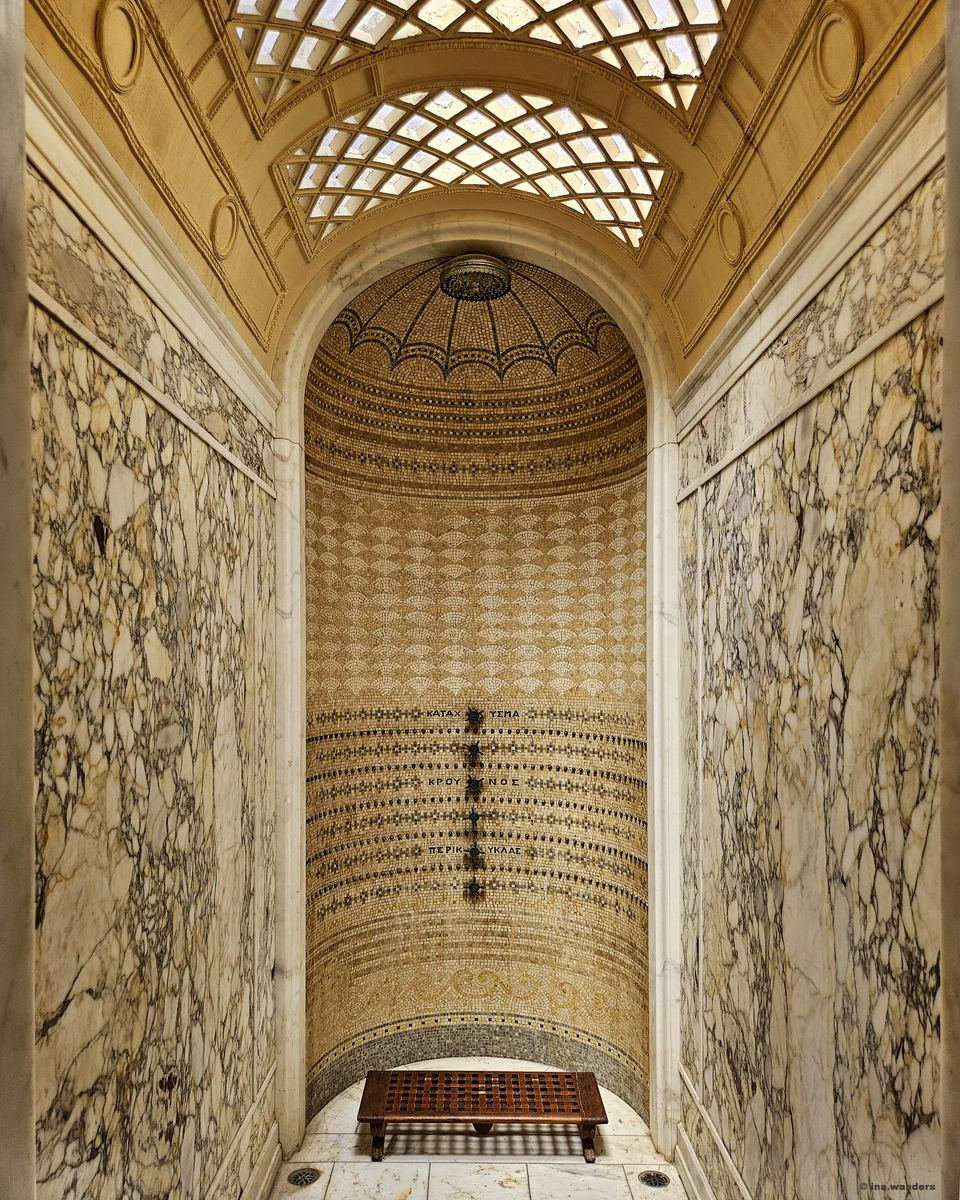
Next door is the bathroom. The shower is a tall niche lined in gold and black mosaic, with a small dome at the top. Words in Greek letters run down the tiles beside the fittings. Even the plumbing was given a classical education.
How Is the Villa Kerylos Different from the Villa Ephrussi?
The two villas went up within a few years of each other, a short walk apart. One sits on the water at Beaulieu, the other on the neck of Cap Ferrat. They could not be more different.
Ephrussi is pink and gilded and full. Nine gardens, rooms stacked with porcelain and Old Masters, a loggia buried in bougainvillea. It is a house about having everything.
Kerylos is about needing less. White columns, bare floors, a bench, a lamp. It cannot have been cheap, with all that marble and ivory. But it spends the money on quiet.
That is why I love that the two are sold on a combined ticket. Doing both in one day stretches your thinking. You spend the morning in one idea of a good life and the afternoon in its opposite. Then you walk back along the sea and decide which you would choose.
Mine is the Greek one.
If you are planning a longer trip, Nice makes the easiest base, ten minutes away by train. For a quieter half-day inland, the old village of Villeneuve-Loubet is a good counterweight to all this seafront glamour.
Visiting the Villa Kerylos: Practical Notes
📍 Where: Villa Kérylos, Rue Gustave Eiffel, 06310 Beaulieu-sur-Mer, on the point at the end of the Baie des Fourmis.
⏰ Opening: 10am to 6pm from 1 April to 30 September, and 10am to 5pm from 1 October to 31 March. Closed on 1 May, and it shuts at 4pm on 24 and 31 December. There are late openings until 10pm on some summer evenings, so check the official site.
🎫 Admission: €15 full price and €10 reduced, for ages 7 to 17 and students aged 18 to 25, as listed in September 2026. Under-7s go free. A combined ticket with the Villa Ephrussi de Rothschild is sold too.
🚇 Getting there: The train from Nice to Beaulieu-sur-Mer takes about ten minutes on the coast line towards Monaco. The villa is under 500 metres from the station, so allow ten minutes on foot.
🚗 Parking: There is parking near the town hall. In September 2026 the official site said Rue Gustave Eiffel was open to pedestrians only because of works, so plan to walk the last stretch.
⏳ How long: An hour and a half to two hours. Longer if, like me, you never want to leave the library.
📷 Best time: A sunny day, for the light through the windows. I went in early June, and the afternoon sun inside was fierce and beautiful.
☕ Food: Beaulieu's seafront and port, a few minutes' walk back from the villa, have cafés and restaurants.
🗺️ Nearby: The Villa Ephrussi de Rothschild on Cap Ferrat, the Plage des Fourmis right beside the villa, and the Promenade Maurice Rouvier, the seaside path to Saint-Jean-Cap-Ferrat.
♿ Access: The bedrooms and bathroom are on the upper floor. The Centre des monuments nationaux offers adapted visits for disabled visitors, so ask before you go.
Have you been to the Villa Kerylos, or its pink neighbour up the hill? Which of the two would you choose to live in?
_______________________
Did you enjoy this article? If you'd like to contribute to the running costs of WithinLondon, click the button below:
All photos were taken by Ina/WithinLondon, unless stated otherwise.


Comments