The Counting House: A Fuller's Pub in a Victorian Bank on Cornhill

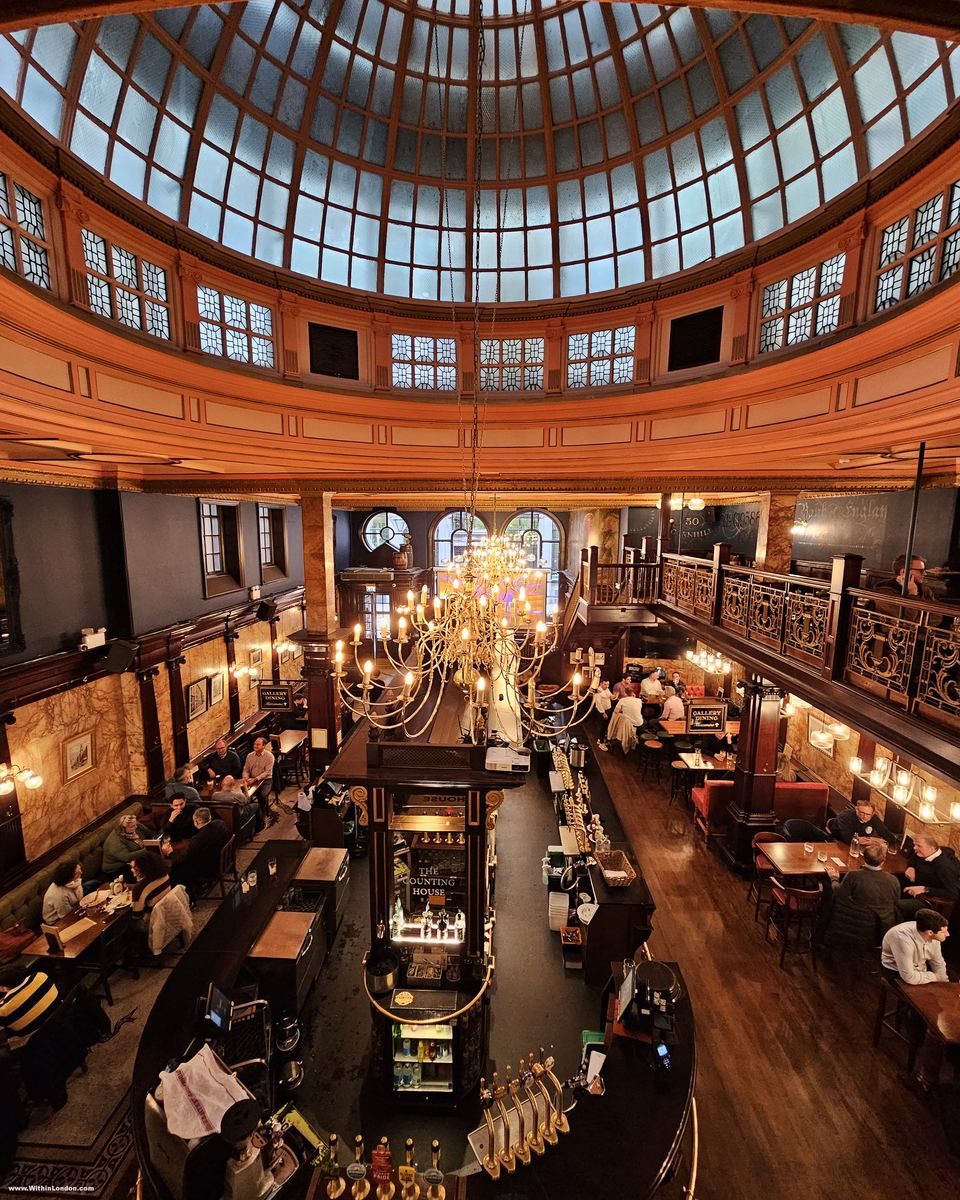
The first thing I saw from the gallery was the dome. A huge oval of glass, letting grey February light pour straight down onto a room full of people. Below it, an island bar. Around the bar, every table taken.
It was a Friday in early February, about 1:35pm, and the City was having its lunch. Suits, pints, plates, a steady roar of conversation rising up to the balustrade where I stood. From up here it was obvious that this is a building first and a pub second.
The Counting House is a Fuller's pub at 50 Cornhill, a short walk from Bank junction. For about a century this room was a banking hall. The counters are gone, but the dome, the gallery and the grand proportions are still there. There is a lot of history packed into this one address.
What Was The Counting House Before It Was a Pub?
A bank, for a very long time. The story starts in 1766, when a bank called Prescott, Grote, Culverden & Hollingsworth opened in Threadneedle Street. The name changed many times as partners came and went. Most people simply called it Prescott's.
One of those partners is a curiosity in himself. George Grote, grandson of the founder, went to work at the family bank in 1810 after leaving Charterhouse. He ran it after his father died in 1830. He also wrote a monumental History of Greece, published in volumes between 1846 and 1856. He left banking in 1842 to write full time.
In 1891 Prescott's merged with three other banks. They were Dimsdale, Fowler, Barnard & Dimsdales of London, Miles, Cave, Baillie & Co of Bristol, and Tugwell, Brymer, Clutterbuck & Co of Bath. The new firm took the long name Prescott, Dimsdale, Cave, Tugwell & Co Ltd, and it needed a head office.
That head office is this building. It was designed by the architect Henry Cowell Boyes. Historic England dates it to 1891–92, while the pub's own history gives 1893. According to Fuller's, it stands on the site of the earlier Dimsdale, Fowler bank.
The bank then went through the chain of mergers that shaped British high-street banking. It was renamed Prescott's Bank Ltd in 1903 and joined the Union of London and Smiths Bank the same year. National Provincial Bank took control in 1918. In 1970 it became part of National Westminster Bank, better known as NatWest.
The bank left in 1997. On 11 July 1997 the building was listed at Grade II, which protects the interior as well as the façade. Fuller's turned the ground floor into a pub in the late 1990s. Its own history gives 1998, and says the conversion won a City Heritage Award that year.
What Makes the Banking Hall and Its Glass Dome So Striking?
Scale, mostly. The banking hall runs across the back of the building, and its ceiling is lifted by a glass dome. The listing describes it as a glass dome on a low drum with pilasters. From the gallery, the dome seemed to fill the whole ceiling. Around its rim is a deep coffered ring, painted a warm orange.
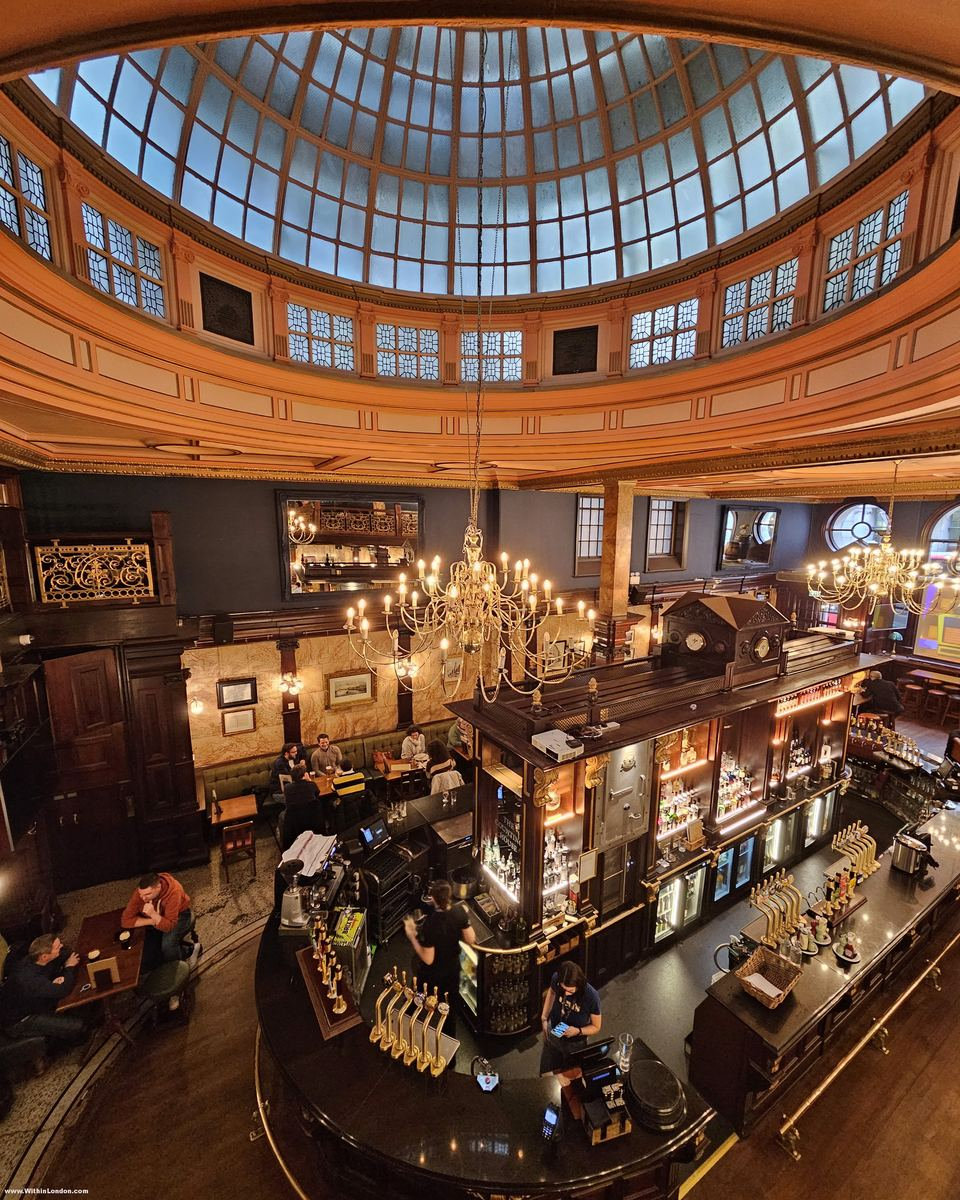
The materials were chosen to impress a Victorian customer. The listing mentions pilasters and panels of Derbyshire alabaster, with a Spanish mahogany dado and cornice. The counters were hardwood to match. Outside, the front is polished Aberdeen granite and Portland stone, with iron grilles that are listed too.
One detail is easy to miss. The listing records a white marble mosaic floor carrying the emblems of the four banks that merged in 1891. It is a merger announcement, set in stone under customers' feet. Ask the staff how much of it is on show.
There is also a bronze war memorial in the pub, remembering bank staff who died in the First World War. CAMRA notes it is reputedly the only such memorial actually inside a pub. I can't confirm that claim, but it is a sobering thing to find in a room built for money.
What Is the Island Bar at The Counting House Like?
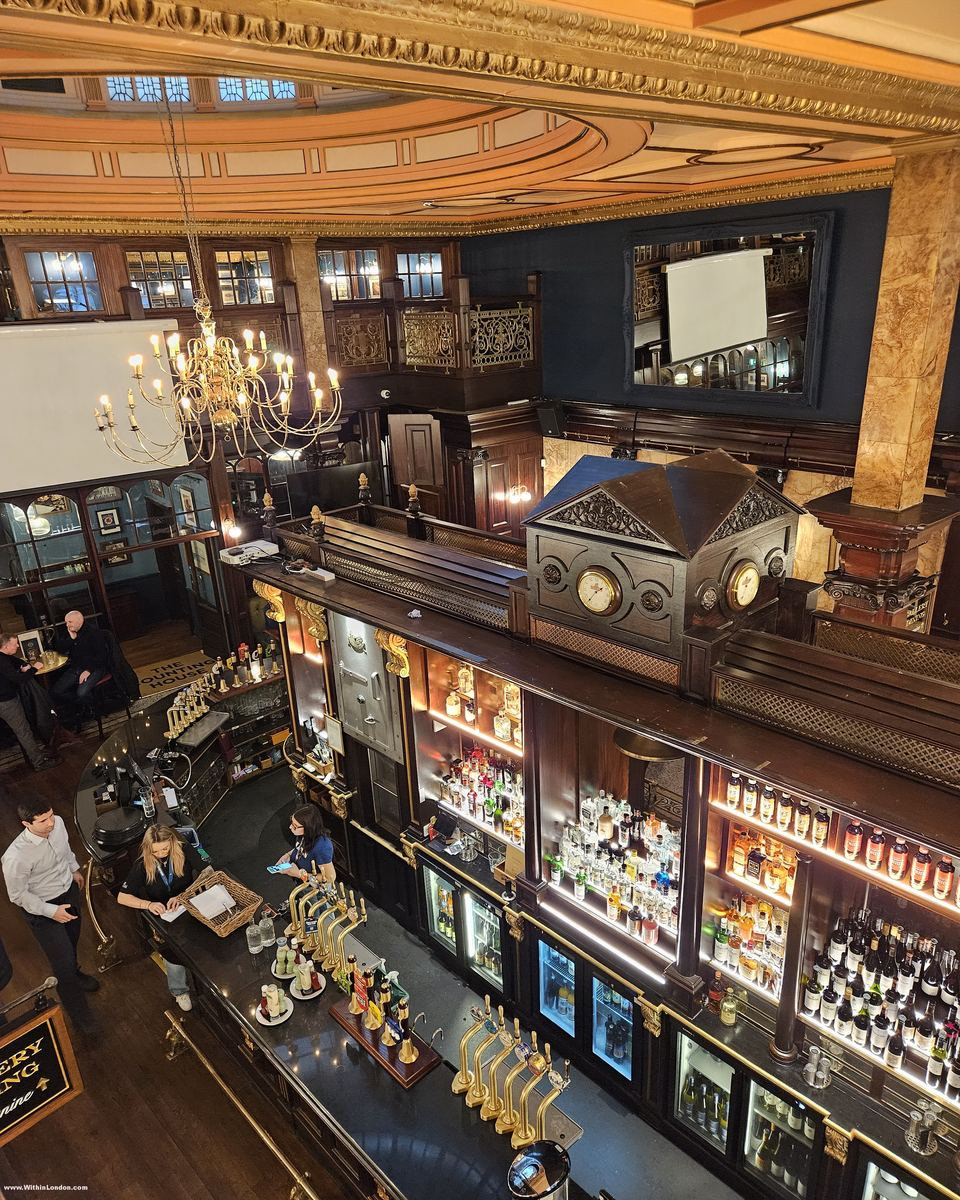
The bar sits in the middle of the room like a ship, an oval with staff working inside it. Brass beer pumps line the counter. In the centre rises a tall wooden back-bar cabinet, topped with a clock, as if the room still needed to know when the doors would close.

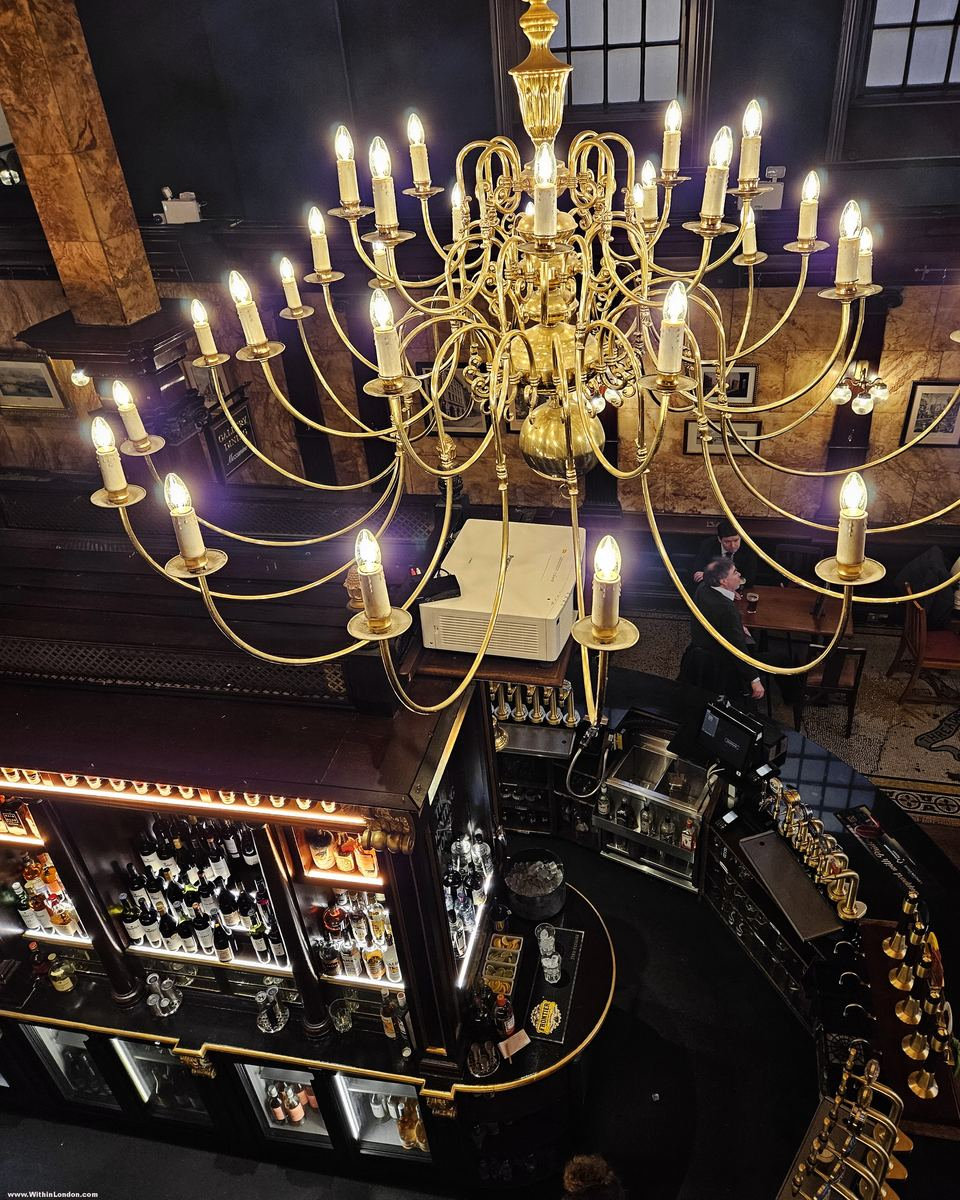
Above the bar hangs a big brass chandelier, many-armed, with candle-shaped bulbs. On the ceiling nearby I spotted a painted roundel with gold lettering. Only part of it was readable from where I stood, ending in the word Sun. I haven't been able to find out what the full inscription says.
Looking straight down from the gallery, I could see the machinery of a busy lunch. Staff moving fast. Bottles lit up on the shelves. A projector screen on one wall and a Gallery Dining sign pointing upstairs.
Fuller's brews its beer at the Griffin Brewery in Chiswick, and the pub says it keeps at least five cask ales on. CAMRA lists London Pride, ESB and Gales Seafarers among the regulars, plus a changing guest. Food is pies, grills and roasts, and the menu changes, so check the pub's website before you go.
Can You Sit Upstairs in the Gallery?
Yes. The gallery is the panelled one the listing places on the east wall of the banking hall. A wooden staircase climbs to it past dark blue walls and marble pillars. Round oculus windows and tall arched windows sit high on the wall.
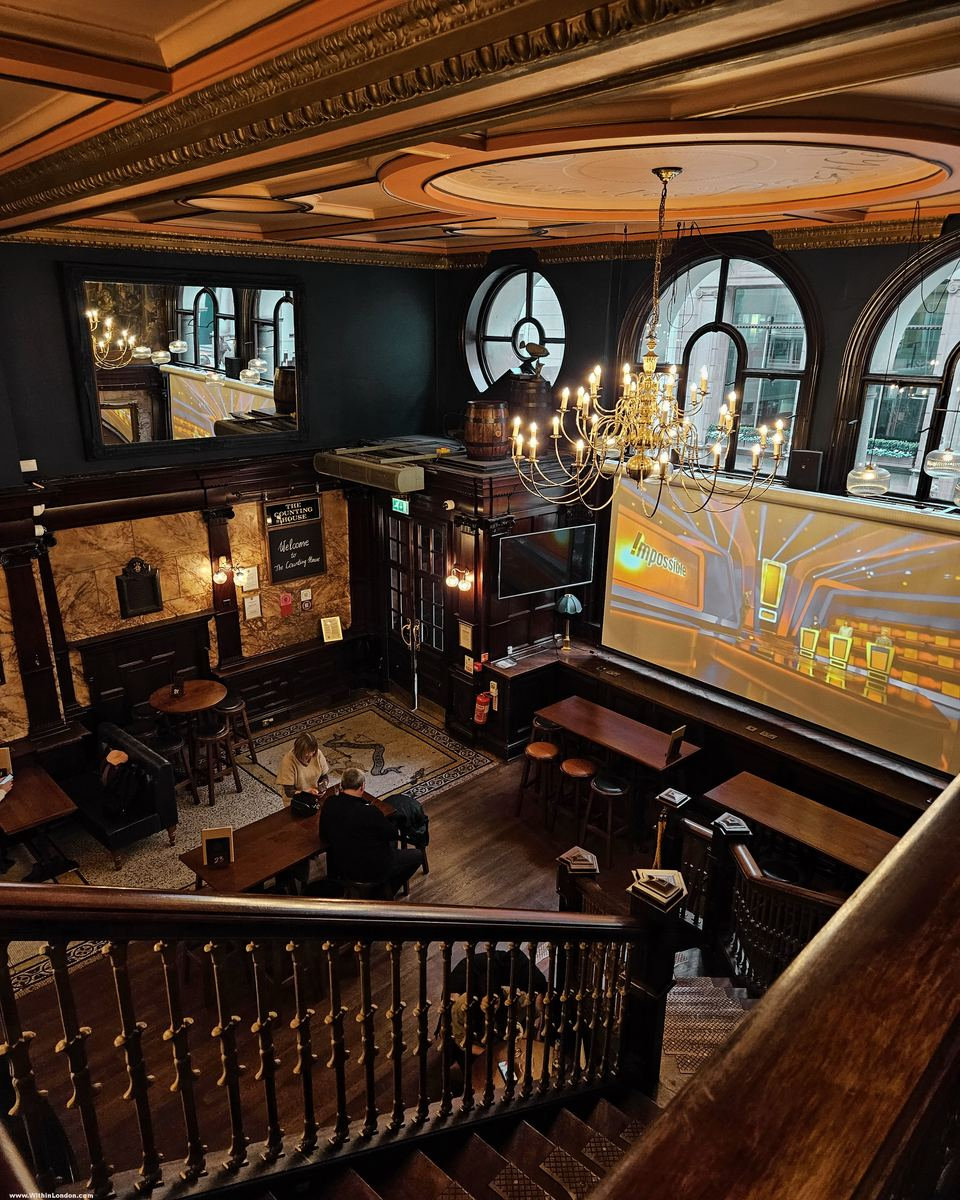
Up there it was a little calmer than the floor below, and the view was the whole point. From the balustrade the room reads like a stage set. A big screen showed sport while I was there. The pub advertises live sport, so match days are likely to be louder.
The upper floors hide another story. From 1895 the City University Club, a luncheon club for Oxford and Cambridge graduates working in the City, used the third to fifth floors of 50 Cornhill. It stayed until the end of 2017, then moved to Crutched Friars in January 2018.
Its old rooms were converted into 15 hotel bedrooms, which Fuller's opened in February 2019. So you can sleep above a Victorian banking hall, in rooms where City graduates once took their lunch.
What Lies Beneath The Counting House on Cornhill?
Roman London. The pub's own history says its foundations rest partly on the Roman basilica of Londinium. This was the civic heart of the Roman city, with offices, law courts and a treasury. After it was enlarged in the late first and early second centuries, it was the largest building of its kind north of the Alps.
The basilica stood at the north side of a great forum, which stretched south towards the river. You can see a surviving fragment of the Roman masonry in a basement near Leadenhall Market, a couple of minutes' walk from the pub. It was found when the market was built in 1880–82.
Cornhill itself is one of the three ancient hills of the City, along with Tower Hill and Ludgate Hill. Its highest point is 17.7 metres above sea level. That doesn't sound like much. But on a flat riverside city it was the obvious place for Rome to put its most important building.
What Other Curiosities Are on Cornhill?
Quite a few, for such a short street. St Peter upon Cornhill, a Wren church, is reputed to stand on the oldest Christian site in London. Legend links its founding to a King Lucius in the second century. Historians treat that story as legend, not fact.
London's first coffee house opened in St Michael's Alley, just off Cornhill, in 1652. Its owner was Pasqua Rosée. The coffee houses around here later became meeting places for merchants and stockbrokers, which fits the street's long life as a place for money.
At 32 Cornhill there is a pair of carved wooden doors by Walter Gilbert, made in 1939 for the Cornhill Insurance company. Its eight panels tell the street's history. One shows Charlotte and Anne Brontë visiting their publishers, Smith, Elder & Co, in 1848. The sisters had come to prove they were real people behind their pen names.
And then there is the name. A counting house was simply an office where a merchant or banker kept the books. In A Christmas Carol, Bob Cratchit leaves Scrooge's counting house on Christmas Eve. Dickens has him slide down Cornhill twenty times to celebrate. If you like the idea of a festive City walk, my guide to Christmas in the City of London covers the lights around here.
For a view over all these rooftops, the free viewing platform at 8 Bishopsgate is a short walk north. The Sky Garden is a little further south, on Fenchurch Street. West towards St Paul's, there is also the rooftop terrace at 25 Cannon Street. Any of them pairs well with a drink under the dome.
Visiting The Counting House: Practical Notes
📍 Where: 50 Cornhill, London EC3V 3PD, a short walk east of Bank junction.
⏰ Opening: In September 2026 the pub's website listed weekdays from 7am until 10–11pm, Saturday 8am to 10pm and Sunday 8am to 6pm. Hours change, so check the official site before you go.
📅 Open days: Open seven days a week. Weekday lunchtimes and after-work evenings are the busiest.
🎫 Admission: Free to walk in. You pay for what you eat and drink.
🚇 Getting there: Bank station (Central, Northern, Waterloo & City lines and DLR) is a couple of minutes away. Monument is a short walk south, and Liverpool Street is about ten minutes on foot.
🚗 Parking: Don't drive. The City has very little street parking and sits inside the Congestion Charge zone.
☕ Food: Pies, grills and Sunday roasts, served most of the day. The pub takes table bookings through its website.
⏳ How long: Half an hour to look around and take photos from the gallery. Longer if you're eating.
📷 Best time: The gallery gives the best view of the dome. For fewer people in the frame, avoid weekday lunch and the early evening rush.
🗺️ Nearby: Leadenhall Market, the Royal Exchange, St Michael's Alley, the Walter Gilbert doors at 32 Cornhill, 8 Bishopsgate and the Sky Garden.
♿ Access: CAMRA lists a step-free entrance and an accessible toilet on the main bar floor. The gallery is reached by stairs, so ask the pub about access upstairs.
Have you ever had a drink in an old banking hall, and did you look up at the ceiling before you looked at the menu?
_______________________
Did you enjoy this article? If you'd like to contribute to the running costs of WithinLondon, click the button below:
All photos were taken by Ina/WithinLondon, unless stated otherwise.


Comments