My 2-Day Hastings Itinerary: Old Town, Clifftops and St Leonards

Updated: 2 days ago
Shingle, white foam and a line of white seafront buildings. That is Hastings Pier, with gulls wheeling overhead and the sky completely blue. Behind me the pier stretched out to sea. In front of me the whole town sat on the beach, pushed up against two sandstone hills.

Hastings is a lot of town for two days. It has a fishing beach that has been in use for over a thousand years, two Victorian cliff railways and a Norman castle. It also has a smugglers' cave, a gallery clad in black tiles and a whole Regency seaside resort next door in St Leonards. Here is how I split it up, with the facts checked so you can plan your own.
What Does a 2-Day Hastings Itinerary Look Like?
My Hastings itinerary follows the lie of the land. Day one is the Old Town, squeezed into a valley between the West Hill and the East Hill. You walk its two old streets, then the Stade with its net shops, fishing boats and museums. The West Hill lift takes you up to the castle and the caves.
Day two starts on the other side of the valley. The East Hill lift climbs to the top of Hastings Country Park, with its cliffs and glens. After that you drop back down and head west along the seafront, past the pier, to the stucco terraces of St Leonards.
Everything on day one is within walking distance. Day two involves more walking, so it is worth wearing proper shoes. The seafront from the Old Town to St Leonards is flat all the way.
What Is There to See on George Street and All Saints Street?
The Old Town has two main streets. George Street runs parallel to the seafront and is pedestrianised. The High Street and All Saints Street run inland up the valley, with the timber-framed houses the Old Town is known for. On my visit George Street was strung with bunting. The café tables were out, and one had a vase of sunflowers on it.

The black-and-white building halfway along George Street is Ye Olde Pump House. It is a Grade II listed pub, and Historic England dates the building to the early 17th century. The listing is honest about it. The timber frame is described as much restored, the old weatherboarding was removed and the ground floor was rebuilt.
So some of what you see is 20th-century restoration on an older frame. It still makes a good photo, especially with the flower baskets hanging from the front.

If you like old high streets, I have written about similar walks in Saffron Walden and in Burford and Witney. Hastings is rougher around the edges than either, and closer to the water.
Why Are the Hastings Net Shops So Tall?
At the eastern end of the Old Town is the Stade, a shingle beach whose name is Saxon for a landing place. Boats have been hauled up here for over a thousand years. Along the back of the beach stand the net shops. These are tall, narrow wooden huts, tarred black and weatherboarded.
They were built to store nets, ropes and gear, and not to dry nets as people often assume. Nets were dried on the beach. The reason for the height is the ground. From 1835 the fishermen leased small plots from the council, roughly eight to ten feet square, for a fixed yearly rent.
With no room to spread outwards, the only way to get more storage was to build upwards. Most are two or three storeys high. At least 36 of them date from 1835 onwards, after the first groyne of 1834 trapped shingle and widened the beach. In 2010, 39 net shops were listed Grade II*.
The fishing boats are still there, drawn up on the shingle. The Stade has the largest fleet of beach-launched fishing boats in Europe. Because they are winched up the beach after every trip, the boats are kept to around ten metres long. They fish only a few miles out.
Right beside the net shops is Hastings Contemporary. It opened in March 2012 as the Jerwood Gallery and took its present name in 2019. The building by HAT Projects is covered in over 8,000 black glazed tiles, glazed in Kent. It shows changing exhibitions of modern and contemporary art.
What Is Inside the Hastings Fishermen's Museum?
The Fishermen's Museum is on Rock-a-Nore Road, in the middle of the net shops. It is housed in the former Fishermen's Church of St Nicholas, a mission chapel that served the fishing community from 1854. The museum opened in 1956 and was extended in 2001. The Old Hastings Preservation Society runs it.
The centrepiece is the Enterprise, which the museum describes as the last Hastings sailing lugger. She was built in 1912 and sits inside the old church. Around her are photographs, model boats and fishing gear from the beach outside. Entry is free, with donations welcome.
Are the East Hill and West Hill Lifts in Hastings Open?
Hastings has two cliff railways, one on each side of the Old Town. The council runs both. The West Hill lift starts on George Street and opened in 1891. It runs mostly through a tunnel in the cliff, still uses Victorian wooden carriages, and was powered by a gas engine until 1971.
The East Hill lift starts on Rock-a-Nore Road, beside the net shops. It opened in August 1902, and the council calls it the steepest funicular railway in the UK. The East Hill lift has had long closures over the years. The council's published 2026 timetable lists both lifts as running, so they can form part of any plan.
From 1 March to 30 September 2026 both run daily from 10am to 5.30pm. From October the West Hill lift runs daily from 11am to 4pm, while the East Hill lift runs at weekends only. An adult day return is £5.50 and both lifts take cards only. The East Hill lift has step-free access; the West Hill lift does not.
Was the Battle of Hastings Fought in Hastings?
No. William of Normandy landed at Pevensey on 28 September 1066. On 14 October he met King Harold's army about seven miles north-west of Hastings. A town grew up on the battlefield, and it is called Battle. William built Battle Abbey there, with the high altar on the spot where Harold was said to have fallen.
Hastings did get the first castle. William put up a wooden motte-and-bailey on the West Hill straight after landing. In 1070 he ordered it rebuilt in stone. Great storms in 1287 sent large parts of the cliff, and parts of the castle with it, into the sea. What is left is a ruin on the edge of the hill.
Hastings Castle opens seasonally from 10am to 5pm, with last entry at 4.30pm, and closes in winter. The official site lists adult tickets at £6.95. If you want to see the actual battlefield, trains from Hastings towards London stop at Battle, which makes it an easy add-on.
What Are St Clement's Caves in Hastings?
Also on the West Hill, a few minutes from the castle, are St Clement's Caves. They are sandstone caverns with a 140-metre tunnel known as Monks Walk. The earliest written mention dates from 1783. In the 1820s a local grocer, Joseph Golding, broke through into them while cutting a garden seat into the cliff.
During the Second World War the caves were used as an air-raid shelter. Since 1989 they have housed Smugglers Adventure, which tells the story of smuggling on the south coast. It closes in winter and reopened for 2026 on 14 February. Check its website for daily hours.
Why Is Part of Hastings Country Park Called the Firehills?
Day two starts at the top of the East Hill lift, which is the western edge of Hastings Country Park. The park covers 345 hectares of sandstone cliffs, heath and wooded glens along the coast towards Fairlight. It was formed in 1974. Most of it is a Site of Special Scientific Interest, and part is a Special Area of Conservation.
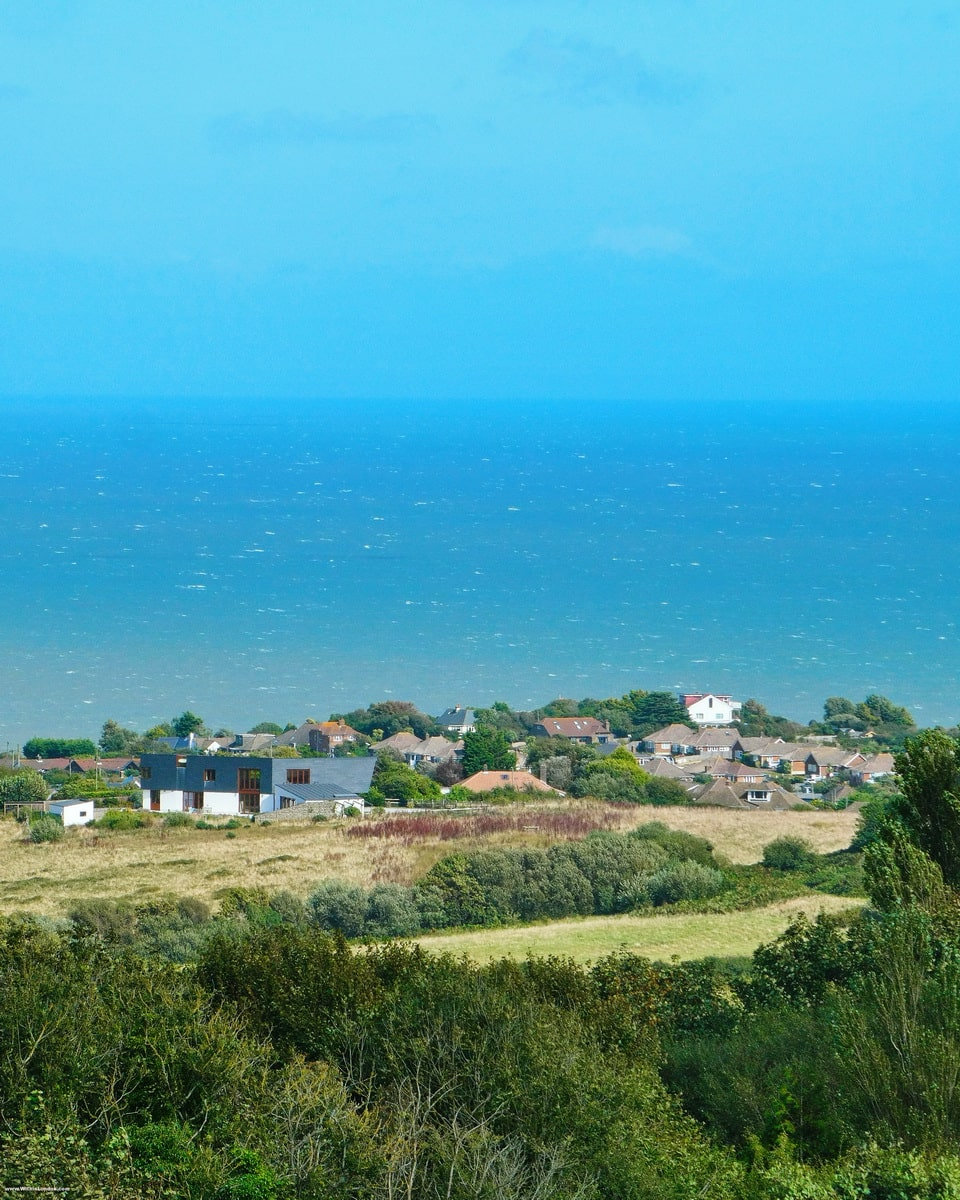
From the slopes I could see down over the houses to a very blue sea. Further east, the path runs along the cliff top between banks of gorse. Walkers were far off ahead of me, with nothing but water on the horizon.

This end of the park is known as the Firehills. The popular story is that the gorse flowers so yellow in spring that the hills look on fire. The Fairlight History Group disagrees. It traces the name to 19th-century rifle and artillery volunteers who held firing practice on these cliffs. Both explanations are told locally.
For a greener, woodier walk than the cliffs, my notes on Lyndhurst and the New Forest are a good contrast.
What Happened to Hastings Pier?
Back down in town, the seafront leads west to the pier. It opened on 5 August 1872 and was designed by Eugenius Birch. On 5 October 2010 a fire destroyed about 95 per cent of the structure above the deck. A community-backed rebuild by the architects dRMM followed.
The pier reopened in April 2016. In 2017 it won the RIBA Stirling Prize for the best new building in the UK. The charity running it went into administration in November 2017. In June 2018 it was sold to Sheikh Abid Gulzar, who also owns Eastbourne Pier.
In October 2025 the owner announced he intended to sell, and a community group registered its interest in buying it. The pier's future is unsettled, so check before you go. On my visit it was open. A pink Candy kiosk had candyfloss hanging along its front, with fairground rides turning behind.

How Did James Burton Build St Leonards?
Keep walking west along the seafront and Hastings turns into St Leonards-on-Sea. It began as a planned resort. The London builder James Burton started it in 1828 on open land west of Hastings. He modelled it on the stucco terraces he had built around Regent's Park, and his son Decimus Burton later designed parts of it too.
The centrepiece was the hotel on the seafront, opened in 1828 as the St Leonards Hotel. It is known today as the Royal Victoria Hotel and is listed Grade II. Historic England notes it was much altered in 1903. The hotel lists Gladstone, Palmerston and Tennyson among its past guests.
I photographed its sea view through a window with heavy curtains, with a wooden chair in front and a grey sea beyond.
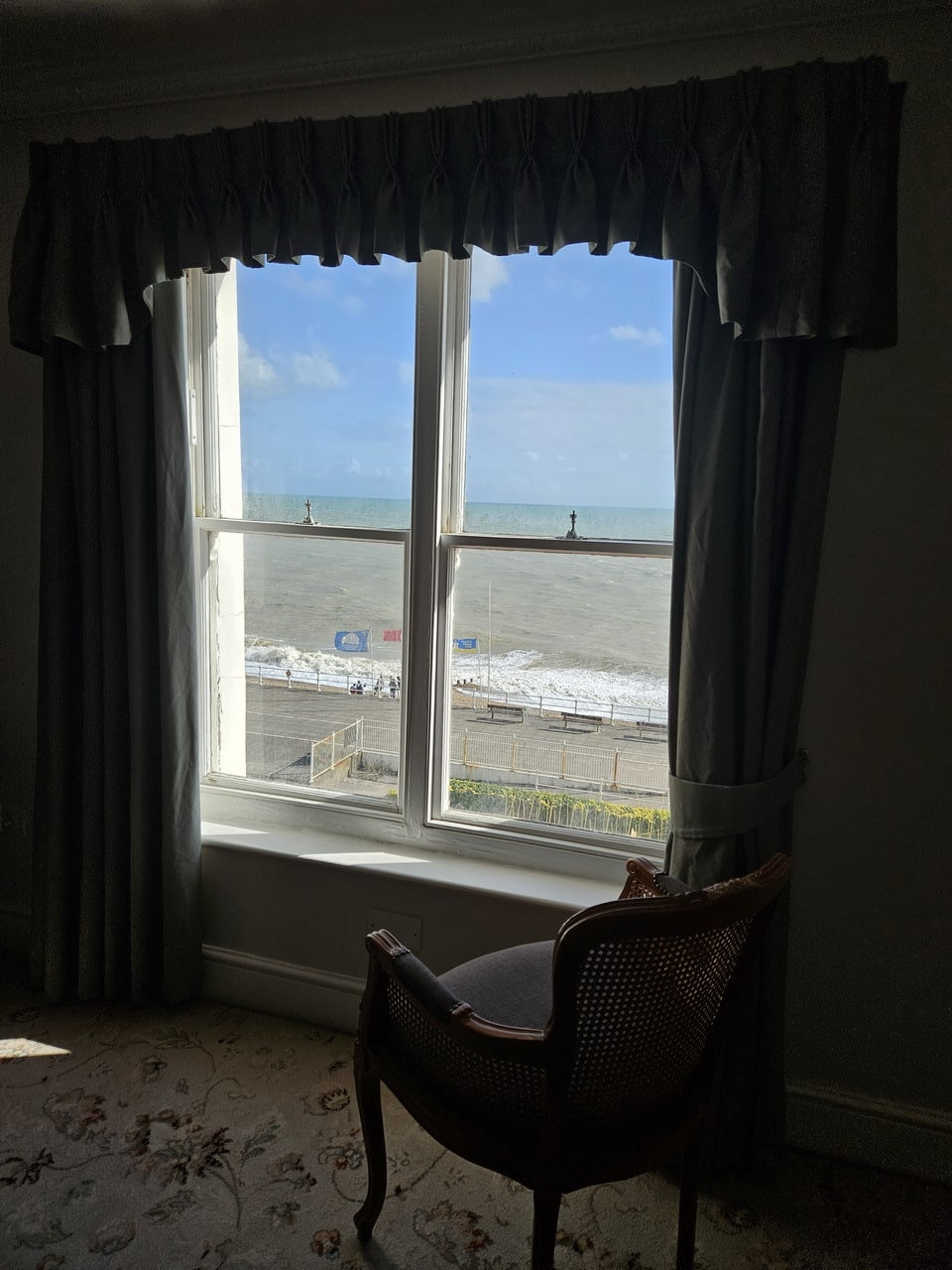
Inside, the public rooms are on a grand scale. There are cream columns, arches and a chandelier over a patterned carpet.

Behind the seafront, the Regency terraces rise in rows of tall pastel houses. Under a cloudy sky the colours were soft. If you like planned Georgian streets, I have a list of photo spots in Bath that shows the same style on a larger scale.

St Leonards is a quieter place to finish the second day. For a slower village trip from London, see my morning in Castle Combe.
Visiting Hastings: Practical Notes
📍 Where: Hastings, East Sussex, on the coast south-east of London. The Old Town is at the eastern end of the seafront; St Leonards is to the west.
🚇 Getting there: Southeastern trains run from London Charing Cross, calling at London Bridge and Tunbridge Wells, in under two hours. Or take the high-speed train from St Pancras to Ashford International and change for the hourly Marshlink train via Rye. Check times on the day.
⏰ Opening: Cliff lifts 10am to 5.30pm daily until 30 September 2026, shorter hours from October. Hastings Castle 10am to 5pm in season. Hastings Contemporary 11am to 5pm, Wednesday to Sunday. Fishermen's Museum 11am to 5pm April to October, 11am to 4pm in winter.
📅 Open days: The East Hill lift runs at weekends only from October to February. Hastings Castle and Smugglers Adventure close in winter, so check their websites.
🎫 Admission: The Fishermen's Museum is free. Lift day return £5.50. Hastings Castle adult £6.95. Hastings Contemporary adult £9, or £10 with Gift Aid. Prices change, so confirm before you go.
🚗 Parking: There is a pay-and-display car park at Rock-a-Nore by the net shops. It fills up on sunny weekends, so arriving by train is easier.
⏳ How long: Two full days covers the Old Town, both hills, the pier and St Leonards. Add half a day for Battle Abbey.
📷 Best time: A clear, sunny day for the view from the pier and across the country park to the sea.
🗺️ Nearby: Battle, one stop up the line, for the battlefield and abbey. Rye is on the Marshlink line towards Ashford.
♿ Access: The East Hill lift is step-free; the West Hill lift is not wheelchair accessible. The Old Town and the seafront are flat, but the hills are steep.
Have you done Hastings in two days, and did you head for the cliffs or the Old Town first?
_______________________
Did you enjoy this article? If you'd like to contribute to the running costs of WithinLondon, click the button below:
All photos were taken by Ina/WithinLondon, unless stated otherwise.


Comments