13 Photo Spots in Bath, and When the Light Is Right
Updated: Sep 28
Bath is the easiest photo day trip I know from London. The train from Paddington takes about an hour and twenty minutes, the whole centre is walkable, and almost every street is built from the same honey-coloured stone.
That stone is the point. It goes flat and grey under a midday sky and glows in low sun, so in Bath the question is less where to stand than when. Here are thirteen spots I keep going back to, in a rough walking order, with a note on the light at each.
Where Do I Start a Photo Walk in Bath?
1. Topping & Company Booksellers. I start on York Street, a minute from the Abbey. Topping's took over a Grade II listed former Friends Meeting House in 2019, and the shop is a high-ceilinged hall lined with wooden shelves and rolling ladders.
Staff offer tea or coffee while you browse, which is as good a reason as any to slow down. Shoot the long aisles from the far end so the shelves converge, and keep the phone level or the ladders lean.

2. Broad Street. From the shop, cut north past the Abbey to Broad Street. It is an ordinary shopping street of Georgian shopfronts, but stand near the top and look south and the Abbey tower closes the view at the end of the road.
Morning is best here, before delivery vans fill the kerb. I like it with a few people in the frame; empty, it looks like a film set.

Which Angle Works at the Roman Baths?
3. The Roman Baths. Everyone photographs the Great Bath from the terrace, and the terrace is Victorian. The columns and statues around the pool date from the 1890s; the Roman part is the bath itself and the lead-lined floor beneath the green water.
The better shot is from ground level, at the far corner, with the Abbey tower rising behind the colonnade. On a cold morning the warm spring water steams, and the first slot of the day is the one to book.
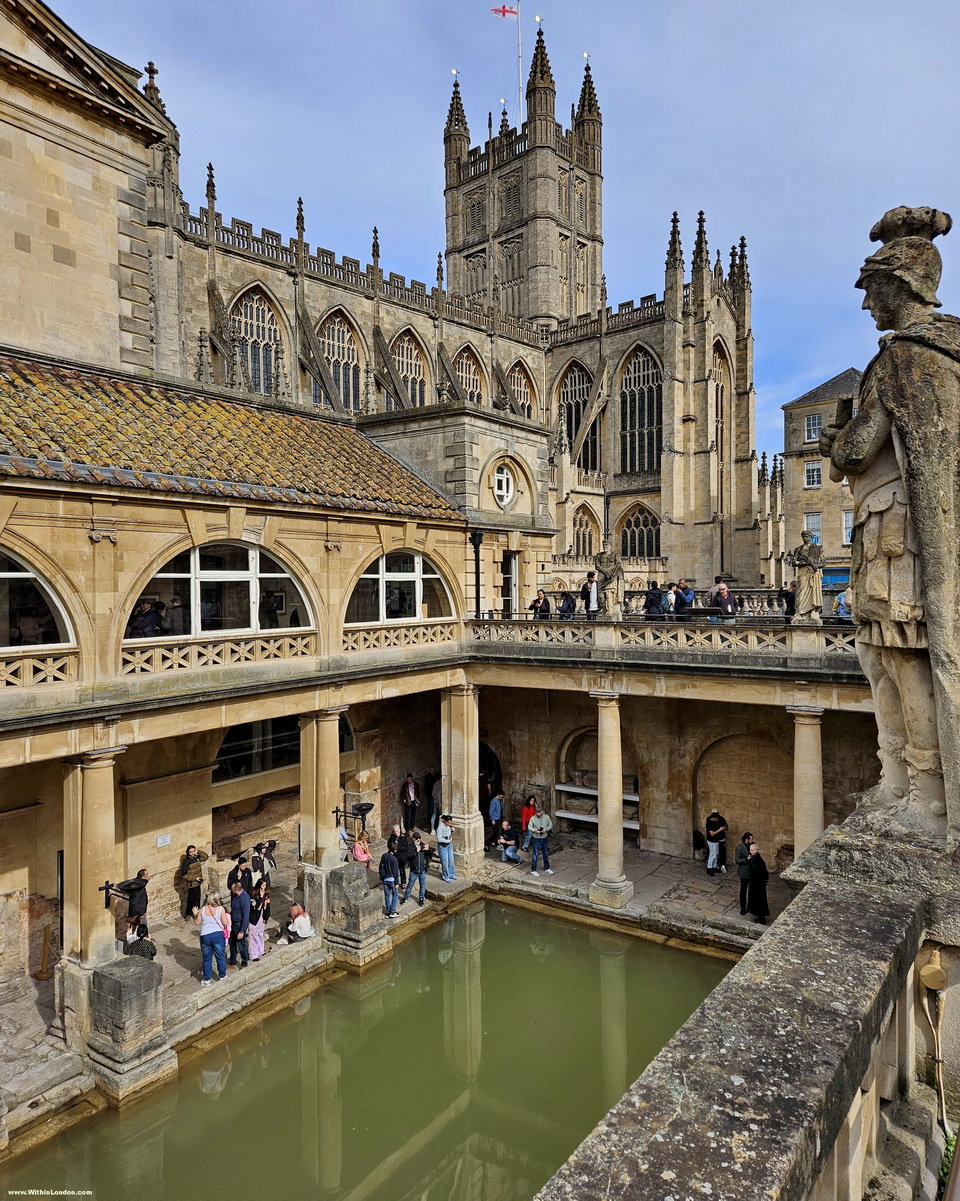
Tickets are timed and priced by day. In summer 2026 an adult ticket booked in advance was £29 on a weekday and £33 at weekends, with a £2 surcharge for buying on the door. Allow two hours.
Is the Bath Abbey Tower Tour Worth the Climb?
4. The Abbey Tower. Yes, if your knees agree. The tower tour climbs 212 steps in stages, past the bell chamber and the back of the clock face, to a roof with the whole city laid out below.
From the top you get the Roman Baths as a green rectangle, the river and Pulteney Bridge to the east, and the hills ringing everything. Tours run Monday to Saturday, are booked in advance, and cost £18 for an adult in 2026.

Go for a late afternoon slot. The stone below turns gold, and the shadows give the terraces some depth. The parapet is high, so a phone held above it works better than a big camera.
Where Is the Best Free View Over Bath?
5. Sham Castle. Sham Castle is exactly what it says. It is a single Gothic wall with a central arch and two round turrets, built in 1762 for Ralph Allen so that he had something castle-like to look at from his townhouse in the city.
There is nothing behind it and nothing to climb. The reward is the field in front, which drops away to the whole of Bath. It is a steep half-hour walk up from the canal at Bathwick, or a short one from the University of Bath bus stop.
The facade faces west, so the last hour of sun lights it head-on while the city below goes blue. It is floodlit after dark, which makes a different picture again.
When Is the Light Right on the Royal Crescent and the Circus?
6. The Royal Crescent. Thirty houses in a single sweep, designed by John Wood the Younger and built between 1767 and 1774. The whole facade faces roughly south, so it is lit for most of the day and glows warmest in the last two hours before sunset.
The obvious frame is from the lawn below, with the ha-ha in the foreground. For something less obvious, walk to either end and shoot along the curve, so the columns stack up like a row of pages.
7. The Circus. Two minutes east, the Circus is the father's work: John Wood the Elder began it in 1754. Three curved blocks form a full ring around a circle of plane trees, with three streets leading off.
The trees make it hard to get the whole ring in one frame, and I have stopped trying. Instead stand in one of the three entrances and shoot across, or go in winter when the branches are bare and the stone shows through.
Which Other Georgian Streets Are Worth the Walk?
8. Great Pulteney Street. If you want the long, straight, symmetrical version of Bath, this is it. Great Pulteney Street runs for 300 metres from Pulteney Bridge to the Holburne Museum, and it is the widest street in the city.
Shoot it from the museum end in the morning, with the sun behind you, or from the bridge end in the evening. Lansdown Crescent, high on the hill to the north, is the quieter alternative if the Royal Crescent is busy.
Where Does the River Make the Shot?
9. Pulteney Bridge. Robert Adam's bridge, finished in 1774, carries a row of shops on both sides, so from the road you would not know you were crossing a river at all. The picture is from below.
Stand on the riverside walk by Parade Gardens, or on the weir side by Grand Parade, and you get the three arches, the horseshoe weir in front of them and the shopfronts above. Morning light hits this face of the bridge.

10. Parade Gardens. The gardens sit below Grand Parade, right on the river, and give you the same bridge view with flowerbeds in the foreground. There is a small entry charge for non-residents in the summer months, and deckchairs when it is warm.
The planting changes with the season, so the bedding is the subject as much as the bridge. Come in the afternoon, when the sun has moved round to the beds.

Which Gardens in Bath Are Worth an Hour?
11. Sydney Gardens. At the top of Great Pulteney Street, behind the Holburne, Sydney Gardens opened in 1795 as a pleasure garden. Jane Austen lived opposite. The Kennet and Avon Canal and the railway both cut through it, crossed by little cast-iron and stone bridges.
The canal bridges are the photograph. Early morning, with the water still, you get the bridge twice.
12. The Holburne Museum. The museum's building closes the vista at the end of Great Pulteney Street, and the front lawn and café garden are free to walk into. The glass extension at the back, opened in 2011, is the modern counterpoint to the stone front.
The collection costs £16.50 for an adult in 2026, with free entry to the collection on Wednesdays after 3pm. For a photo, though, the exterior and the garden are enough.
Does Bath Have Any Street Art?
13. Walcot Street. Bath is not a mural city, but it has one street that tries. Walcot Street, north of Broad Street, is the artisan quarter, and the alleys and yards behind it carry most of the city's painted walls. They change often, which is the fun of it.
Look for the passage behind the shops and the walls around the car parks. Overcast light is best here; the colours read better without shadows across them.

How Do I Fit Thirteen Spots into One Day?
Start at Topping's when it opens, do Broad Street and the Baths before the coach parties, and take the Abbey tower in the afternoon. The Crescent and the Circus are a fifteen-minute walk uphill and want the evening light anyway.
Sham Castle is the one that does not fit. Save it for a second day, or for a summer evening when the last train back gives you time.
If you are staying overnight, Bath is also the natural base for the southern Cotswolds. Castle Combe is 25 minutes away by car and best seen before nine. Westonbirt Arboretum is 40 minutes and worth the whole of an autumn morning. I put both into a Cotswolds weekend from London, if you want the longer version.
Visiting Bath: Practical Notes
📍 Address: Bath Spa station, Dorchester Street, Bath BA1 1SU. Everything above is within a 20-minute walk, except Sham Castle.
🎫 Cost: Roman Baths from £29 (adult, weekday, advance, summer 2026); Abbey tower tour £18; Holburne Museum £16.50; Parade Gardens a small charge for non-residents in season. Everything else is free.
🕒 Opening: Roman Baths 9am to 6pm, last entry 5pm, longer in summer; Topping's 8.30am to 9pm daily; Holburne 10am to 5pm, Sundays from 11am; Abbey tower tours Monday to Saturday.
🚉 Getting there: GWR from London Paddington to Bath Spa, about 1 hour 20 minutes, two trains an hour. Book in advance for the cheap fares.
☕ Food: Tea or coffee while you browse at Topping's; the Holburne garden café; the Pump Room next to the Baths if you want the full Georgian experience.
⏳ How long to allow: A full day for the twelve central spots; add a half day for Sham Castle.
📷 Best time to go: Late afternoon for the Royal Crescent, the Circus and the Abbey tower; morning for Broad Street, Pulteney Bridge and Sydney Gardens; the last hour of sun for Sham Castle. Winter gives you empty streets and low light all day.
🗺️ Nearby: Castle Combe (25 minutes by car), Westonbirt Arboretum (40 minutes), Bradford-on-Avon (15 minutes by train).
Photography rules: Handheld cameras are fine at the Roman Baths and on the tower tour; tripods are not. The Royal Crescent and the Circus are lived-in streets, so keep off the doorsteps.


Comments