Chinatown in London: The Gates, the Lanterns and Where to Eat

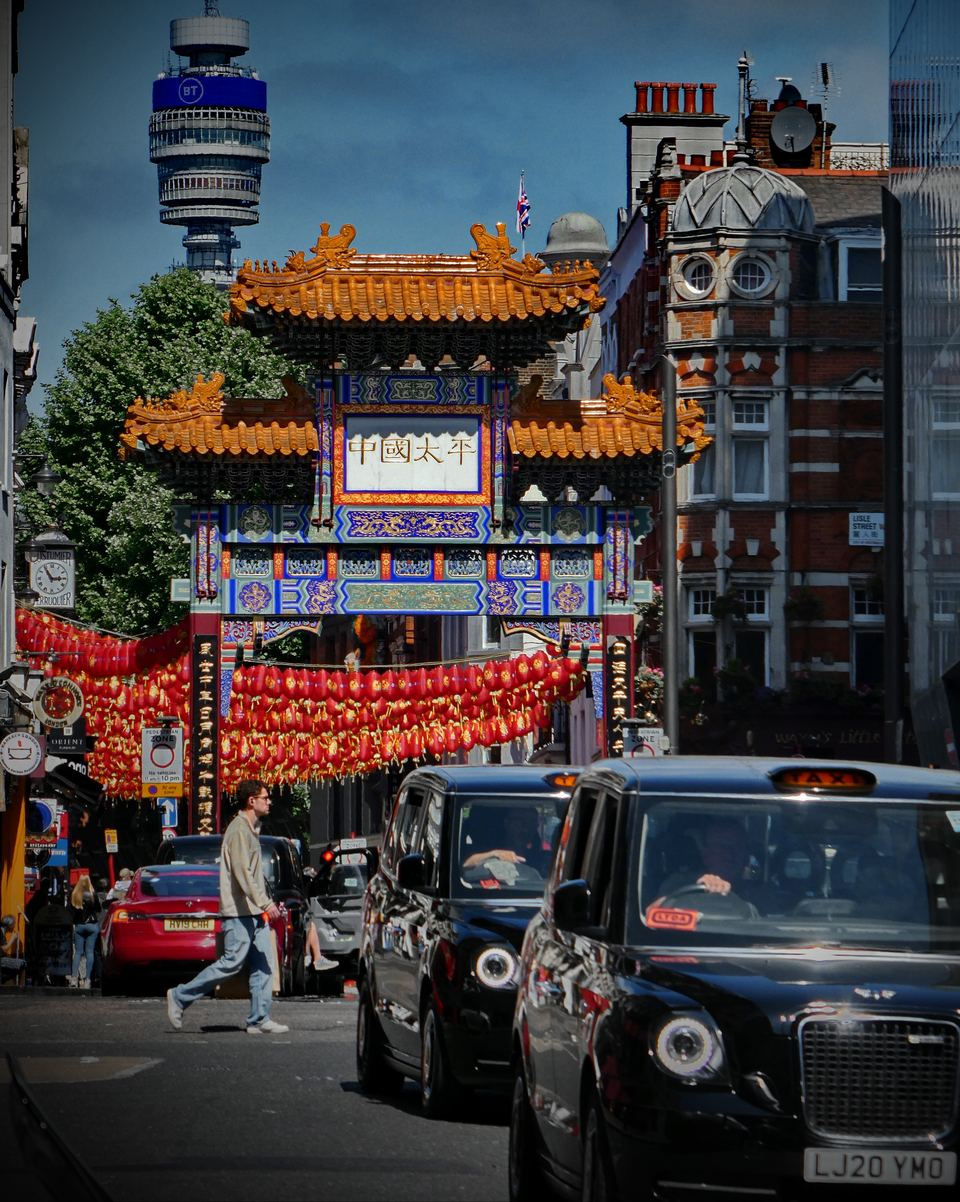
Stand at the bottom of Wardour Street and look north, and the whole thing is in one frame: a huge green and blue Chinese gate with upturned eaves, a thousand red lanterns strung away behind it in receding lines, a black cab, and the BT Tower sticking up over the top of it all. There is nowhere else in London that looks like that.
Chinatown in London is twelve mostly pedestrianised streets wedged between Shaftesbury Avenue and Leicester Square, and it is far older, far more layered and far better than the two-restaurants-and-a-photo version most visitors get. Here is how it got here, what the gates and the lanterns actually are, and where to eat once you have finished photographing the ceiling of lanterns.
From Limehouse to Gerrard Street
London's first Chinatown was not here. It was in Limehouse, out east by the West India and East India Docks, and it grew from the eighteenth century onwards around Chinese sailors working the East Asia shipping lines. By the early twentieth century it was a real settlement of boarding houses, laundries and grocers.
It was also comprehensively libelled. The opium den of the popular imagination, the Sax Rohmer novels, the Thomas Burke stories, all of that was a sensational fiction laid over a small, ordinary, working community. It is worth saying plainly, because the myth has outlived the place.
Limehouse was heavily bombed in the Blitz, the docks went into decline, and post-war clearance dispersed what remained. At the same time two things pulled the community west: British servicemen coming home from the Far East had developed a taste for Chinese food, and immigration from Hong Kong's New Territories, accelerating after agricultural collapse there in the 1950s, supplied both the cooks and the customers.
The first Chinese restaurants in the West End clustered on Lisle Street in the 1950s and 60s. Gerrard Street next door was cheap, shabby post-war property, and through the 1960s Chinese businesses took it over. By the 1970s everybody called it Chinatown; in 1985 Westminster City Council made it official, adding the gates, the pagoda in Newport Place and the Chinese street furniture.
Gerrard Street itself was laid out between 1677 and 1685 and has had an absurd run of tenants. John Dryden lived at number 43. Edmund Burke at number 37. Johnson and Reynolds founded The Club at the Turk's Head at number 9 in 1764. Dickens put Jaggers' house here in Great Expectations. Ronnie Scott opened his club in the basement of number 39 in 1959, and Led Zeppelin held their first rehearsal in a Gerrard Street basement in August 1968. It is a very busy street.
The Four Gates, and Why One Looks Different
There are four paifang gates. Three small ones stand on Gerrard Street and went up in 1985 and 1986, part of Westminster's formal recognition of the quarter: red pillars, calligraphy, tiled roofs, pleasant and frankly a bit decorative.
The fourth is the one on Wardour Street at the Shaftesbury Avenue end, and it is a different order of things. The foundation stone was laid in July 2015, positioned by feng shui, and it was opened in July 2016 by the Duke of York to mark the UK-China Year of Cultural Exchange. It is the largest Chinese gate in the UK, built in Qing dynasty style in blues and greens rather than red, hand-carved by Chinese artisans, shipped over, and assembled on site.
Look at the two side by side, and the difference is obvious in the bracketing under the eaves. The 1980s gates are an impression of a paifang. The 2016 one is a paifang. It also marks the physical expansion of Chinatown onto Wardour Street, which is where a lot of the best eating now is.

The Lanterns Are Not for Chinese New Year
This surprises people. The red lanterns strung across Gerrard Street, Wardour Street, Newport Place and Lisle Street are permanent. They are not put up for the new year and taken down after. They are there in March and in August and on a wet Tuesday in November.
They do get replaced. In September 2020, as part of the Love Chinatown campaign, the estate's landlord and the London Chinatown Chinese Association installed a completely new set, retiring lanterns that had been hanging for over forty years. That run included a rainbow-tinted section as a tribute to NHS and key workers.
Photographically, the trick is not to shoot them flat. Stand under a run and shoot up the line so they stack into a receding canopy, or find a foreground: a red telephone box in one of the side lanes, a shopfront, the gate. My favourite photograph from the whole morning is a plain red phone box in a quiet back street with lanterns going overhead, which is about as London as an image gets.
Where to Eat in Chinatown in London
There are something like eighty to a hundred restaurants here and the mix is now pan-Asian rather than only Chinese: Sichuan hotpot, Hong Kong dim sum, Vietnamese pho, Korean barbecue, Japanese matcha. A few reliable anchors.
Four Seasons at 12 Gerrard Street is the roast duck benchmark, and has been since 2007. The ducks come from a farm in Ireland and hang in the window in rows. There are three branches within a few hundred yards, and people have firm opinions about which one is better, and which is the correct amount of seriousness to bring to roast duck.
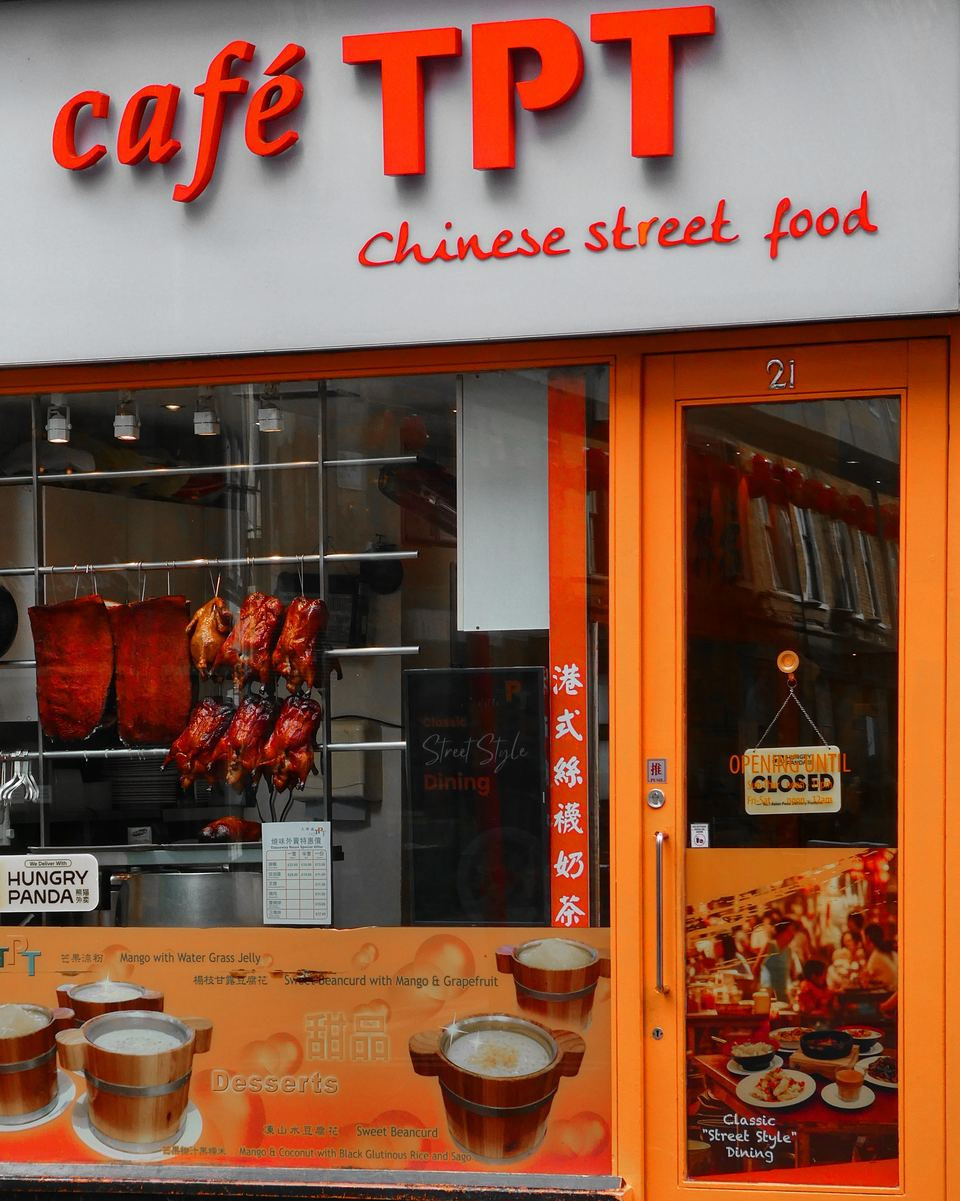
Café TPT at 21 Wardour Street does Cantonese and Malaysian street food, the sort of menu that runs to several hundred items and includes bak kut teh and an extremely long bubble tea list. It opens until eleven most nights and midnight on Fridays and Saturdays. The orange frontage with the ducks in the window is one of the most photographed shopfronts in the area.
Wong Kei at 41 to 43 Wardour Street is the legend, and the legend needs updating. For decades it had a reputation as the rudest restaurant in London, where you were shouted upstairs and told where to sit. It was refurbished in 2001 and has been perfectly pleasant ever since, which slightly disappoints people. Go anyway: the building is by the theatrical wigmaker Willy Clarkson, with a foundation stone laid by Sarah Bernhardt in 1904 and a coping stone by Henry Irving in 1905.

For bakeries: Golden Gate Cake Shop at 13 Macclesfield Street does more than eighty kinds of Cantonese cake and bun, and Chinatown Bakery at 7 to 9 Newport Place does Hong Kong-style roast pork buns and egg tarts for about the price of a coffee. Go before two in the afternoon while the trays are still full. Loon Fung on Gerrard Street is the supermarket, and worth ten minutes even if you are not cooking.
One more thing: Newport Court has quietly become dessert alley, a run of East and South East Asian dessert shops that did not exist a decade ago. And the old advice about bringing cash is out of date. Card is standard now, though a few small bakeries and kiosks still prefer notes.

Lunar New Year in the West End
The first organised celebration was in 1985. It expanded into Leicester Square and Trafalgar Square in 2002, and it is now run by the London Chinatown Chinese Association with the Mayor of London.
The shape of the day is a parade that starts near Trafalgar Square and works its way through the West End into Chinatown, a free stage programme in Trafalgar Square with lion and dragon dances, and food and events spilling across Chinatown, Shaftesbury Avenue, Leicester Square and Charing Cross Road. It usually falls on the Sunday closest to the new moon in late January or February. Organisers describe it as the largest celebration outside Asia, and it draws hundreds of thousands of people.
Honest advice: it is a wonderful day and a terrible day to photograph anything. If you want the pictures, come on an ordinary weekday morning. If you want the atmosphere, come to the parade and accept that you will see it over somebody's shoulder.
Visiting Chinatown in London: Practical Notes
Where it is: centred on Gerrard Street, W1D, with Lisle Street, Newport Place, Newport Court, Little Newport Street, Macclesfield Street, Rupert Street and the lower end of Wardour Street. Twelve streets, mostly pedestrianised since the mid-1980s scheme.
Getting there: Leicester Square is under two minutes away and is the obvious one. Piccadilly Circus and Tottenham Court Road are both under ten minutes on foot. Do not attempt to drive.
When to go: evening for the lanterns and the gates lit up, which is the photogenic hour. Weekday lunchtime for dim sum without a wait. Avoid half past six to half past eight on a Friday or Saturday unless you enjoy queueing. Roast meat windows and bakeries are best before two.
Cost: free to walk. A bun is a couple of pounds, a bowl of noodles under fifteen, a proper roast duck dinner for two rather more.
What to know: it is busy, it is narrow, and the crowd at the gate on Wardour Street is permanent. Be patient with the people photographing it, because you are about to become one of them.
Nearby: Leicester Square is thirty seconds away, Soho starts on the other side of Shaftesbury Avenue, and Cecil Court with its Victorian bookshops is five minutes south. For more West End photographs there is Covent Garden as a neon wonderland, and London's prettiest streets covers the rest. If you want a different corner of Asian London, Japan House on Kensington High Street is free and consistently good.
Chinatown in London is not a theme park, and it has not been tidied into one. It is a working neighbourhood that has fed three generations of Londoners, with an argument about roast duck going on under a permanent ceiling of red lanterns. Go hungry.
_______________________
Did you enjoy this article? If you'd like to contribute to the running costs of WithinLondon, click the button below:
All photos were taken by Ina/WithinLondon, unless stated otherwise.


Comments