The Best Christmas Lights in London, Ranked

Updated: 5 days ago
Every list of the best Christmas lights in London puts the same ten things in a slightly different order, and most of them are ranked by whoever had the best press release. So here is mine, ranked honestly, based on standing under all of them in the cold with a camera.
The short version: Regent Street is genuinely the best and it is not close. Covent Garden is the best place to actually spend an evening. And the City of London, which I had at number one in the first version of this article, is a pleasant twenty-minute detour rather than a destination, and I have moved it accordingly.
What follows is the best Christmas lights in London in the order I would actually send someone to see them, with what each one is, when it switches on, and how to see it without spending the evening in a queue. All of them are free unless I say otherwise, and every photograph here is my own. I add to this list every year, so if something new has gone up, it will turn up here.
How I Ranked the Best Christmas Lights in London
Three things decided the order. Scale, meaning how much of it there is and whether it changes the whole street rather than one building. Whether it is worth a special journey, or just something nice you pass. And whether it still looks good in a photograph taken by a normal person with a phone at half past five on a wet Tuesday, which is when most of us actually see it.
Anything that only really works if you are already standing in front of it for another reason got demoted. That is the honest test, and it is why a couple of very handsome City buildings are now near the bottom.
1. Regent Street: The Spirit of Christmas
Nothing else in Britain is at this scale. More than thirty winged angels, each with a wingspan of around seventeen metres, hang the full length of Regent Street from Langham Place down to Waterloo Place, and spill into Jermyn Street, Glasshouse Street, Swallow Street and St James's Market. There are over 300,000 LEDs in them, programmed so the wings appear to beat as you walk underneath.
They were designed by Paul Dart of James Glancy Design with The Crown Estate, first went up in 2016, and have come back every year since, which is unusual and, I think, correct. The frames alone took more than two thousand hours of welding. Regent Street was the first street in Britain to have Christmas lights at all, back in 1954, and in 1955 it strung up snowflakes made from recycled aircraft landing lights.
The single best view is standing in the middle of the road at the pedestrian crossing near the Quadrant, looking north, with the curve of the street pulling the angels away from you in a line. Do it at about half past nine when the traffic thins.

Switch-on is usually the first week of November, and the lights come down around 4 January. Nearest tube: Oxford Circus at the top, Piccadilly Circus at the bottom.

2. Covent Garden and Seven Dials
If Regent Street is the best display, Covent Garden is the best evening. The Market Building is hung with forty giant bells, twelve enormous baubles and eight spinning mirror balls, finished with something like twenty-nine miles of gold leaf and 275kg of glitter. There are around 260,000 bulbs across the piazza and the streets around it, and the tree on the West Piazza by the Royal Opera House is a 55ft Norway spruce carrying about 30,000 lights and two hundred baubles. It takes roughly sixty people to dress it.
There is artificial snowfall in December, an 1884 hand-painted sleigh you can photograph, mulled wine, and choirs on Thursday evenings.
Then walk two minutes north to Seven Dials, which since 2024 has had the best single piece of lighting design in London: 150,000 lights in curving canopies radiating out from the sundial pillar down Monmouth Street and Earlham Street, so you walk through a tunnel of warm gold. It is calmer than the piazza, thirty seconds away from it, and almost nobody photographs it properly.

Both switch on in the second week of November. Covent Garden's lights usually come down at the very end of December, earlier than most. Use Leicester Square rather than Covent Garden station, which is frequently exit-only in December.
3. Carnaby Street
Carnaby does something different every year and it is the only display in London with a sense of humour. Sixty thousand LEDs in six-metre sculptural forms hang the length of the pedestrianised street, and they are reprogrammable, which is why the same hardware has come back recoloured for several seasons: Carnaby Universe in 2023, Into the Light in white in 2024, All Is Bright in full colour in 2025.
It is a five-minute walk from Oxford Street and feels like a completely different and more playful city. There is also a charity partner each year, which has included Choose Love and Centrepoint, and the switch-on is an actual street party rather than a photo opportunity.

4. Oxford Street
Five thousand stars made of more than 300,000 LED bulbs, running the length of the street, and fully recyclable. The same design has been up since 2021, so if it feels familiar, it is.
It is on this list for scale and for history rather than for invention. Oxford Street first lit up in 1959, the lights were scrapped in the late sixties, and they came back in 1978 with a Star Wars laser display, which is the single most 1978 sentence I have ever written. The switch-on is now the earliest in London, usually the first Monday in November, and there is no public ceremony, so you lose nothing by skipping the night itself.
The photograph everybody wants is the stars overhead with a red bus underneath. Go late. The lights go off at eleven, and by half past ten the pavements have cleared enough to stand still.

5. New Bond Street and the Mayfair Flagships
I have merged what used to be three separate entries on this list, because Bond Street is one experience and you should walk the whole thing end to end.
The street lights themselves are called The Jewel in the Crown: 93,652 LEDs forming a tiara-like gateway, diamond and pearl crossings along the street, and four crowns modelled on the Imperial State Crown at the junctions. They replaced a peacock feather scheme that ran for about eight years, and they use around 75 per cent less energy than it did.
But the real show is the shops competing with each other. Cartier wraps the store in an enormous red ribbon, which is the most reliably spectacular of the lot. Dior goes all in on a single theme each year and rewards standing still for two minutes rather than photographing and moving on. Ralph Lauren puts a five-metre Nordmann fir outside 1 New Bond Street as a Giving Tree for The Royal Marsden Cancer Charity, with calligraphers writing personalised star ornaments. Louis Vuitton, Boodles, Chaumet, Bulgari, Tiffany and Mikimoto all do something. In 2024 Chanel hung a giant illuminated bow across its facade, which was the best single thing on the street that year.

The cumulative effect after dark is the point. One window is a shop display; twenty of them lit in a row is an event.

Carry on into the Mayfair backstreets afterwards. Claridge's and Brown's both do a tree, the townhouses hang wreaths, and the side streets are lit and almost empty while Bond Street itself is shoulder to shoulder.

Bond Street switches on in the second week of November and, unusually, its lights tend to stay up into the second week of January.

6. Leadenhall Market
The best thing in the City by a distance, and the one place on this list where the building is doing most of the work. Sir Horace Jones's 1881 arcade is painted cream, maroon and green with an ironwork and glass roof, and at Christmas it gets a large tree and lights strung through the ironwork.
There is artificial snowfall twice a day, usually at midday and six, and an Alpine Lodge pop-up doing mulled things. It is not a Christmas market, despite what a lot of listings imply: it is a working arcade with resident shops and pubs and occasional weekend pop-ups.
The great advantage is that the City empties out. Come at seven on a weekday evening, and you can stand in the middle of the arcade and take a photograph with nobody in it, which is impossible anywhere in the West End in December. The flip side is that at weekends a lot of it is shut, so check before you make a Saturday trip of it.

Bank or Monument, three to five minutes' walk.
7. Battersea Power Station
The newest entry on the list and the one that has improved fastest. A 40ft tree with more than a thousand baubles in Malaysia Square, a set of oversized red baubles on the riverside piazza that photograph beautifully against the chimneys, giant candy canes along Electric Boulevard, Art Deco dressing in Turbine Hall A and snowflake projections in Turbine Hall B.
Glide, the ice rink, comes back each festive season, and recently added a 200-metre skate trail as well as the rink itself. Lift 109 takes you up inside the north-west chimney for a 360-degree view over the whole lit-up city, which is the only place on this list where you can see the other displays from above. Both of those are ticketed; everything outside is free.

It runs from early November to about 4 January. Battersea Power Station station, Northern line, is directly outside.
8. Somerset House
Skate at Somerset House put an ice rink in the Edmond J. Safra Fountain Court and has been doing it for around twenty-five years. There is a 40ft tree, the courtyard walls get lit, and the whole thing sits inside one of the best neoclassical courtyards in Europe.
The loophole worth knowing: you do not need a skate ticket to walk in. The courtyard is free and open, there is rinkside viewing including wheelchair-accessible space, and standing at the edge watching other people fall over while holding a hot drink is arguably the better deal. Skating runs roughly mid-November to the second week of January and tickets are typically somewhere between eleven and twenty-six pounds depending on the slot, so book early if you want the cheap end.

Temple is the closest station, though Covent Garden, Charing Cross and Embankment are all walkable.

9. Liberty and the Soho Edges
Liberty's mock-Tudor facade is the most photogenic shopfront in London at any time of year and it is extremely good with lights on it and trees either side of the door.
It is worth knowing what you are looking at. The building went up between 1922 and 1924 to a design by Edwin T. Hall and Edwin Stanley Hall, and it is built from the timbers of two Royal Navy ships, HMS Impregnable and HMS Hindustan: more than 24,000 cubic feet of ships' oak and teak. HMS Impregnable had itself been built from 3,040 New Forest oaks, and HMS Hindustan's length and height match the finished store exactly. There is a gilded copper Mayflower weathervane on the roof.
The Christmas shop on the fourth floor opens in September, which tells you everything about how seriously they take it. Go on a weekday morning; December afternoons in there are a scrum.

10. Burlington Arcade
Understated rather than spectacular, and on the list because the setting does something no street can. Crystal chandeliers run the full length of the 1819 arcade, with a suspended installation every few bays. The 2025 theme was the Twelve Days of Christmas, so there was a partridge in a pear tree, turtle doves above the jewellers, swans wearing the arcade's coronet and nine ladies dancing in Regency dress and Manolo Blahnik shoes.
Ten lords a-leaping was a nod to the Beadles, the arcade's own uniformed guards, who are the oldest and smallest private police force in the country and still wear top hats and frock coats. They used to enforce a ban on running, singing, whistling and opening umbrellas.
It takes four minutes to walk and it is worth doing on your way between Bond Street and Piccadilly. Green Park or Piccadilly Circus.

Also Worth the Detour
Things that did not make the ten but that I would still walk past on purpose.
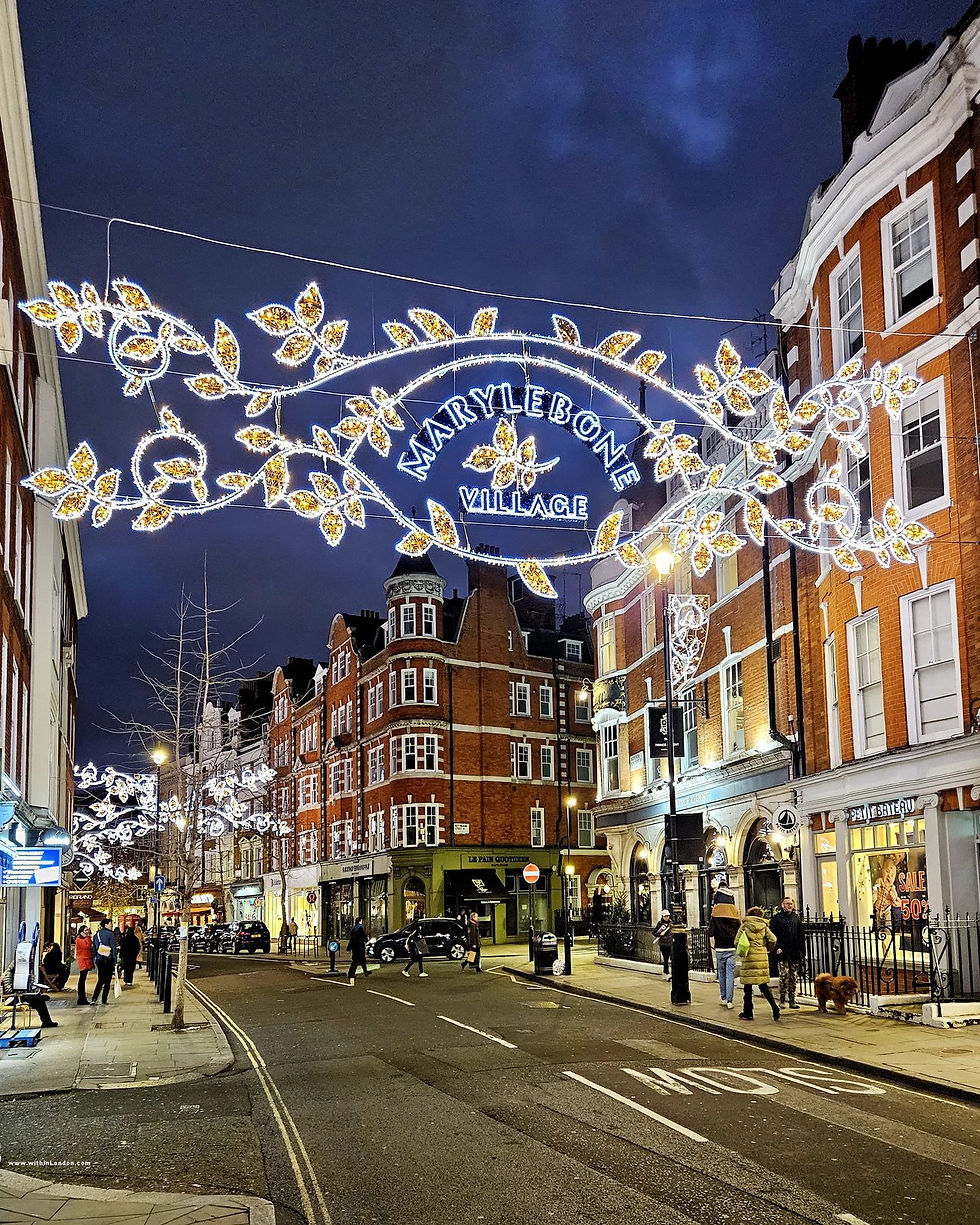
Marylebone Village. The high street and its side streets get a lit scheme, recently made from fully recycled materials, and the switch-on in the second week of November closes the road for market stalls, choirs, street food and a Ferris wheel. It is the most village-like Christmas evening in zone one.
Hay's Galleria. A restored Victorian dock with a glass barrel roof between London Bridge and Tower Bridge, with a big tree and an enormous wreath hung under the glass. It sits inside the London Bridge Christmas market, now branded Winter By the River, which runs chalets from Tower Bridge past HMS Belfast. Free, indoors when it rains, and much less crowded than Southbank Centre's market up the river.

Sloane Square and Duke of York Square. Lights, a small market and a decorated bandstand give Chelsea a cosier feel than its usual polish. Good for mulled wine with a bit of market atmosphere rather than for the lights themselves.

The City of London. Here is where the Royal Exchange now sits, and I am comfortable with that. The 2025 installation was genuinely well done, with more than seven kilometres of LED in vertical bands wrapping the eight thirty-metre portico columns, plus a Fortnum & Mason tree and real spruce at the entrances.
It photographs superbly because the columns are dramatic and the streets are deserted after six. But it is one building, it takes five minutes, and calling it the best display in London, which is roughly what I did last year, does not survive contact with Regent Street.

The rest of the City is a scatter rather than a scheme: trees outside the medieval churches, office plaza installations, Bishopsgate. Do Leadenhall, do the Royal Exchange, look at a tree outside a Wren church with the Gherkin behind it, and go home. Half an hour, no crowds, and that is a perfectly good evening.

Mayfair's quiet corners. Away from the flagships, the residential streets do wreaths, spiral-lit columns either side of a doorway and single trees on corners. No crowds, no queue, and it is the London that Christmas cards are actually based on.

When Everything Switches On
The pattern is consistent enough to plan around. The big shopping streets go first, in the first week of November: Oxford Street is always the earliest, usually the first Monday, with Regent Street and Carnaby a few days later. Burlington Arcade follows around the second weekend.
The village districts go in the second week: Covent Garden and Seven Dials, Marylebone and Bond Street all switch on around the same few days, and Somerset House's rink opens with them. Kew's trail opens mid-November. Trafalgar Square's Norwegian tree is always the exception, lit on a Thursday in early December.
Most come down on 4 or 5 January. Covent Garden goes earliest, around the end of December. Bond Street tends to hang on the longest, sometimes to the second week of January, and Somerset House's rink runs latest of all.
One planning note: as I write this, none of the current season's dates have been announced. The displays themselves are very likely to be familiar, because Regent Street's angels have returned every year since 2016, Oxford Street's stars have been unchanged since 2021, and Carnaby's sculptures were engineered to last several seasons and be recoloured. But check before you build an evening around a switch-on.
How to See Them Without Hating It
Go Monday to Wednesday. Thursday to Saturday in the West End in December is genuinely unpleasant, and Thursday is late-night shopping on top of it.
Go in the second half of November. The lights are all on by about the twelfth, and the Christmas shopping crowds do not really arrive until the first week of December. That two-week window is the best of the year.
Go late rather than at dusk. Everyone goes at about half past four when it gets dark, which is exactly when it is worst. From half past nine the streets thin out dramatically and the lights are still on: Oxford Street until eleven, Covent Garden until midnight.
Avoid Oxford Circus station on December weekends, when it is routinely exit-only or shut for crowd control. Use Tottenham Court Road or Bond Street instead, about seven minutes' walk either way. Same for Covent Garden station: use Leicester Square.
The efficient walking route is about five kilometres and takes an evening: Oxford Street, down Regent Street, detour into Carnaby, across to Bond Street and Mayfair, through Burlington Arcade to Piccadilly, then east to Seven Dials and Covent Garden. If you want it seated and warm instead, the 139 bus runs along Oxford Street and Regent Street to Trafalgar Square.

The Ticketed Ones, For Comparison
Everything above is free. If you want the full production, Christmas at Kew is the original British light trail, running since 2013: about three kilometres, roughly two hours, timed entry from mid-afternoon, adults from around twenty-seven pounds and children from about eighteen. It sells out, so book in October.
Hampton Court Palace puts an ice rink in front of the West Front from late November, with skating from around eighteen pounds for adults, plus a Festive Fayre on two December weekends and Tudor Christmas cookery in the historic kitchens.
And for the shop windows rather than the streets, Harrods is a whole outing in itself, with the Brompton Road facade lit after dark and the in-store Christmas shop.
Practical Notes
Cost: every street display in the ranked ten is free and unticketed. Only the skating, Lift 109 and the out-of-town trails charge.
Best fortnight: roughly 12 to 30 November, after everything is lit and before the shopping crowds.
Best hour: after 9.30pm for photographs, 4.30 to 6pm if you want the atmosphere and do not mind the crush.
Camera advice: the lights are much brighter than the street, so let the exposure drop rather than trying to lift the shadows. Find a foreground, a bus, a cab, a lit shopfront, a person under an umbrella, because a photograph of lights with nothing underneath them never looks like what you saw.
Dress for standing still. You will be on pavements for three hours and moving very slowly, which is colder than walking.
If you want more of this: the most Instagrammable spots in London at Christmas covers the ones I have not ranked here, there is a photo diary of a rainy Christmas Eve in central London, Ham House does a gilded Christmas if you want a country house version, and London's prettiest streets is the year-round version of this walk.
Start at Regent Street, finish at Seven Dials, and go on a Tuesday.
_______________________
Did you enjoy this article? If you'd like to contribute to the running costs of WithinLondon, click the button below:
All photos were taken by Ina/WithinLondon, unless stated otherwise.


Comments