London Allotments: How They Started and Why the Waiting Lists Are So Long

London is supposed to be brick. That is the version of the city that gets photographed and the version that gets complained about: terraces, pavements, scaffolding, the same grey stock brick from Acton to Bow, a place you move through rather than live in. I live in West London, and the city I actually walk through every week is greener and considerably stranger than that.
It has parakeets, orchards, cattle grazing on a common inside the M25, and hundreds of pieces of ground where people are growing runner beans behind a fence you have walked past without noticing.
London allotments are the clearest proof of it, and they are almost invisible. They sit behind garage blocks and railway embankments and the back gardens of Victorian terraces, and most Londoners have never been inside one, because you cannot simply walk in.
They are tenanted ground. Somebody pays rent for that patch, keeps a shed on it, and has very likely waited years for the privilege.
That waiting is the thing that made me want to write this. Tens of thousands of people in this city are queueing, sometimes for a decade, for a piece of ground the size of a tennis court. Which raises the obvious question: where did any of this come from in the first place?
So how did allotments appear in the first place?
The word gives it away. An allotment is land allotted to an individual under an enclosure award, and that is not a charming coincidence of vocabulary. Allotments exist because commons stopped existing.
Through the eighteenth and early nineteenth centuries, land that ordinary villagers had used for grazing a cow, gathering fuel and growing food was fenced off into private ownership by a long series of enclosure acts. The people who lost it lost the margin that kept them fed. Allotments were the compensation: small plots, let cheaply, so that labouring families could feed themselves and stay off the parish. The motive was as much fiscal as charitable. A family with potatoes was a family not claiming poor relief.
The earliest surviving example anybody agrees on is at Great Somerford in Wiltshire, where the rector, Stephen Demainbray, secured land for the poor of the parish in 1809 and the Free Gardens are still there. The historian Jeremy Burchardt, who wrote the standard account of the allotment movement, reckons there were probably no more than a hundred allotment sites in the whole of England by 1830.
Then the countryside caught fire. The Swing Riots of 1830 and 1831 ran across southern England: hayricks burned, threshing machines smashed, nineteen men hanged and more than a thousand imprisoned or transported. What followed was a sudden, nervous enthusiasm for allotments among exactly the people who owned the land. The Labourer's Friend Society was founded in 1832 by Benjamin Wills, a London surgeon, to promote letting small plots at fair rents.
The Duke of Bedford had 600 plots by that same year. The Duke of Richmond ran to 1,500 during the 1830s, and the Duke of Newcastle to 2,000 in Nottinghamshire by 1843.
By 1873 there were roughly 243,000 allotments in Britain. In forty years the thing had gone from a hundred scattered experiments to a national institution, and it had done so because the alternative looked like unrest.
Did the law ever actually protect them?
Eventually, and badly at first. The most important of the early statutes was the General Inclosure Act 1845, which required that provision be made for the landless poor in the form of field gardens, capped at a quarter of an acre each. It sounded like a settlement. In practice, between 1845 and 1869, out of 614,800 acres enclosed, the grand total set aside for the poor was 2,223 acres. That is about a third of one per cent.
The law that still governs allotments today is the Small Holdings and Allotments Act 1908, which consolidated everything that came before it and put a duty on councils to provide plots where people want them. It was amended in 1922, in 1925 and again in 1950, the last of which set the standard plot at no more than one-eighth of an acre in any district of ten thousand people or more. That is where the familiar ten-rod plot comes from.
Two details of that legislation still shape what happens in London now. Six registered electors in an area can formally demand that their council provide allotments, which sounds powerful until you discover that the Act sets no time limit for the council to do anything about it. And section 8 of the Allotments Act 1925 says statutory allotment land cannot be sold or built on without the consent of the Secretary of State, who is not supposed to grant it unless the displaced plot holders are provided for somewhere else. That single section is the reason a good deal of London allotment ground is still allotment ground and not flats.
How did allotments reach London?
Late, and unevenly. For most of the nineteenth century allotments were a rural institution, a response to rural poverty. Only in the second half of the century did parcels of land in towns and cities begin to be turned over to the same use, usually awkward leftovers: railway edges, land waiting for a builder, the far end of a park.
The result is a city with a wildly lopsided distribution, and the reason is legal rather than geographical. Under the London Government Act 1963, outer London boroughs carry a statutory duty to provide allotments where residents ask for them. Inner London boroughs were left with a discretionary power instead, which is to say no duty at all. Land in the middle of London is expensive, the obligation was lifted, and the allotments went.
So Ealing, where I live, has around 60 allotment sites, more than any other London borough. Kensington and Chelsea, Westminster and the City of London have none whatsoever. Not fewer. None.
Nobody can tell you exactly how many there are across the capital, which is remarkable for a city that counts everything else. The last full survey was carried out by the London Assembly's Environment Committee and published in October 2006 as A Lot to Lose: London's Disappearing Allotments. It found 737 allotment sites, down from 769 a decade earlier, a net loss of 32 sites and more than 87 acres of growing ground. The Greater London Authority dataset built from that survey has not been updated since May 2007. Twenty years on, that count is still the best figure anyone has.

What did the two world wars do to them?
They turned a charitable institution into a strategic asset, twice. During the First World War, the number of plots in Britain went from about 600,000 to 1,500,000. During the Second World War, under Dig for Victory, roughly 1,400,000 plots were producing something in the order of 1,300,000 tonnes of food a year. Parks were dug up. So were tennis courts, bomb sites and the moat at the Tower of London.
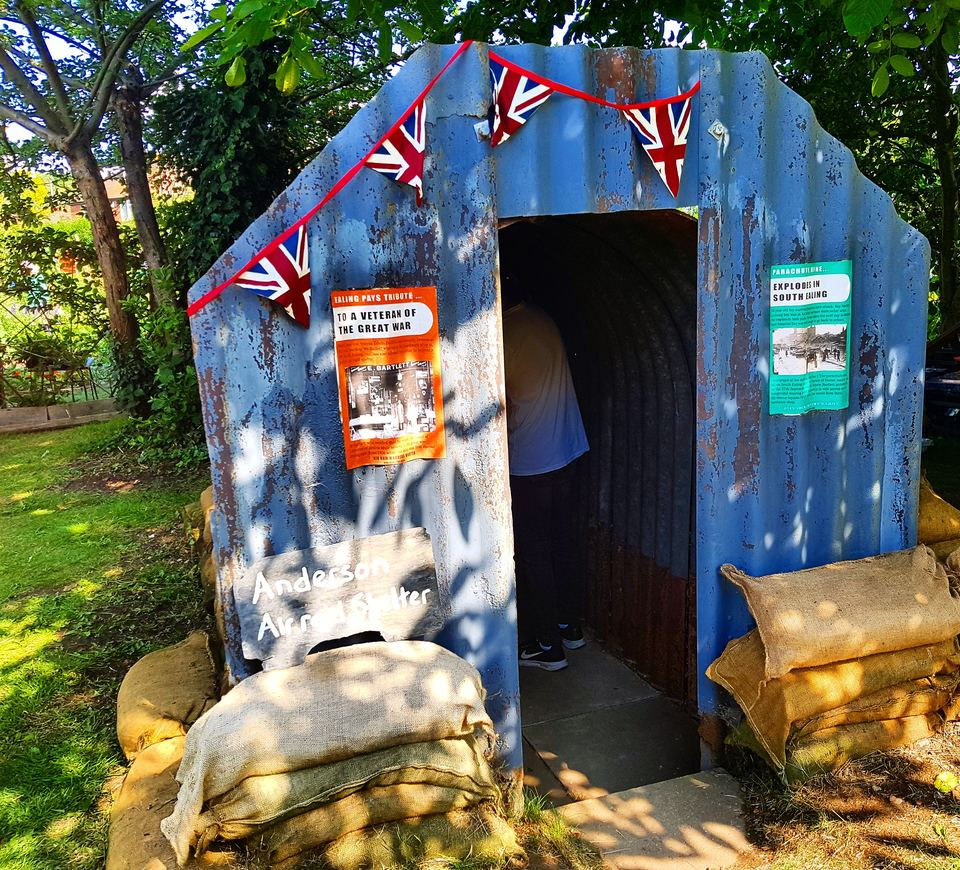
That era is still physically present on a few sites. At Northfields Allotments in Ealing there is a restored corrugated iron Anderson shelter standing on the heritage plot, sandbagged and hung with bunting, and you can walk into it. The two things belong together in a way that is easy to forget now: the same government that told people to dig up their lawns also told them where to hide when the bombers came over.

Then came the collapse. There were still around 1,117,000 plots in 1948. Six hundred thousand by the late 1960s. Roughly 300,000 by 2009. The government commissioned an inquiry into why, and the Thorpe Report of October 1969 put it down to three things: land disappearing under development, rising prosperity that made growing your own food a choice rather than a necessity, and the arrival of other ways to spend a Sunday. For about forty years, an allotment looked like a hobby on its way out.
Where are the oldest London allotments?
In Ealing, on a quarter-mile strip between Northfields Avenue and Radbourne Walk in W13. The blue plaque wired to the mesh gate at Northfields Allotments reads Est. 1832, Oldest Allotments in London, and as far as anyone has managed to establish, it is telling the truth. Burchardt told campaigners in 2017 that the site was almost certainly the oldest in the capital, which is about as firm as a historian will ever put anything.

The date is exact: 7 November 1832. Note where that falls. Two years after the Swing Riots, the same year the Labourer's Friend Society was founded, right inside the decade when nervous landowners all over England were suddenly finding plots for the poor.
Charles James Blomfield, Bishop of London and lord of the manor of Ealing, carved the land out of Ealing Dean Common, known locally as Jackass Common, and let it to poor parishioners at five shillings a year. The original grant ran to 20 acres, 2 roods and 16 perches, which is the sort of measurement that tells you immediately how old a thing is.
Roughly 60 per cent of that ground has since gone, taken by compulsory purchase for housing and for Dean Gardens park. What is left holds around 173 rented plots, most of them five-pole half plots rather than full ones. The land belongs to Pathways, an almshouse charity, and has been run since 2015 by the Ealing Dean Allotment Society, a committee of plot holders elected each year by the other plot holders.
The borough lists it as an Asset of Community Value, and it is designated a Site of Importance for Nature Conservation, largely on the strength of the nine hundred metres or so of hedgerow wrapped around it and the stag beetles and hedgehogs living in it.
A field given to the poor of a country village, that is now a quarter-mile of wildflower meadow and beehives in the middle of a London borough, still being worked, one hundred and ninety-odd years later. Nothing about the survival of that was inevitable.

What is an allotment open day actually like?
Better than it sounds on paper, and not much like visiting a garden. The difference is the people. Everyone you meet is a plot holder standing next to something they made themselves, over years, with their own hands, and that does something to a person. They want you to look at it. You are not being tolerated; you are being shown.

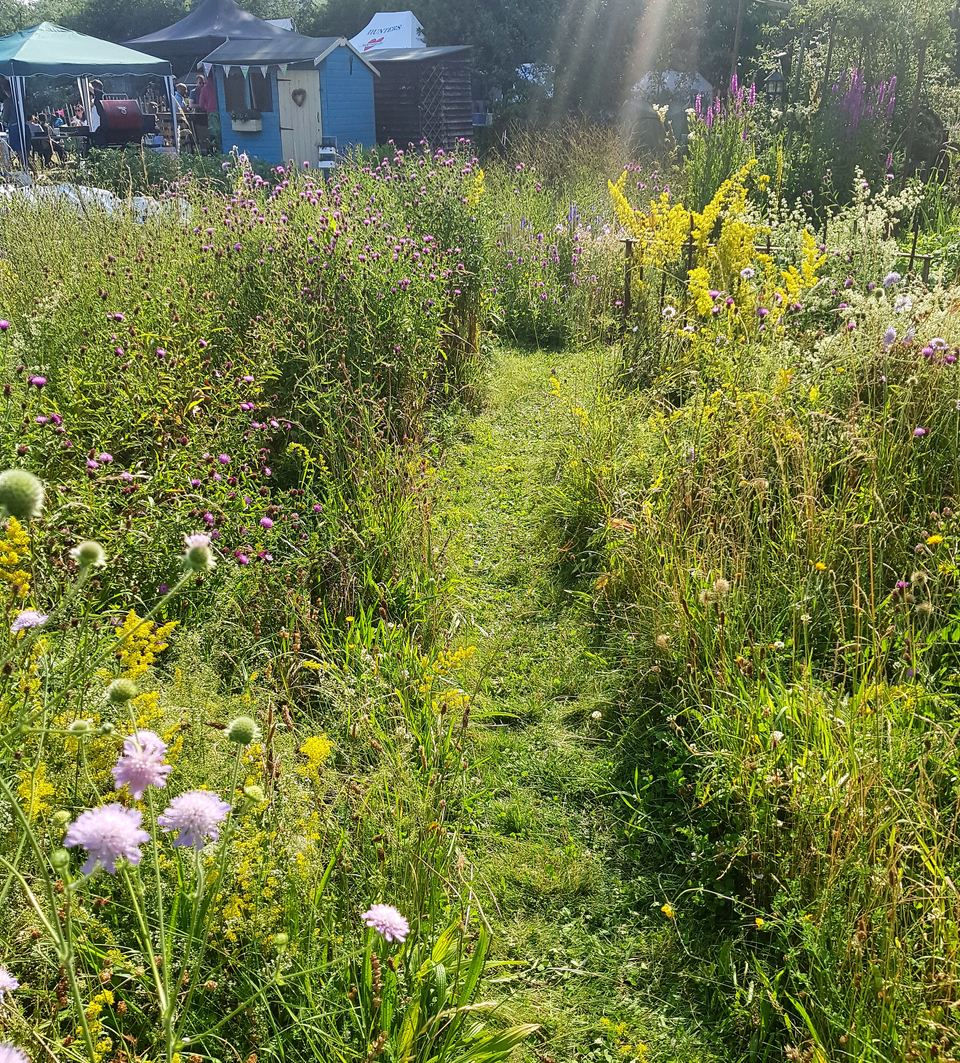
The surface of it is a village fete that has wandered into the wrong century. Bunting strung between fruit trees. A hand-painted fingerpost at the entrance sending you off towards the wildflower meadow, the bees, the air raid shelter and the toilets. A bar. A barbecue. Tea and homemade cake under a gazebo, served off a trestle table with a cloth on it.
You can also buy the place itself, more or less. There is a plant stall. There is fruit grown on the site. There are jams and preserves the plot holders have made from their own trees, sold by the people who picked the fruit. Nothing on those tables has travelled more than about fifty metres to reach them, which is a claim almost no shop in London can make.

But the part nobody warns you about is that you get invited to sit down. Plots have benches on them, and summerhouses, and shady corners under an apple tree, and the people who built those corners would much rather you used one than walked past it.
Sit for five minutes and you will be given advice you did not ask for and will be grateful for later: what to do about slugs without poisoning the hedgehogs, which apple variety copes with London clay, why the plot three along has better tomatoes than anybody and whether its owner will admit how.

Some plots have ponds. Actual ponds, the size of a paddling pool, dug by hand, with frogs in them and a laminated sign inviting you to come and sit by the water. A pond on a rented patch of ground behind a fence in Ealing is a wildly impractical thing to build, and that is precisely why somebody built one. These are not vegetable factories. They are small private worlds, and for one afternoon a year you are allowed to walk through them.
I came away doing what I suspect everybody does on the walk back to the station, which is imagining my own. A hot afternoon, the watering done, sitting in the shade at the top of the plot and just looking down it. Waving at whoever is working the next one along. Swapping a glut of courgettes for something I had failed to grow. It is a very small daydream. Tens of thousands of people in this city are on a waiting list to have it, which suggests it is not a small thing at all.
How long is the wait for an allotment in London?
Long, and the direction of travel is not in doubt. When Greenpeace put Freedom of Information requests to every council in England, Wales and Scotland in 2023, it counted 157,820 people waiting for an allotment in England. The same exercise in 2011 had found 86,787. The queue had very nearly doubled in twelve years. The average wait came out at three years, and the worst authority in the country averaged fifteen.
London is where it bites hardest, because London has the least spare ground. Waits here are measured in years rather than months, many boroughs keep their lists closed to new applicants altogether, and the inner boroughs with almost no allotment land have the longest queues of all. Camden has reported waits of over a decade. Northfields itself had 173 rented plots and more than 450 names on the list in 2025, which is the whole problem in one line: the queue is longer than the site.
It has become a political question again. In April 2025, the London Assembly's environment committee asked the Mayor to review food-growing land across the capital and to consider a London-wide right to grow, pointing at exactly the gap between a borough with sixty allotment sites and a borough with none. City Hall said food growing would be looked at as part of the London Plan review.
What are allotments for now?
Not poor relief. That much has clearly gone, and the Thorpe Report's prediction that prosperity would finish allotments off turned out to be exactly wrong. Something else took over, and you can read what it is off the handwritten signs, which is what I ended up photographing more than the vegetables.

A chalkboard by a produce stall: home grown produce, zero food miles, jam and chutney, homemade and homegrown. A laminated notice by a pond: come in and relax by the pond, you might even see the frogs. A carved wooden fence spelling out BEES, with a polite warning that the beekeepers are working beyond the gate. And, taped to the side of a pale blue shed, the sign that sums up the whole place.
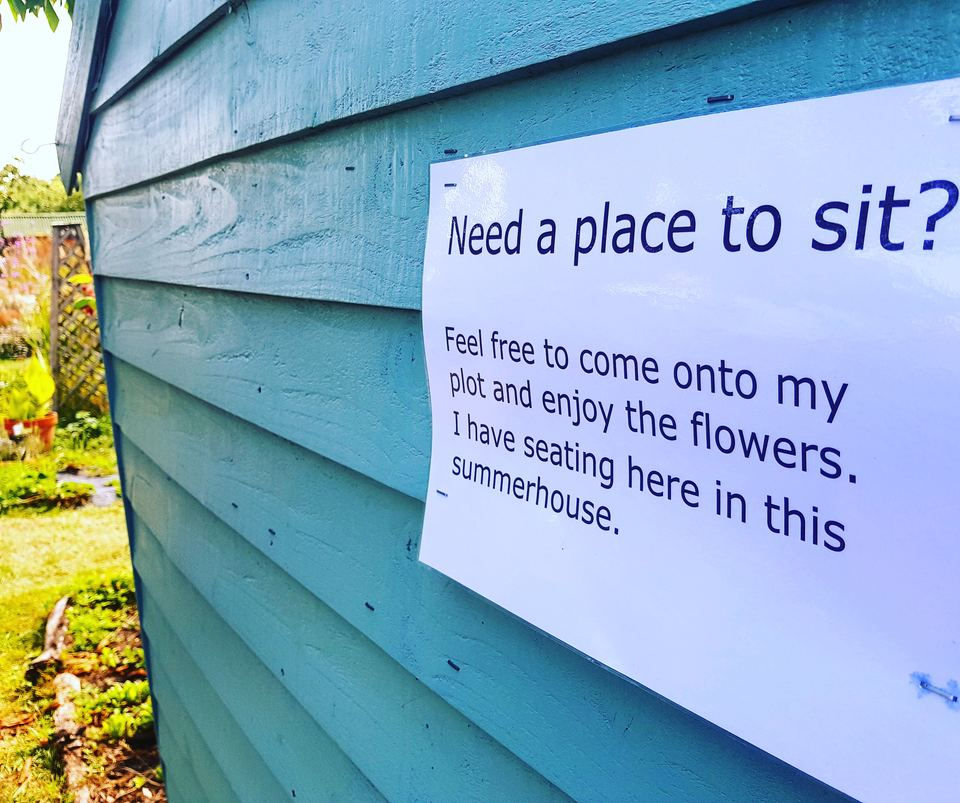
Need a place to sit? Feel free to come onto my plot and enjoy the flowers. I have seating here in this summerhouse. Somebody wrote that out, laminated it and stuck it on their own shed so that strangers would sit in their garden for an afternoon. Nothing in the 1908 Act requires it. That is what the waiting lists are actually measuring: not a shortage of vegetables, but a shortage of somewhere to belong outdoors.
There is a serious ecological argument alongside the human one. A mature allotment site is a patchwork of microhabitats that no park mowing regime could reproduce: compost heaps, ponds, fruit trees, unmown corners, a hedgerow nobody has touched since the Georgians. The nature conservation designation at Northfields is not a courtesy. And the two arguments turn out to be the same argument, which is that unmanaged, uncommercial, slightly scruffy ground is good for almost everything that lives on it, people included.
Where can you actually visit one?
Usually you cannot, and this is the part people find surprising. An allotment site is not a park. It is a collection of private tenancies behind a locked gate, and the gate is locked because sheds get broken into. But four London sites let the public in at some point in the year, and they are worth knowing about.

Northfields Allotments, Ealing. The summer open day is normally the first Sunday in July, 1 pm to 5 pm, free, donations welcome. The gates opened on 7 July in 2019, 3 July in 2022, and the first Sunday in July in the years since, and the society reckoned about seven hundred people came through in 2018.
There is a history trail with a map of the old sheds, the apiary producing Northfields honey, the heritage plot and its Anderson shelter, a wildlife shed built entirely from salvaged materials, plant and produce stalls, a barbecue, a bar, tea and cake, and children's activities. Dogs on leads are welcome. Bring cash for the plant stall, because the plants are cheap and you will not get out without one. Nearest Underground station is Northfields on the Piccadilly line; West Ealing and Ealing Broadway are both walkable from the other end.
The Regent's Park Allotment Garden. The only one on this list you can visit on an ordinary weekday. The Royal Parks run it as a training allotment on the corner of the Inner Circle and Chester Road, next to the Park Office, open Monday to Friday from 8.30 am to 4.30 pm and free to walk into, staffed by volunteers and run with Capital Growth and Capel Manor College.
Fulham Palace Meadows Allotments. 406 plots across 5.87 hectares, on land given by a later Bishop of London in 1916, in the middle of the First World War growing push. It takes part in Open Garden Squares Weekend most years.
Golf Course Allotments, Muswell Hill. More than eleven and a half acres laid out over a golf course that was turned over to food growing during the First World War, with well over two hundred plots. It opens to the public for one day at its Summer Show, usually in early September.
If the one-day-a-year rhythm sounds familiar, it is the same logic as Open House: somebody's private ground, thrown open for an afternoon on the understanding that you behave yourself. And if you are making a day of it in Ealing, Pitzhanger Manor is the obvious pairing, John Soane's own country house, a walk north through Walpole Park. A little further west, Boston Manor House in Brentford is Jacobean, free to enter and criminally under-visited.

What stays with me is the shape of the whole story. Land taken from the poor, handed back in quarter-acre pieces to keep them quiet, dug up twice to feed a country at war, written off in 1969 as a pastime the modern world had outgrown, and now so sought after that people put their names down and wait a decade. London allotments are the least brick-and-mortar thing about this city, and they have been here the whole time, behind the fence, waiting for somebody to open the gate.
_______________________
Did you enjoy this article? If you'd like to contribute to the running costs of WithinLondon, click the button below:
All photos were taken by Ina/WithinLondon, unless stated otherwise.


Comments